Registration
for the Meetup: AI in Psychology – Research, Applications & Practice on November 10, 2026
Register herefor the Meetup: AI in Psychology – Research, Applications & Practice on November 10, 2026
Register hereHow can artificial intelligence be used in psychology? What opportunities does this open up for research, diagnostics, and therapeutic applications? And what are the challenges and limitations of current AI systems?
We cordially invite yout to the next ScaDS.AI Meetup on November 10, 2026, where we’ll be focusing on the topic of AI in psychology. Three short talks will provide insights into current research, specific projects, and practical applications – ranging from AI-driven approaches in psychology and digital support systems to automated emotion recognition.
Together with researchers, developers, students, and others who are interested, we would like to discuss current developments, share experiences, and identify potential opportunities for new projects and collaborations.
As always, there will be plenty of time afterward for discussions, networking, and open exchanges.
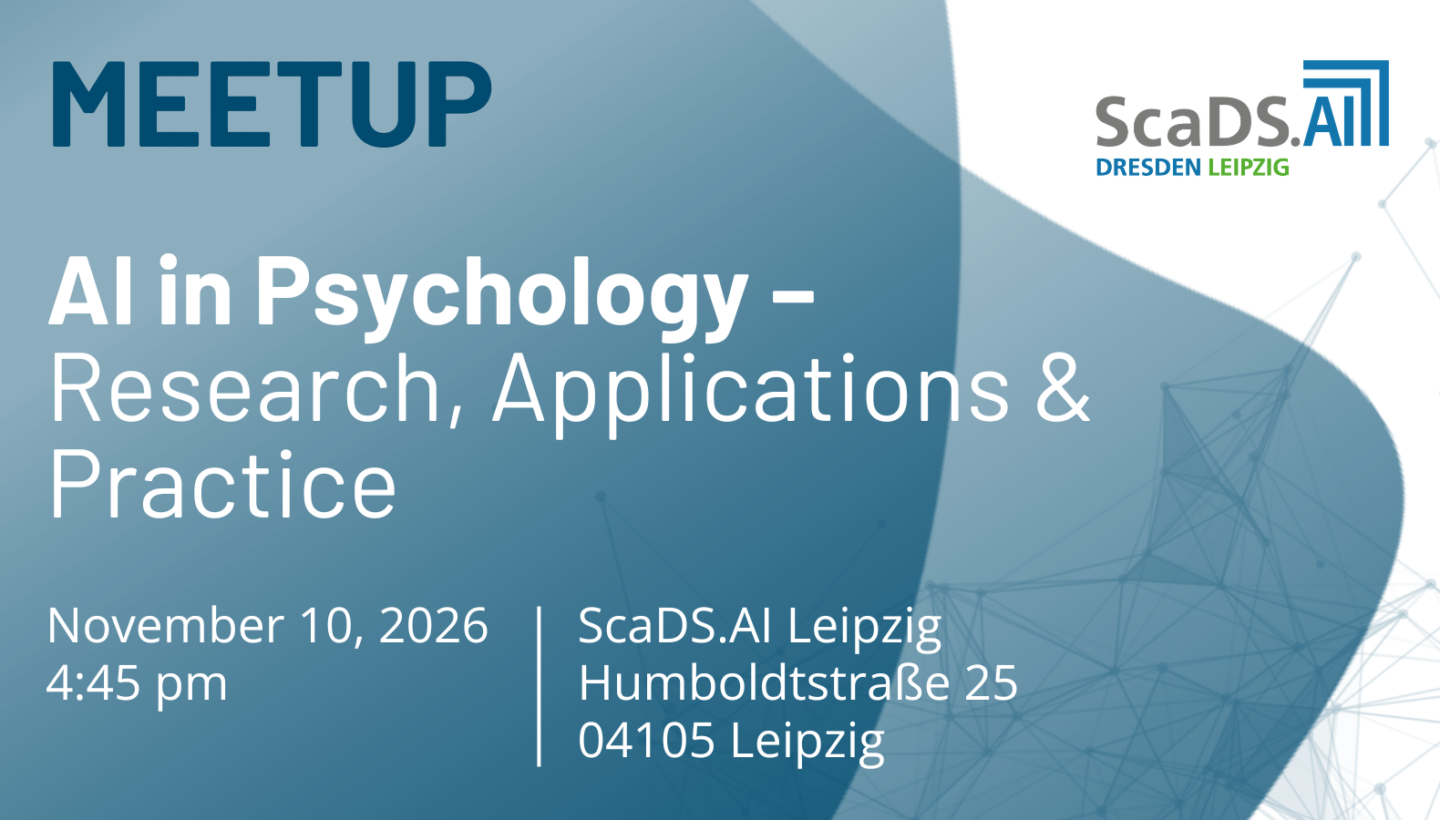
ScaDS.AI Leipzig
Humboldtstr. 25
04105 Leipzig
Arrival, exchange, and networking.
A brief overview of ScaDS.AI Dresden/Leipzig, its current research activities, and what it offers to academia, industry, and society. We’ll also show you how to get in touch with us and initiate joint AI projects.
Speaker: Dr. Björn Hommel, Leipzig University
Psychological questionnaires and testing methods play a central role in many areas of society: Personality tests determine suitability for jobs, political attitudes predict the electoral success of parties, and market research and studies of consumer behavior shape which products will be on the shelves tomorrow. Until now, all these insights have been based on time-consuming and costly surveys of people. But for how much longer? The presentation explores recent developments in psychological research that demonstrate how complex patterns in human judgment can be derived directly from AI models.
Speakers: Valentin Forch & René Larisch, Therabox Project, TU Chemnitz
Psychotherapy involves a significant amount of administrative work for documentation and report writing. To relieve psychotherapists of this burden, the Therabox project is developing a local AI solution that transcribes therapy sessions live and generates professional case documentation. Avoiding cloud solutions enhances data protection, but it also means that hardware constraints must be taken into account during development. In this presentation, we’ll share the results from the initial tests and, using a practical example, illustrate the challenges that arise during real-world use.
Presentation of the Therabox project at TU Chemnitz. The focus is on the project idea, the use of digital and AI-based technologies, and potential application scenarios in psychological or therapeutic settings.
Speaker: Eric Huget, Eigendrive
Computers respond to clicks, not to people. Eigendrive changes that: It senses when you’re stuck on a task and responds. A voice speaks to you at the exact moment things get difficult. A tool becomes a companion, and this human connection helps you overcome resistance. Behind it all is my Flow Model, and it changes more than just the voice: a to-do list that updates itself because it knows what you’ve been working on, a daily schedule that schedules difficult tasks during your most productive hours, and a review that shows you in the evening what you’ve accomplished. In this talk, I’ll show how this works and what psychological ideas underpin it.
Open Q&A session with the speakers.
What potential does AI offer in psychology? Where are the technical, scientific, and ethical limits? And which approaches are already practical today?
Open exchange in the Living Lab.
Space for:
Please note that the event will be held in German.
Registration is required for this event.
for the Meetup: AI in Psychology on November 10, 2026





Copyright 2026 © SCADS.AI Dresden/Leipzig – All rights reserved.