

Understanding Language
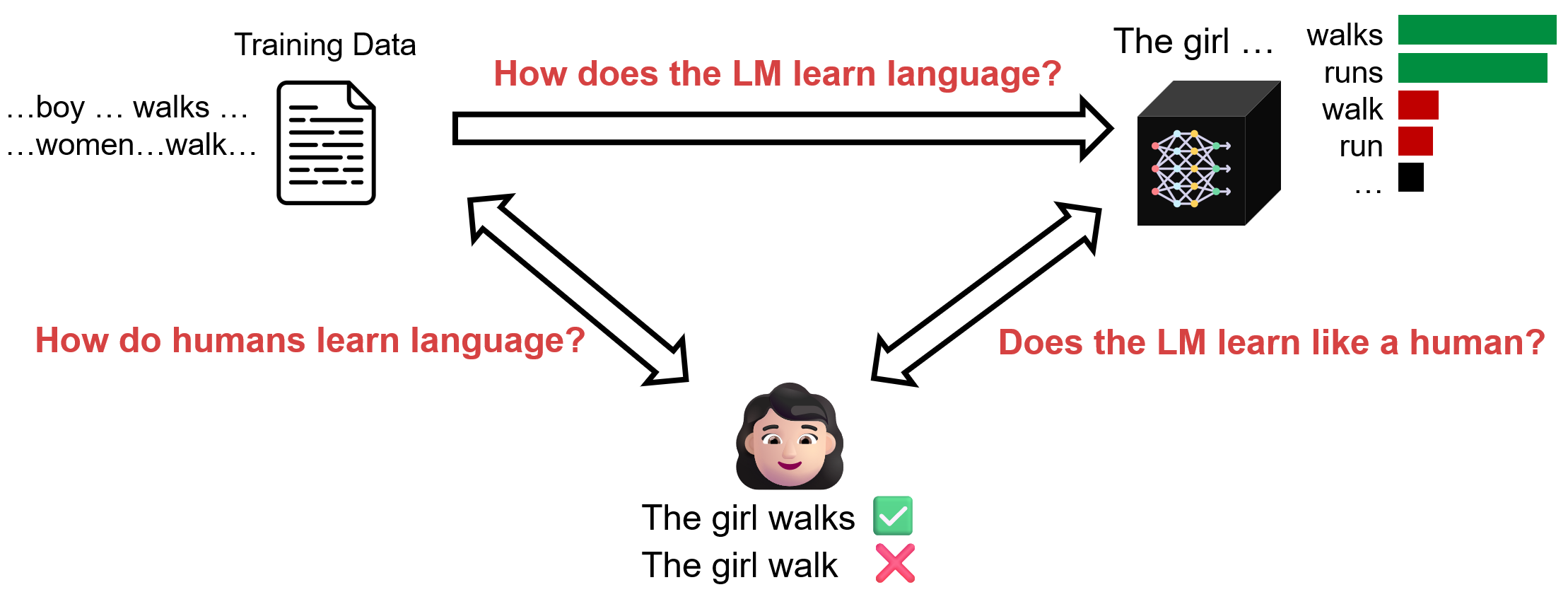
Language models have become remarkably fluent and capable. Yet it remains unclear what they have actually learned about language, whether they learn it in the way humans do, and what their limits are. Our research treats this as an empirical question. We develop linguistic evaluations, interpretability methods, and multilingual resources that reveal how language models generalise and where they still fail. We use language models as instruments for linguistics itself, testing long-standing hypotheses about grammar, meaning, and language acquisition at a scale that was previously out of reach, as well as to explore their interpretive and reasoning capabilities.
Research Focus
Our research in natural language processing and computational linguistics focuses on evaluation, analysis and resource creation. The overarching challenge is to determine which theories of language best describe the behaviour of language models, and what this tells us about the models and about human language. We also apply methods from natural language processing and interpretability to questions in other scientific domains, in collaboration with partners inside and outside ScaDS.AI Dresden/Leipzig.
Key topics
- constructional and morphological generalisation, and the difference between memorisation and abstraction
- multilingual and typological evaluation across the languages of the world
- retrieval, reasoning, and the interpretation of information in context
- the application of NLP and interpretability methods to data from other scientific domains
Aims
In the research area “Understanding Language”, we are building the evaluations, resources and methods needed to understand how language models generalise, how they should generalise, and how models that generalise in more human-like ways can be built:
- Evaluating language models where meaning is not compositional, contrasting rule-based with analogical accounts of generalisation against both model and human behaviour.
- Extending linguistic evaluation beyond English to the full typological diversity of the world’s languages, and building the openly available resources this requires.
- Investigating how linguistic knowledge is acquired during training and represented internally, including by modifying training data and retraining models.
- Applying our evaluation and interpretability methods to research questions in other scientific disciplines, in collaboration with partners across and beyond the centre.




Dresden
ScaDS.AI Dresden/Leipzig
Bürogebäude Strehlener Straße
Strehlener Straße 12, 14
01069 Dresden
Center for Interdisciplinary Digital Sciences (CIDS)
ScaDS.AI Dresden/Leipzig
01062 Dresden
Leipzig
Löhrs Carré
Humboldtstraße 25, Uferstr. 11
04105 Leipzig
Data Science Center ScaDS.AI Leipzig
Internes Postfach: 322001
04081 Leipzig
Quicklinks:
Copyright 2026 © SCADS.AI Dresden/Leipzig – All rights reserved.