
Von der Punktwolke zum Baumgraphen – Klassische und ML-basierte Verfahren zur Rekonstruktion von Baumstrukturen
Status: open / Type of Theses: Bachelor Theses / Location: Leipzig
Wie lässt sich die dreidimensionale Struktur eines Baumes so abbilden, dass wir seine Reaktion auf Wind besser verstehen können? Terrestrisches Laserscanning (TLS) erfasst Bäume als detaillierte Punktwolken. Graphen bieten die Möglichkeit, die Verbindungen zwischen Stamm und Ästen abzubilden und darauf aufbauend die Bewegung des Baumes zu modellieren. Sie können künftig eine Grundlage bilden, um beispielsweise windinduzierten Astbruch und die mechanische Stabilität von Bäumen zu untersuchen.
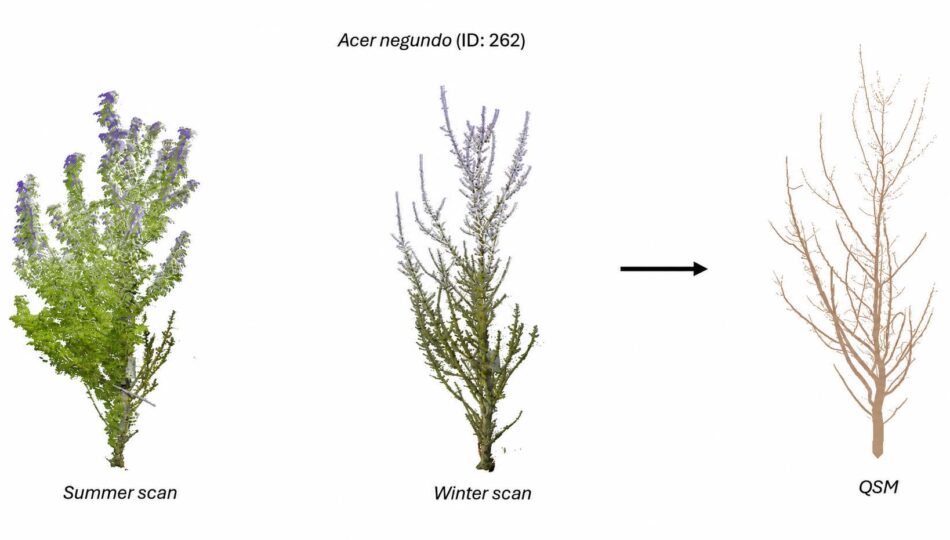
Ziel der Bachelorarbeit ist es, klassische und auf maschinellem Lernen basierende Verfahren zur Überführung von Baum-Punktwolken in Graphstrukturen zu untersuchen und zu vergleichen. Datengrundlage sind TLS-Aufnahmen einzelner Bäume aus dem Arboretum Großpösna im Oberholz, die im belaubten und unbelaubten Zustand aufgenommen wurden. Im Mittelpunkt steht die Frage, wie zuverlässig sich die Verzweigungsstruktur rekonstruieren lässt und wie robust die Verfahren gegenüber unvollständigen Scans und unterschiedlichen Baumarchitekturen sind. Je nach Interesse und Fortschritt kann zudem untersucht werden, welche Eigenschaften der rekonstruierten Graphen für spätere Simulationen der Windreaktion besonders relevant sind.
Die Arbeit verbindet Informatik und maschinelles Lernen mit Ökologie und Biologie. Sie entsteht in Zusammenarbeit zwischen iDiv, der Universität Leipzig (Spezielle Botanik und funktionelle Biodiversität, Prof. Dr. Christian Wirth und Max Tölle) und ScaDS.AI (Dr. Martin Ritzert und Dr. Josefine Umlauft).
Interesse an maschinellem Lernen, dreidimensionalen Daten, ökologischen Kenntnisse und interdisziplinären Fragestellungen sowie grundlegende Programmierkenntnisse sind willkommen, aber jeweils nicht unbedingt erforderlich.
Hintergrund und mögliche methodische Ansätze:
[1] TreeQSM: https://github.com/InverseTampere/TreeQSM
[2] SmartQSM: https://github.com/project-lightlin/SmartQSM
[3] Transformer-based QSM: https://arxiv.org/abs/2502.04762
English translation:
From Point Cloud to Tree Graph – Classical and ML-Based Methods for Reconstructing Tree Structures
How can we map the three-dimensional structure of a tree in a way that allows us to better understand its response to wind? Terrestrial laser scanning (TLS) captures trees as detailed point clouds. Graphs offer the possibility of mapping the connections between the trunk and branches and, based on this, modeling the tree’s movement. In the future, they could serve as a foundation for investigating, for example, wind-induced branch breakage and the mechanical stability of trees.
The goal of this bachelor’s thesis is to investigate and compare classical and machine learning-based methods for converting tree point clouds into graph structures. The data set consists of TLS scans of individual trees from the Großpösna Arboretum in Oberholz, which were captured both when the trees were in leaf and when they were bare. The focus is on how reliably the branching structure can be reconstructed and how robust the methods are against incomplete scans and different tree architectures. Depending on interest and progress, it may also be possible to investigate which properties of the reconstructed graphs are particularly relevant for subsequent simulations of wind response.
This project combines computer science and machine learning with ecology and biology. It is a collaborative effort between iDiv, the University of Leipzig (Special Botany and Functional Biodiversity, Prof. Dr. Christian Wirth and Max Tölle), and ScaDS.AI Dresden/Leipzig (Dr. Martin Ritzert and Dr. Josefine Umlauft).
An interest in machine learning, three-dimensional data, ecological knowledge, and interdisciplinary research questions, as well as basic programming skills, are welcome but not strictly required.
Background and possible methodological approaches:
[1] TreeQSM: https://github.com/InverseTampere/TreeQSM
[2] SmartQSM: https://github.com/project-lightlin/SmartQSM
[3] Transformer-based QSM: https://arxiv.org/abs/2502.04762




Dresden
ScaDS.AI Dresden/Leipzig
Bürogebäude Strehlener Straße
Strehlener Straße 12, 14
01069 Dresden
Center for Interdisciplinary Digital Sciences (CIDS)
ScaDS.AI Dresden/Leipzig
01062 Dresden
Leipzig
Löhrs Carré
Humboldtstraße 25, Uferstr. 11
04105 Leipzig
Data Science Center ScaDS.AI Leipzig
Internes Postfach: 322001
04081 Leipzig
Quicklinks:
Copyright 2026 © SCADS.AI Dresden/Leipzig – All rights reserved.