September 3, 2026
AI for Better Guidance and Less Stress in Everyday Care
Transfer and Service
How can artificial intelligence meaningfully support family caregivers in their daily lives without replacing professional advice or nursing decisions?
The Institute for Health, Aging, Work and Technology (GAT) at the Zittau/Görlitz University of Applied Sciences, the startup Pflegana, and ScaDS.AI Dresden/Leipzig plan to explore this question together. To this end, the partners are combining practical expertise in social work, experience in the care context, user-centered technology development, and scientific AI expertise.
The collaboration focuses on developing and testing a socially oriented relief, navigation, and support measure for family caregivers providing home care. The goal is not to create a comprehensive technical system or provide medical assistance. Rather, the project aims to investigate how AI can help family caregivers navigate support systems, find suitable support services, and manage recurring organizational tasks.
Common Starting Point: Living Lab Approaches, AI Education Open to All Target Groups, and Networking
A common starting point for this collaboration lies in open knowledge-transfer and engagement formats that provide people with access to artificial intelligence, regardless of age, prior knowledge, or institutional affiliation. Both the ScaDS.AI Living Lab and the activities of the GAT Institute aim to communicate technology – and artificial intelligence in particular – in a way that is understandable, practical, and socially relevant. This explicitly includes informing older adults about the opportunities, limitations, and concrete applications of AI and empowering them to engage with digital technologies in a self-determined and reflective manner.
The GAT Institute and ScaDS.AI Dresden/Leipzig came together through several jointly organized events focused on senior citizens. These events highlighted the importance of formats tailored to the target audience – ones that do not explain technological developments in abstract terms but rather align them with concrete life situations and societal needs. From this exchange, a shared perspective emerged: to more closely link issues of aging, care, and digital participation with application-oriented AI expertise.
The connection between Pflegana and ScaDS.AI Dresden/Leipzig was established through the ScaDS.AI Meetup. The Meetup has evolved into an established networking platform that brings together stakeholders from research, business, civil society, and the public sector. It is of interest not only to local and regional partners but also to those from beyond the region who wish to discuss new application ideas, combine expert perspectives, and initiate collaborations.
These events gave rise to a shared perspective: rather than viewing AI in isolation as a purely technological matter, it should be developed in socially relevant contexts in a way that is understandable, participatory, and accountable. This is the basis for the collaboration between the GAT Institute, Pflegana, and ScaDS.AI Dresden/Leipzig in the area of support for family caregivers.
Why New Support Approaches Are Needed in Everyday Care
Family caregivers provide a significant portion of home care. In addition to the actual caregiving work, they often have to research information, clarify responsibilities, prepare applications, find counseling services, and coordinate numerous organizational tasks.
Many existing resources are professionally valuable but are scattered across various agencies, websites, and formats. Especially in stressful everyday situations, it can be difficult to find relevant information, make sense of it, and apply it to one’s own situation.
AI systems can open up an additional avenue here: They can process information from various, verified sources in a context-specific manner, communicate in natural and as understandable a language as possible, and be available at any time. The added value thus lies not only in the digitization of information, but in its context-specific, adaptive, and practical presentation.
What We Want to Develop and Test Together
The partners aim to investigate how an AI-based support measure must be designed so that it is truly usable, accepted, and accountable for family caregivers and can be integrated into existing support systems.
Possible areas of application include, in particular:
- guidance on appropriate regional support services,
- clear explanations of available services and support options,
- structuring and preparing for counseling sessions,
- practical assistance with recurring organizational and documentation tasks.
The specific design should not be based solely on technical considerations. The plan is to take a participatory approach in which family caregivers and relevant stakeholders in the field systematically contribute their experiences, needs, and requirements to the development process. On this basis, selected application scenarios will be prototyped, tested in realistic situations, and scientifically evaluated in terms of their usefulness, comprehensibility, and practicality.
Pflegana is already working on AI-supported solutions for family members and care services designed to simplify administrative tasks such as gathering information, preparing applications, and coordination. The company explicitly distinguishes its services from medical advice and focuses on providing organizational support and guidance.
Different Areas of Expertise, a Common Goal
The strength of this collaboration lies in the complementary perspectives of the three partners.
The GAT Institute contributes its expertise in social and nursing sciences research, as well as its co-creation approach, in which those directly affected are involved in research and development processes from the very beginning. This includes experience in participatory needs assessment and scientific guidance, as well as a close network of care, counseling, and support structures in the region. This ensures that the solutions developed are tailored to the actual needs of family caregivers and are compatible with existing care structures.
Pflegana brings the user-centered and technical perspective to the collaboration. This includes experience in developing AI-powered applications, designing intuitive interactions, and translating specific requirements from everyday care settings into prototype solutions.
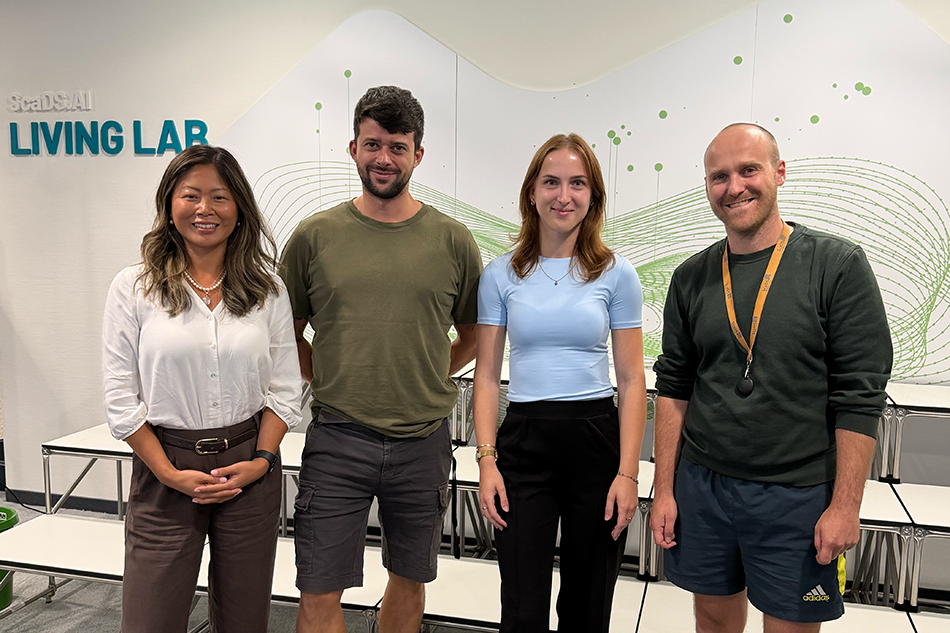
ScaDS.AI Dresden/Leipzig complements the collaboration with scientific AI expertise, methodological guidance, and experience in bridging the gap between research and societal practice. To this end, ScaDS.AI’s Living Lab creates a user-centered space for experimentation and interaction, where current developments in AI, big data, and data science can be experienced firsthand and discussed with various social groups.
Together, the partners aim to do more than just develop a prototype; transferable insights are equally important: What kind of support do family caregivers actually need? Where does AI offer recognizable added value compared to static information resources? What are the requirements regarding comprehensibility, trust, data protection, and accountability? And how can AI-supported services meaningfully complement existing counseling and support structures?
This collaboration is intended to help address these issues in a practical, participatory, and scientifically sound manner.
The Institute for Health, Aging, Work, and Technology (GAT) is a research institute at the Zittau/Görlitz University of Applied Sciences that has been conducting interdisciplinary research on issues in the fields of health, care, aging, and technology since 2016. The institute’s mission is to shape societal challenges such as demographic change and digitalization in a way that benefits older adults, professional caregivers, and family caregivers – among other things, by researching trust, comprehensibility, and acceptance of technical assistance systems. Central to this is the co-creation approach, in which the use of technical innovations is explored based on the needs of the respective target groups. The focus is always on people, not the technology itself. The GAT Institute also brings this perspective to its collaboration with Pflegana and ScaDS.AI Dresden/Leipzig.
Pflegana is a care-tech startup founded in 2025 that is developing an AI-powered companion for family caregivers. It is designed to relieve family members of organizational and bureaucratic tasks, such as applying for a care level, communicating with government agencies and care services, and handling recurring tasks in daily care. Pflegana was founded by Bettina Kleemann (CEO) and Alessio Zachariades (CPO); the idea arose from their own years of experience as family caregivers and their desire for a solution that not only provides information but also offers tangible relief.
ScaDS.AI Dresden/Leipzig is a national center of excellence for data science, artificial intelligence, and big data with locations at the Technical University of Dresden and Leipzig University. The center combines interdisciplinary basic and applied research with knowledge transfer, professional development, and collaboration with industry and society. The Living Labs in Dresden and Leipzig create open spaces for experimentation and interaction where current AI research can be experienced through concrete applications and new collaborations can emerge.
funded by:
ScaDS.AI Dresden/Leipzig (Center for Scalable Data Analytics and Artificial Intelligence) is a center for Data Science, Artificial Intelligence and Big Data with locations in Dresden and Leipzig.


Dresden
Visitor address
Technische Universität Dresden
ScaDS.AI Dresden/Leipzig
Bürogebäude Strehlener Straße
Strehlener Straße 12, 14
01069 Dresden
ScaDS.AI Dresden/Leipzig
Bürogebäude Strehlener Straße
Strehlener Straße 12, 14
01069 Dresden
Postal address
Technische Universität Dresden
Zentrum für Informationsdienste und Hochleistungsrechnen
ScaDS.AI Dresden/Leipzig
01062 Dresden
Zentrum für Informationsdienste und Hochleistungsrechnen
ScaDS.AI Dresden/Leipzig
01062 Dresden
Leipzig
Visitor address
ScaDS.AI Dresden/Leipzig
Löhrs Carré
Humboldtstraße 25, Uferstr. 11
04105 Leipzig
Löhrs Carré
Humboldtstraße 25, Uferstr. 11
04105 Leipzig
Postal address
Universität Leipzig
Data Science Center ScaDS.AI Leipzig
Internes Postfach: 322001
04081 Leipzig
Data Science Center ScaDS.AI Leipzig
Internes Postfach: 322001
04081 Leipzig
Quicklinks:
Copyright 2026 © SCADS.AI Dresden/Leipzig – All rights reserved.