July 9, 2026
Greetings from the 37th IEEE Intelligent Vehicles Symposium in Detroit
Research
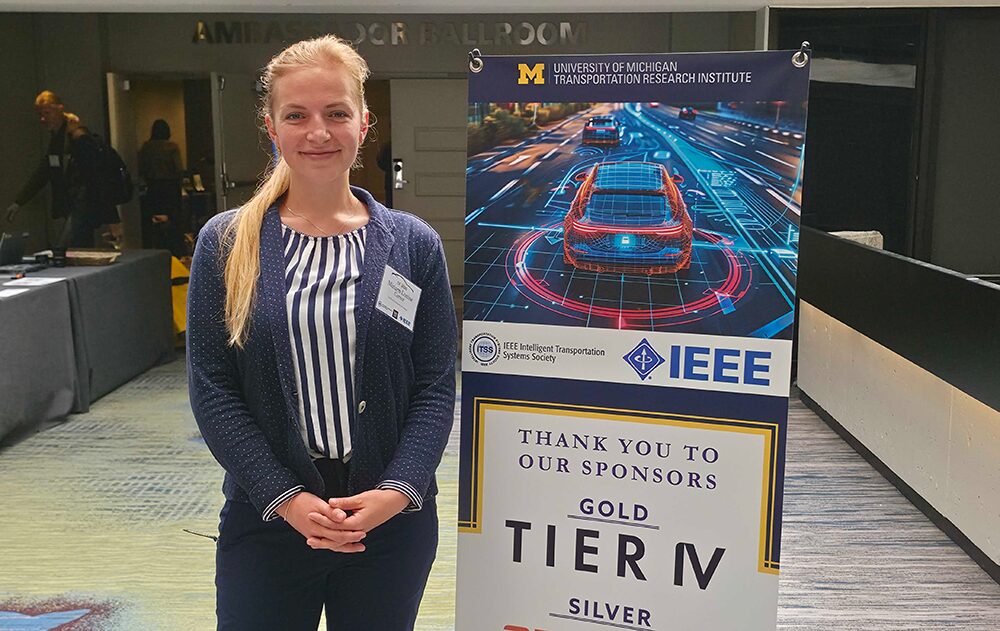
Last Week Miriam Louise Carnot took part at the 37th IEEE Intelligent Vehicles Symposium in Detroit.
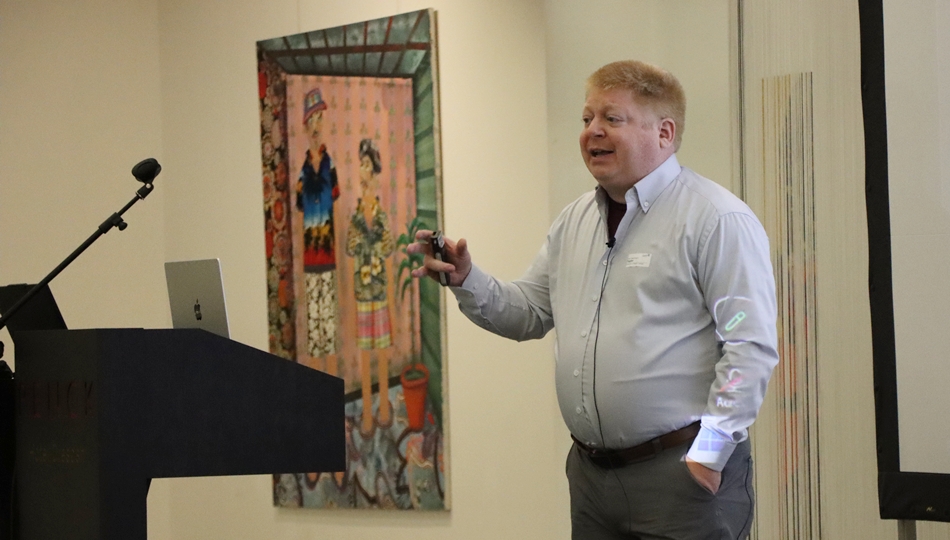
She gave a keynote talk at the 4th Workshop on Bridging the Gap Between Map-Based and Mapless Driving, organised by Karlsruher Institut für Technologie (KIT) researchers Jonas Merkert, Alexander Blumberg and Prof. Christoph Stiller. The workshop focused on hybrid solutions that combine HD maps and mapless driving as key sources of information for autonomous driving systems, supporting safety-critical tasks such as localisation, prediction and behaviour planning. Although HD maps are robust in the event of sensor failure, they are costly to create and maintain, and may contain outdated information. In contrast, map-less driving is becoming more prominent: modern sensor technology and machine learning are enabling increasingly accurate real-time modelling of the vehicle’s environment. The workshop brought these two approaches together, exploring hybrid solutions ranging from the fusion of uncertain online map estimates with HD maps to certifiable robustness, map change detection and training data generation.
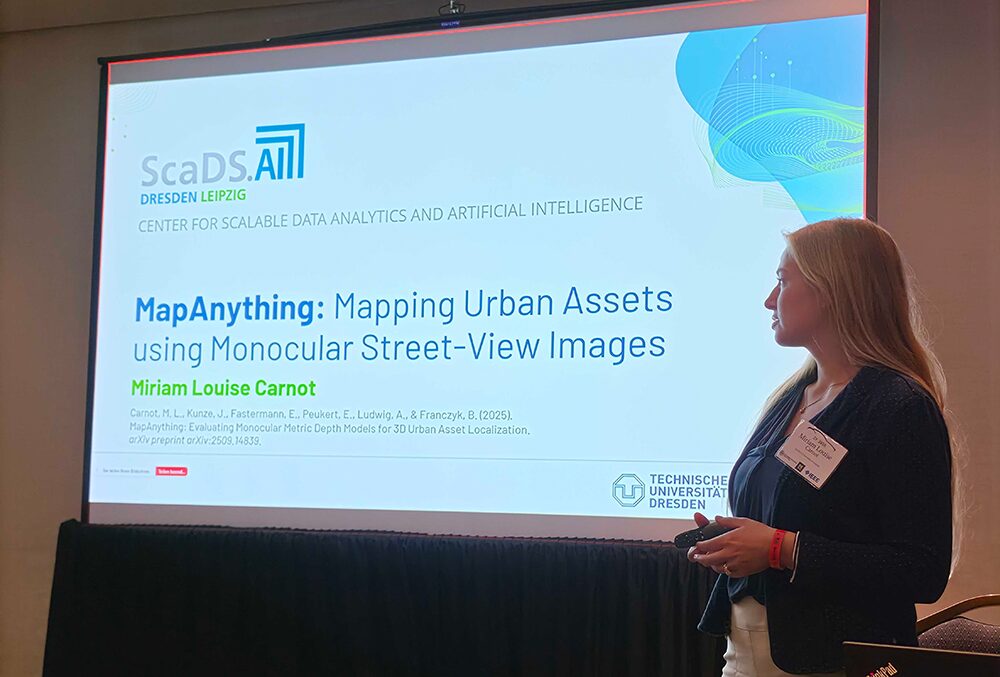
GTSIGN-220: A Crowd-Sourced, StVO-Aligned Dataset of German Traffic Signs
Later that week, Miriam Carnot presented her new dataset paper “GTSIGN-220: A Crowd-Sourced, StVO-Aligned Dataset of German Traffic Signs” in form of a poster. Anyone developing autonomous or driver assistance systems needs reliable training data. This is what GTSIGN-220 provides: This dataset contains more than 75,000 images of German traffic signs and strictly adheres to the German Road Traffic Regulations (StVO). The images, which are specifically designed as a benchmark for detailed traffic sign recognition, are sourced from street views on the Mapillary platform. One useful feature is that: You can easily download the corresponding original images via the Mapillary API using the ID included in the filename, which makes working with the dataset particularly flexible.
You can download the dataset here.
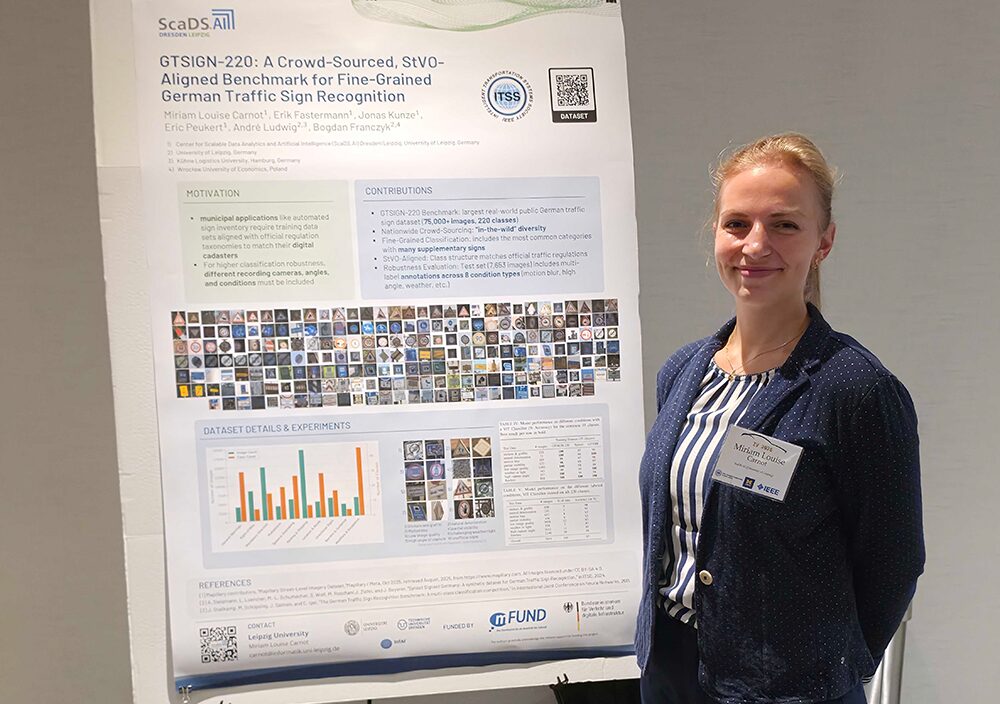
Additionally, she chaired the ‘Mobility Systems and ODDs’ session.
IEEE Intelligent Vehicles Symposium
From June 22 – 25, 2026, the IEEE Intelligent Vehicles Symposium invited researchers, engineers, practitioners and students from industry, universities and government agencies to present their latest work and discuss research and applications for intelligent vehicles and vehicle-infrastructure cooperation. The conference features technical sessions, workshops, poster sessions, exhibitions and much more besides.

funded by:


ScaDS.AI Dresden/Leipzig (Center for Scalable Data Analytics and Artificial Intelligence) is a center for Data Science, Artificial Intelligence and Big Data with locations in Dresden and Leipzig.


Dresden
Visitor address
Technische Universität Dresden
ScaDS.AI Dresden/Leipzig
Bürogebäude Strehlener Straße
Strehlener Straße 12, 14
01069 Dresden
ScaDS.AI Dresden/Leipzig
Bürogebäude Strehlener Straße
Strehlener Straße 12, 14
01069 Dresden
Postal address
Technische Universität Dresden
Zentrum für Informationsdienste und Hochleistungsrechnen
ScaDS.AI Dresden/Leipzig
01062 Dresden
Zentrum für Informationsdienste und Hochleistungsrechnen
ScaDS.AI Dresden/Leipzig
01062 Dresden
Leipzig
Visitor address
ScaDS.AI Dresden/Leipzig
Löhrs Carré
Humboldtstraße 25, Uferstr. 11
04105 Leipzig
Löhrs Carré
Humboldtstraße 25, Uferstr. 11
04105 Leipzig
Postal address
Universität Leipzig
Data Science Center ScaDS.AI Leipzig
Internes Postfach: 322001
04081 Leipzig
Data Science Center ScaDS.AI Leipzig
Internes Postfach: 322001
04081 Leipzig
Quicklinks:
Copyright 2026 © SCADS.AI Dresden/Leipzig – All rights reserved.