October 19, 2026
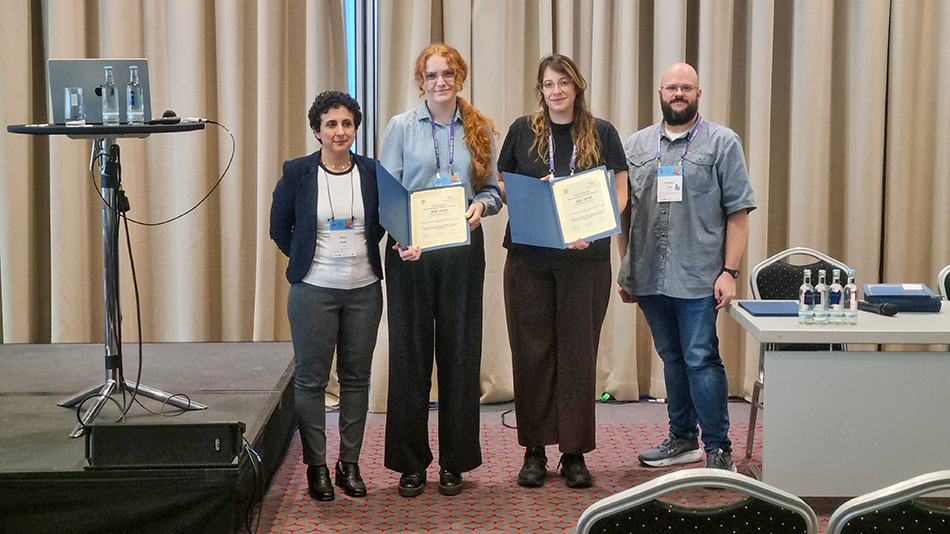
ASE 2026: ACM Distinguished Paper Award for Work on Productivity Evidence
ScaDS.AI Dresden/Leipzig
We congratulate Annemarie Wittig (Leipzig University), Alina Mailach and Norbert Siegmund (both Leipzig University and ScaDS.AI Dresden/Leipzig) on winning an ACM Distinguished Paper Award at this year’s International Conference on Automated Software Engineering (ASE 2026).
Fragmented Markers, Mixed Results: A Systematic Review of AI Coding Assistants and Developer Productivity
In a phased, systematic literature review, Annemarie Wittig, Alina Mailach, and Norbert Siegmund examined the effects of using AI coding assistants on the productivity of software developers. They did this by identifying a wide range of distinct productivity and productivity-related indicators. The aim is to make existing studies on this topic comparable and to facilitate cross-study conclusions.
Annemarie Wittig presented their work with a talk at the ASE 2026. You can find the article, which is freely accessible, in the Proceedings of the ASE ’26.
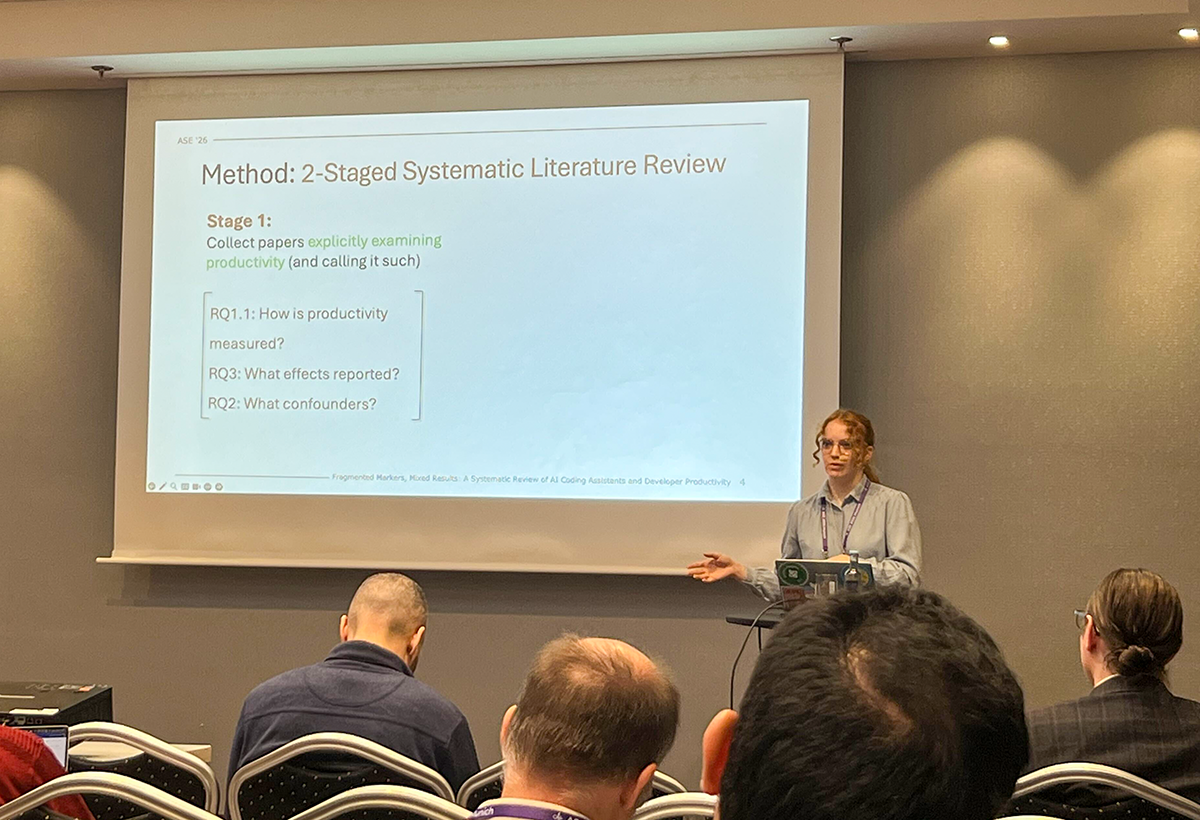
AI coding assistants are increasingly embedded in software engineering practice, yet the literature still offers no cumulative, easily interpretable picture of their effects on software developer productivity. The central problem is not a lack of studies, but a lack of comparability: prior work operationalizes productivity through heterogeneous markers, settings, and reporting styles, making cross-study conclusions difficult. To address this, we conduct a staged systematic literature review. In the first stage, we synthesize studies that explicitly examine developer productivity. In the second, we extend the scope to productivity-related developer outcomes using SPACE as a theory-informed lens, capturing human-centered evidence that explicit productivity studies often omit. Across both stages, we analyze how productivity is operationalized, which confounding factors are discussed, and how reported effects are distributed.
We identify 187 unique productivity and productivity-related markers, while individual studies typically only use five, revealing a broad but highly fragmented evidence base. Explicit productivity research is dominated by time-, output-, and artifact-oriented proxies, whereas the broader SPACE-aligned corpus makes satisfaction, psychological aspects, and well-being substantially more visible. Reported effects are often positive, but this pattern is stronger in perceived and tendency-based findings than in objective or statistically evaluated ones. Overall, the literature suggests that AI coding assistants can support productivity, but current evidence does not yet support simple, context-independent conclusions. The key contribution of this review is therefore a structured basis for making productivity evidence more interpretable, multidimensional, and comparable across studies.
Assessing Uncertainty in Performance Modeling: Conformal Prediction vs. Bayesian Regression
Another project in which ScaDS.AI Dresden/Leipzig was involved was presented by Stefan Jahns. He presented his group’s work on quantifying uncertainty in software performance predictions with a talk at the confernece. Using conformal prediction, they are attempting to predict the performance of previously unknown configurations. The paper was authored by Stefan Jahns, Johannes Dorn, Max Weber (all three Leipzig University), Sven Apel (Saarland University) and Norbert Siegmund (Leipzig University/ ScaDS.AI Dresden/Leipzig). Find the full version of the paper it in the Proceedings of the ASE ‘ 26.
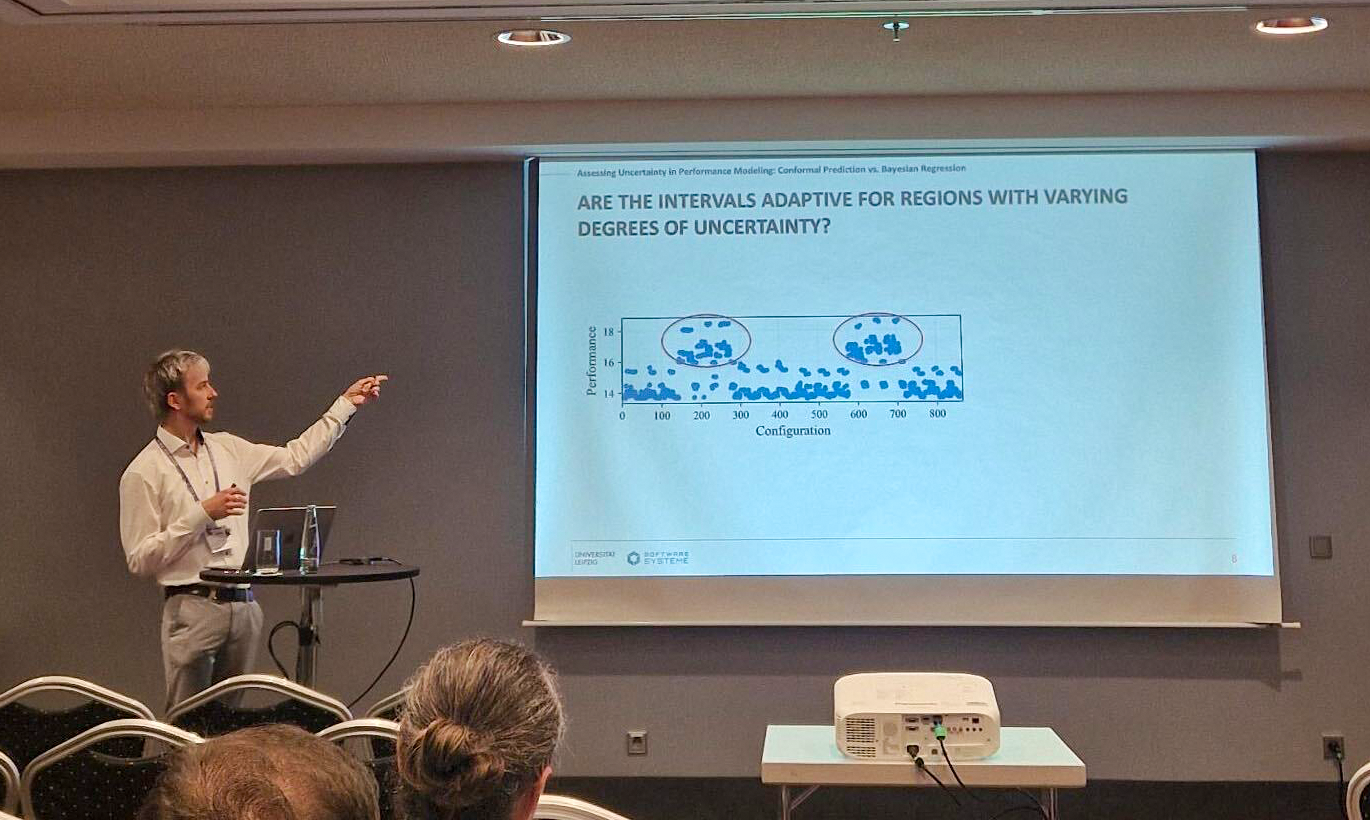
Most software systems today are configurable. As a consequence, predicting performance is inherently challenging due to the sheer number of configurations exhibiting individual performance variations. When predicting the performance of unseen configurations, it is imperative to know how reliable such predictions are. Bayesian methods have been shown to be able to quantify the uncertainty in their estimates, but require prior information about performance distributions and, more importantly, are constrained in their learning technique, effectively limiting their practical applicability. Conformal prediction, an entirely novel approach to uncertainty quantification in this area, augments existing learning algorithms via a statistical post-hoc analysis. This allows us to provide uncertainty estimates even for point-estimate algorithms, such as random forests or deep neural networks. The goal of this study is to evaluate how assumptions of conformal predictions regarding sample size and distribution, as well as the heterogeneity of learning algorithms, affect their applicability to software performance prediction. We conduct a comprehensive study comparing four conformal prediction variants against P4, the current standard for uncertainty-aware performance prediction, analyzing accuracy, scalability, and uncertainty quantification. Our results show that conformal prediction consistently outperforms the state of the art across six out of eight real world scenarios, producing correct confidence intervals that are 46–75 % narrower, and thus more certain. Notably, conformal prediction can be used to enrich existing techniques, with post-hoc uncertainty quantification in a plug and play fashion.
IEEE/ACM International Conference on Automated Software Engineering
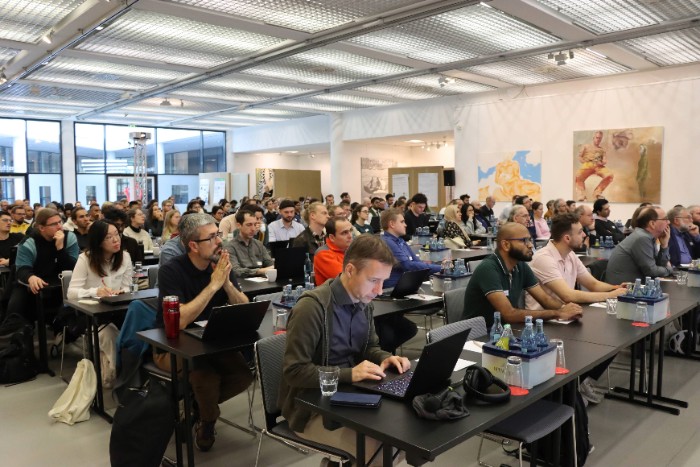
The 41st edition of the conference took place in Munich this year from October 12 to 15 and brought together researchers and practitioners to discuss foundations, techniques, and tools for automated analysis, design, implementation, testing, and maintenance of large software systems. The conference’s program consisted of keynotes, paper and poster presentations, workshops, symposia, and the student research competition.

funded by:


ScaDS.AI Dresden/Leipzig (Center for Scalable Data Analytics and Artificial Intelligence) is a center for Data Science, Artificial Intelligence and Big Data with locations in Dresden and Leipzig.


Dresden
Visitor address
Technische Universität Dresden
ScaDS.AI Dresden/Leipzig
Bürogebäude Strehlener Straße
Strehlener Straße 12, 14
01069 Dresden
ScaDS.AI Dresden/Leipzig
Bürogebäude Strehlener Straße
Strehlener Straße 12, 14
01069 Dresden
Postal address
Technische Universität Dresden
Zentrum für Informationsdienste und Hochleistungsrechnen
ScaDS.AI Dresden/Leipzig
01062 Dresden
Zentrum für Informationsdienste und Hochleistungsrechnen
ScaDS.AI Dresden/Leipzig
01062 Dresden
Leipzig
Visitor address
ScaDS.AI Dresden/Leipzig
Löhrs Carré
Humboldtstraße 25, Uferstr. 11
04105 Leipzig
Löhrs Carré
Humboldtstraße 25, Uferstr. 11
04105 Leipzig
Postal address
Universität Leipzig
Data Science Center ScaDS.AI Leipzig
Internes Postfach: 322001
04081 Leipzig
Data Science Center ScaDS.AI Leipzig
Internes Postfach: 322001
04081 Leipzig
Quicklinks:
Copyright 2026 © SCADS.AI Dresden/Leipzig – All rights reserved.