September 23, 2026
Anna Sterzik Wins Second Place at the Karl-Heinz-Höhne Award
ScaDS.AI Dresden/Leipzig
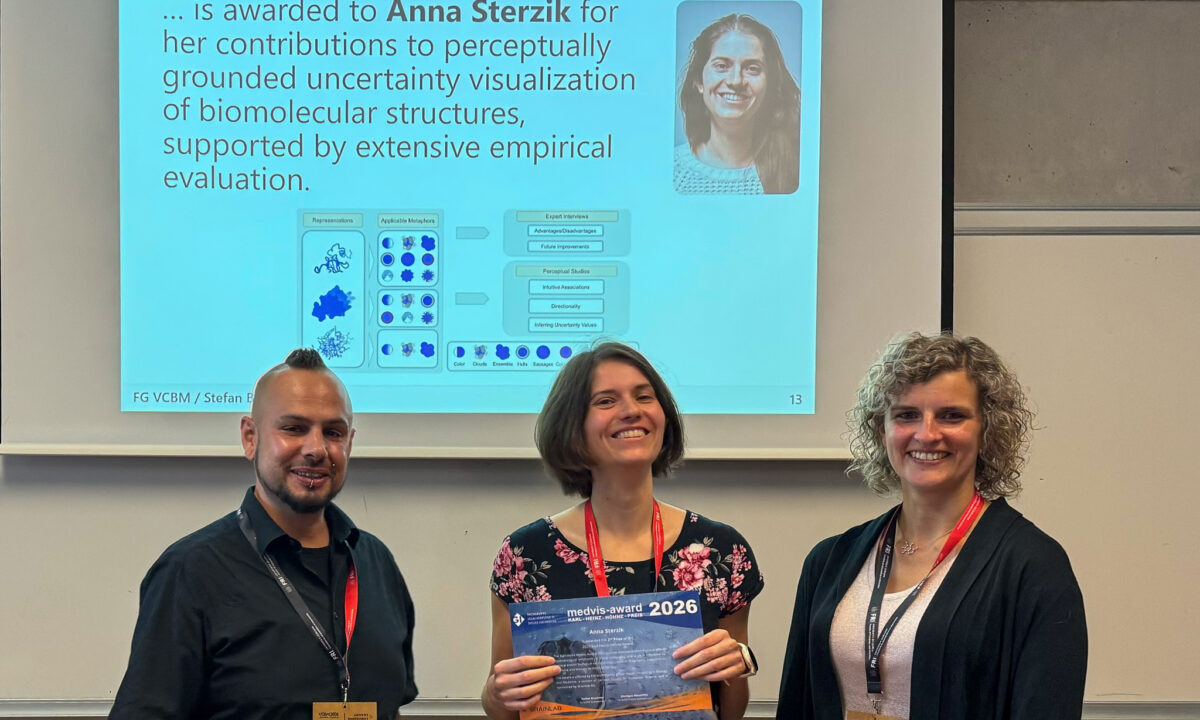
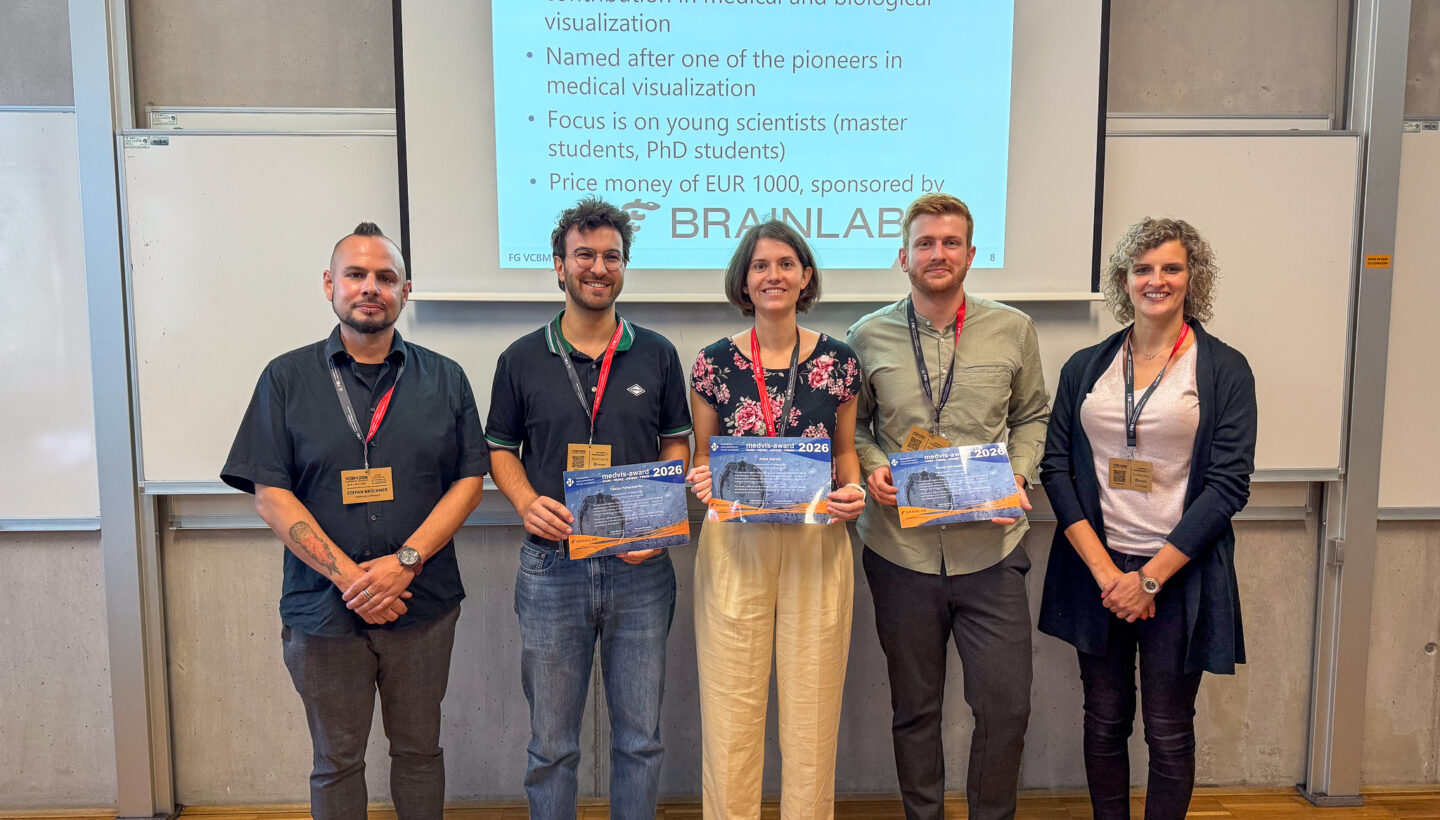
We are delighted to join ScaDS.AI Dresden/Leipzig PhD student Anna Sterzik in celebrating her second-place win at last week’s Karl-Heinz-Höhne Award. Presented every second year at the meeting of the GI’s Visual Computing in Biology and Medicine (VCBM) Special Interest Group, immediately before the VCBM workshop, the award recognizes outstanding contributions in the field of medical and biological visualization. Her submission consisted of two publications:
- Uncertainty Visualization for Biomolecular Structures: An Empirical Evaluation
- Evaluating the Perceptual Space of Surface Noise for Visualization
Visualising Uncertainty: A Systematic Assessment of Biomolecular Representation Techniques
Her submission is an increasingly important topic in biomedical research. While traditional 3-D models often depict proteins, DNA, or lipids as rigid objects, reality is far more dynamic. Molecules oscillate, rotate, and change their conformation depending on their environment. This positional uncertainty is usually not visualised, which limits our understanding of disease mechanisms and drug design. In the two studies presented, Sterzik and her colleagues investigated how to best implement uncertainty visualization for biomolecules. The first paper is about the evaluation of uncertainty visualizations for biomolecular structures. In the second paper, she refines surface noise as a promising encoding method by studying its perceptual properties and deriving improved mappings. Together, the papers promote a more precise interpretation and communication of biomolecular structures and their uncertainties.
Uncertainty is an intrinsic property of almost all data, regardless of the data being measured, simulated, or generated. It can significantly influence the results and reliability of subsequent analysis steps. Clearly communicating uncertainties is crucial for informed decision-making and understanding, especially in biomolecular data, where uncertainty is often difficult to infer. Uncertainty visualization (UV) is a powerful tool for this purpose. However, previously proposed uncertainty visualization (UV) methods lack sufficient empirical evaluation. We collected and categorized visualization methods for portraying positional uncertainty in biomolecular structures. We then organized the methods into metaphorical groups and extracted nine representatives: color, clouds, ensemble, hulls, sausages, contours, texture, waves, and noise. Furthermore, we assessed their strengths and weaknesses in a twofold approach: expert assessments with six domain experts and three perceptual evaluations involving 1,756 participants. Through the expert assessments, we aimed to highlight the advantages and limitations of the individual methods for the application domain and discussed areas for necessary improvements. Through the perceptual evaluation, we investigated whether the visualizations are intuitively associated with uncertainty and whether the directionality of the mapping is perceived as intended. We also assessed the accuracy of inferring uncertainty values from the visualizations. Based on our results, we judged the appropriateness of the metaphors for encoding uncertainty and suggested further areas for improvement.
Surface noise provides a geometric alternative to color for encoding scalar information on surfaces, yet its perceptual characteristics remain insufficiently understood. We present a systematic investigation of how variations in noise amplitude and frequency are perceived when applied to 3D surfaces. Across three online perceptual studies with 142 participants, we gathered similarity judgments for surface noise stimuli and modeled the resulting perceptual space using multi‐dimensional scaling (MDS). Our analysis shows that the amplitude–frequency perceptual space requires at least three dimensions for accurate reconstruction; however, the stimuli lie near a 2D manifold. Building on these findings, we derive locally perceptually uniform reparameterizations for both amplitude and frequency, improving the suitability of surface noise as a mapping for scalar data. These results provide perceptual guidance for the design of geometric encodings based on surface perturbation.
from VRVis GmbH
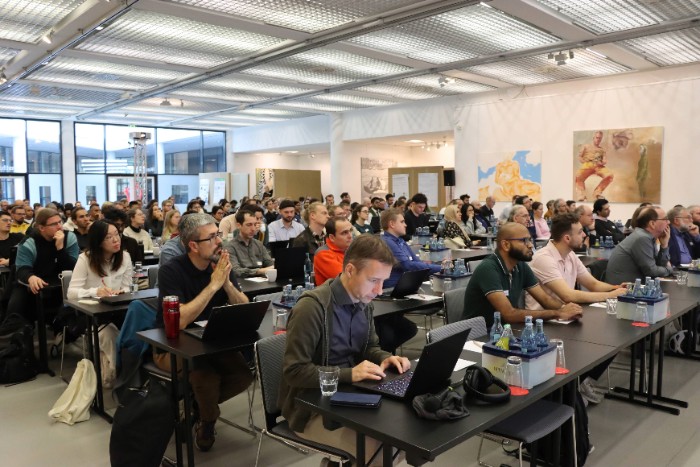
Eurographics Symposium on Visual Computing for Biology and Medicine (VCBM)
The EG-VCBM focuses on current research questions in visual computing with applications in biology and medicine. It serves as an interdisciplinary forum for researchers in the fields of visualization, visual analytics, computer graphics, image processing, computer vision, and human-computer interaction, as well as for experts in biology and medicine. Together, they develop advanced visual computing methods for medical practice, healthcare, and biotechnology.

funded by:



ScaDS.AI Dresden/Leipzig (Center for Scalable Data Analytics and Artificial Intelligence) is a center for Data Science, Artificial Intelligence and Big Data with locations in Dresden and Leipzig.


Dresden
Visitor address
Technische Universität Dresden
ScaDS.AI Dresden/Leipzig
Bürogebäude Strehlener Straße
Strehlener Straße 12, 14
01069 Dresden
ScaDS.AI Dresden/Leipzig
Bürogebäude Strehlener Straße
Strehlener Straße 12, 14
01069 Dresden
Postal address
Technische Universität Dresden
Zentrum für Informationsdienste und Hochleistungsrechnen
ScaDS.AI Dresden/Leipzig
01062 Dresden
Zentrum für Informationsdienste und Hochleistungsrechnen
ScaDS.AI Dresden/Leipzig
01062 Dresden
Leipzig
Visitor address
ScaDS.AI Dresden/Leipzig
Löhrs Carré
Humboldtstraße 25, Uferstr. 11
04105 Leipzig
Löhrs Carré
Humboldtstraße 25, Uferstr. 11
04105 Leipzig
Postal address
Universität Leipzig
Data Science Center ScaDS.AI Leipzig
Internes Postfach: 322001
04081 Leipzig
Data Science Center ScaDS.AI Leipzig
Internes Postfach: 322001
04081 Leipzig
Quicklinks:
Copyright 2026 © SCADS.AI Dresden/Leipzig – All rights reserved.