

The Seismic Fingerprint of Tree Sway
Title: The Seismic Fingerprint of Tree Sway
Project duration: since June 2024
Research Area: Environmental Seismology, Forest Ecosystems, Machine Learning, Time-Series Analysis
Forests respond continuously to wind, water availability and changing environmental conditions. This project investigates whether these responses can be monitored using seismic sensors installed in the ground. Seismometers record vibrations generated by wind-induced tree sway and transmitted through the root–soil system. By combining seismic observations with tree-mounted sensors and meteorological measurements, we demonstrated that characteristic tree-sway dynamics can be detected from the ground. Building on these results, we are currently investigating whether seismic observations also contain information about tree water status and can complement conventional meteorological measurements. Machine-learning methods are used to identify relevant seismic features and link them to environmental and physiological processes.
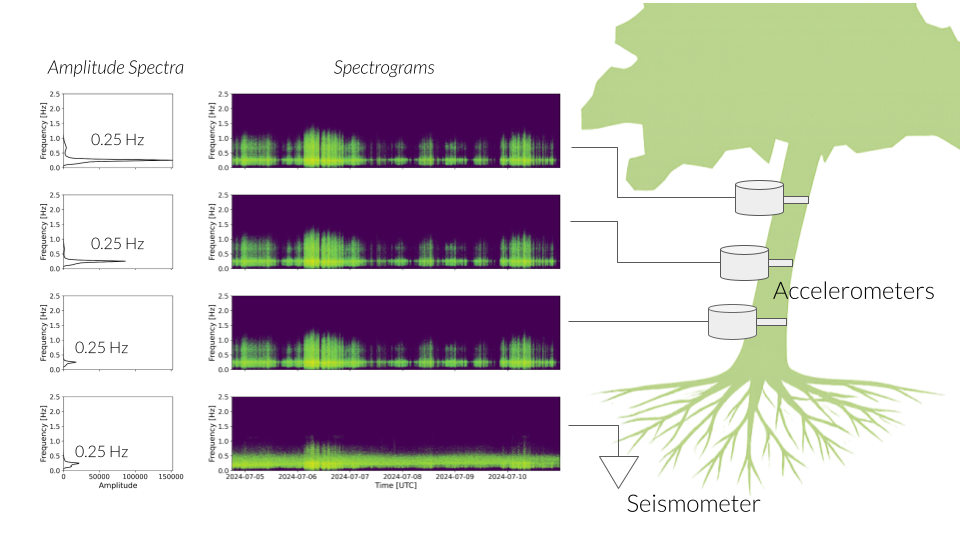
From tree sway to seismic signals. Accelerometers mounted at different heights record wind-induced tree motion, while a ground-based seismometer captures vibrations transmitted through the root–soil system. The corresponding spectra and spectrograms reveal characteristic tree-sway frequencies around 0.25 Hz and demonstrate that tree motion can be observed from the ground.
Aims
The project aims to establish ground-based seismic sensing as a non-invasive approach for monitoring tree and forest dynamics. We investigate how seismic signals reflect wind-induced tree motion and explore whether machine learning can extract information about tree water status that complements established meteorological and physiological observations.
Problems
Continuous monitoring of tree water status and biomechanical responses is important for understanding forest resilience to drought and climate extremes, but established measurements are often invasive, tree-specific or difficult to scale. We ask whether vibrations recorded in the ground can provide a complementary, spatially scalable indicator of how trees respond to wind and changing water availability.
Practical example created during the project (if applicable)
At the ECOSENSE forest site, a network of ground-based seismometers records tree-generated vibrations continuously. We demonstrated that these measurements capture wind-induced tree sway and are now using the same network to investigate tree water deficit. This provides a real-world test of seismic sensing as a passive monitoring tool for forest ecosystems.
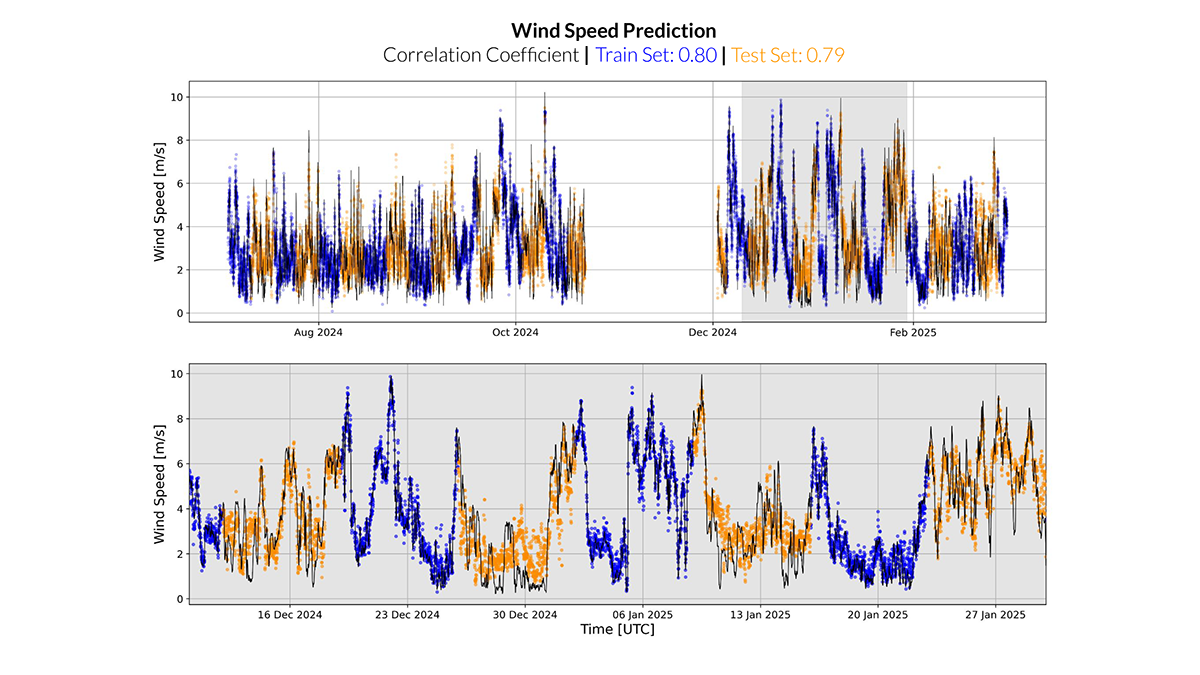
Predicting wind speed from seismic observations. A machine-learning model trained on features extracted from ground-recorded seismic signals reconstructs the temporal variability of wind speed. The close agreement between measured and predicted values (test-set correlation: 0.79) demonstrates that seismic recordings contain quantitative information about wind-driven forest dynamics.
Technology
The project combines dense seismic sensor networks with accelerometers on tree trunks, meteorological observations and measurements of tree water deficit. Seismic time series are analyzed using signal processing, spectral and time-frequency features, dimensionality reduction and machine-learning regression. Explainable-AI methods are used to identify which seismic characteristics contribute to predictions and to link model performance back to physical tree responses.
Outlook
The project demonstrates the potential of seismic observations for monitoring wind-induced tree and forest dynamics. Current research extends this approach towards hydrological tree status, investigating whether seismic observations can contribute to continuous monitoring of tree water deficit. Future work will test the transferability of these approaches across seasons, tree species, forest structures and environmental conditions.
Publications
- Umlauft, J., Mora, K., Limberger, F., Gerberding, K., Wirth, C., Werner, C., & Kattenborn, T. (2025). The seismic fingerprint of wind-induced tree sway. Methods in Ecology and Evolution, 16, 2886–2900.
https:/doi.org/10.1111/2041-210X.70173
Team
Lead
- Dr. Josefine Umlauft
Team Members
- Dr. Josefine Umlauft – ScaDS.AI Dresden/Leipzig, Leipzig University
- Dr. Karin Mora – Institute for Earth System Sciences and Remote Sensing, Leipzig University
- Dr. Fabian Limberger – Goethe University Frankfurt am Main
- Kilian Gerberding – Sensor-based Geoinformatics, University of Freiburg
- Prof. Christian Wirth – Institute of Systematic Botany and Functional Biodiversity, Leipzig University / iDiv
- Prof. Christiane Werner – Ecosystem Physiology, University of Freiburg
- Prof. Teja Kattenborn – Sensor-based Geoinformatics, University of Freiburg
Partners





Dresden
ScaDS.AI Dresden/Leipzig
Bürogebäude Strehlener Straße
Strehlener Straße 12, 14
01069 Dresden
Zentrum für Informationsdienste und Hochleistungsrechnen
ScaDS.AI Dresden/Leipzig
01062 Dresden
Leipzig
Löhrs Carré
Humboldtstraße 25, Uferstr. 11
04105 Leipzig
Data Science Center ScaDS.AI Leipzig
Internes Postfach: 322001
04081 Leipzig
Quicklinks:
Copyright 2026 © SCADS.AI Dresden/Leipzig – All rights reserved.