

Denoising Icequakes
Project duration: 08/2023 – 08/2026
Research Area: Environmental Seismology, Cryoseismology, Machine Learning Techniques on Time Series Data
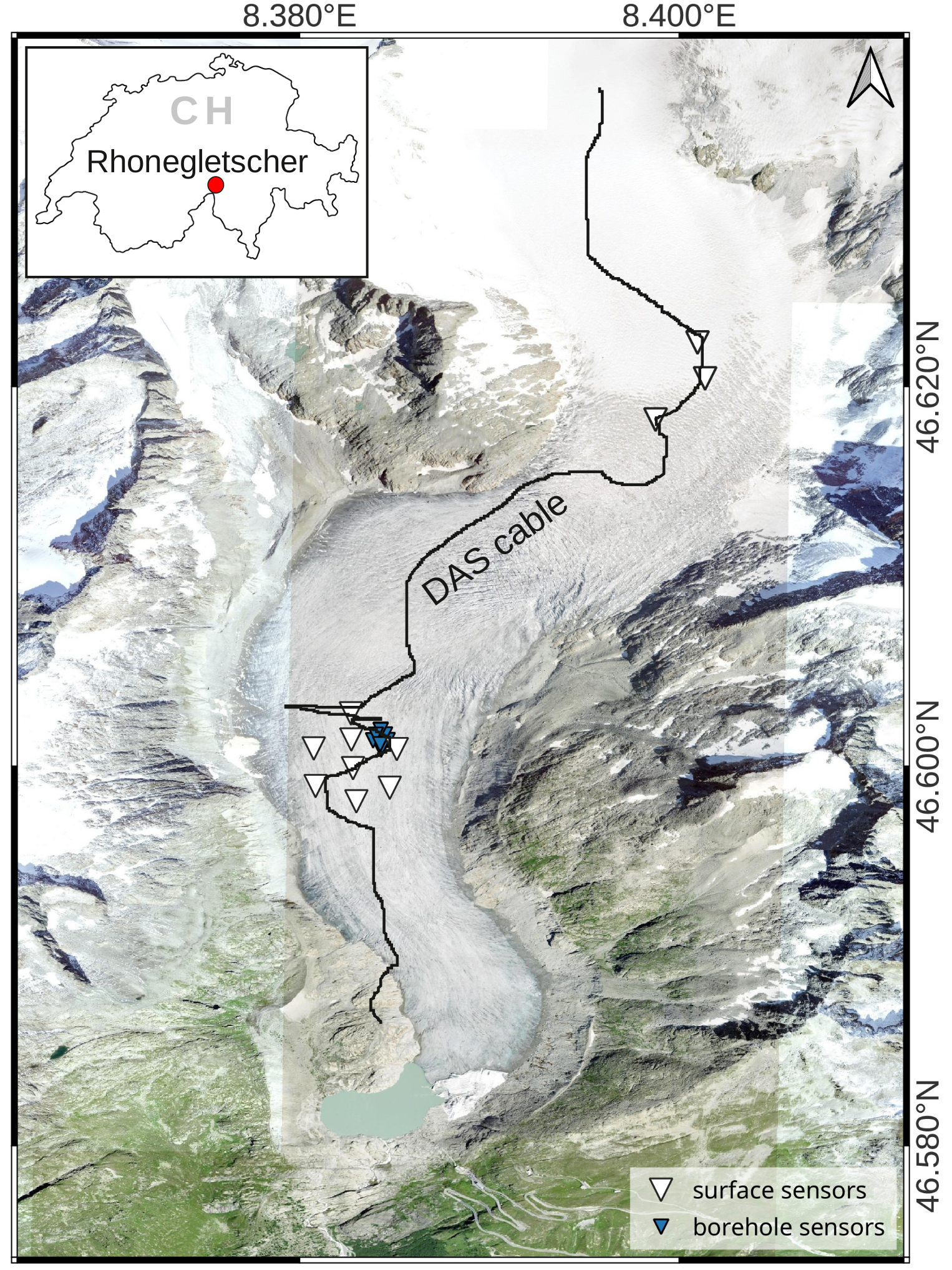
One major challenge in cryoseismology is that signals of interest are often buried within the high noise level emitted by a multitude of environmental processes. Specifically, basal sources such as stick-slip events often stay unnoticed due to long travel paths to surface sensors and accompanied wave attenuation. Yet, stick-slip events play a crucial role in understanding glacier sliding and therefore, it is of great interest to investigate their spatio-temporal evolution, across entire glaciers from ablation to its accumulation zone. Based on a newly acquired DAS data set from Rhonegletscher (Switzerland), spanning 9 km along the flow line of the glacier, we develop and test denoising techniques for effective icequake detection.
Aims
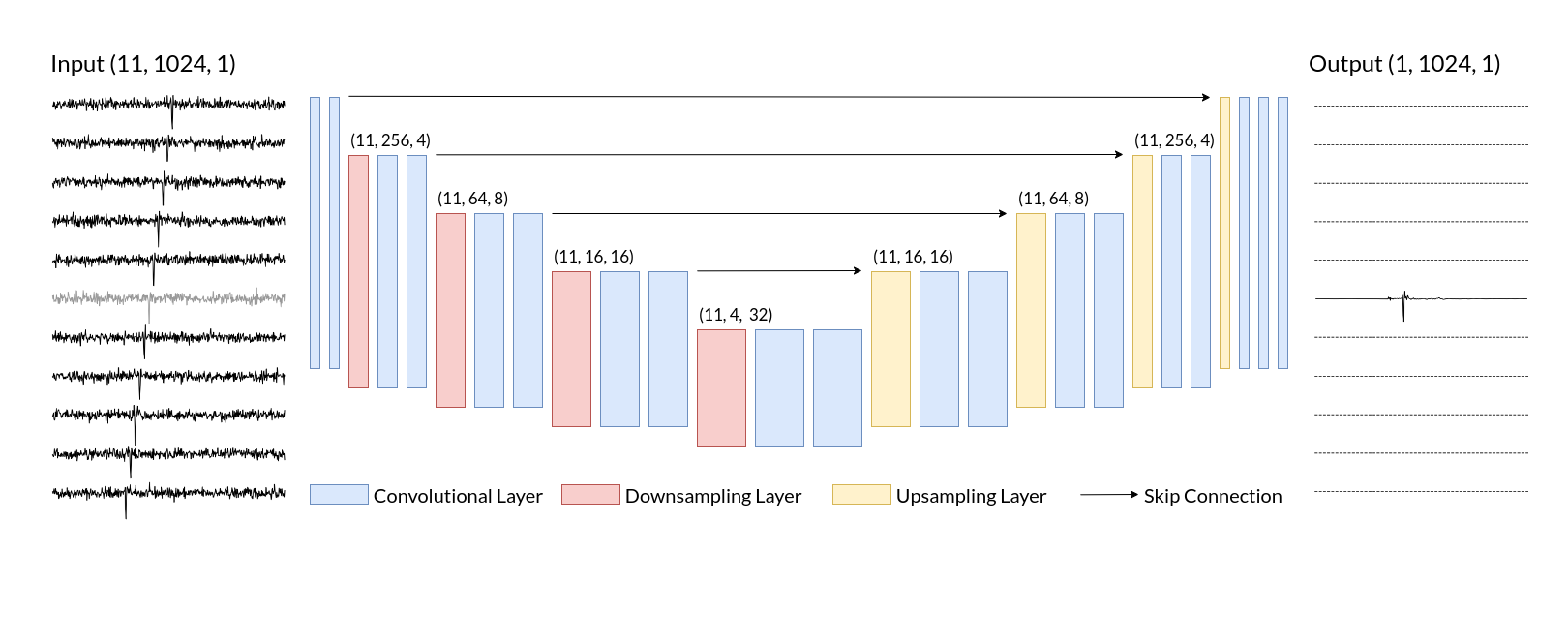
To unmask stick-slip events, new techniques are required that effectively and efficiently denoise large cryoseismological DAS data sets. In order to denoise continuous seismic records from Rhonegletscher (Switzerland), we trained an autoencoder that reveals coherent signals across a fiber optical cable (DAS technology) and suppress incoherent signal parts.
Several models were trained on a variety of data subsets, differing in recording positions (ablation or accumulation zone), event types (stick-slip event or surface event) and the quantity of training events. We compare and discuss the denoising capabilities of these models with several metrics, such as:
- inter-channel coherence,
- similarity between seismometer and DAS recordings, and
- visual assessment.
This evaluation is conducted while considering different data types in a qualitative and quantitative manner. All models show an increase in inter-channel coherence of the seismic records after denoising. Further, all models uncover previously undetected stick-slip events, whereby models trained on manually picked training data perform better than models trained on randomly picked training data. We believe that the application of our models can improve our understanding of basal stick-slip information in cryoseismological DAS datasets, potentially uncovering previously hidden information.
Problems
Due to the highly active and dynamic cryospheric environment as well as non-ideal cable-ground coupling, the collected DAS data are characterized by a low signal to noise ratio compared to classical point sensors.
Technologies
Distributed Acoustic Sensing (DAS) is a technology for measuring strain rate by using common fiber-optic cables in combination with an interrogation unit. This technology enables us to acquire seismic data over an entire glacier with great spatial and temporal resolution.
Here, we implement an Autoencoder, a type of deep neural network, which is able to separate the incoherent environmental noise from the temporally and spatially coherent signals of interest (e.g., stick-slip events or crevasse formations).
Outlook
The expectation of this project is that the investigations lead to a better understanding of glacial basal motion, which is one of the most debated and difficult to observe processes in glaciology. Gaining more knowledge about basal-sliding is a crucial step for modeling and predicting melt water production and sliding of ice streams in more detail. Furthermore, understanding stick-slip events lays the foundation for predicting failures of deep ice tongues in the future, with the aim of better protecting mankind and infrastructure.
Team
- Johanna Zitt
Supervisors
- Dr. Josefine Umlauft (ScaDS.AI Dresden/Leipzig)
- Dr. Sven Schippkus (University of Hamburg)
Partners
- Prof. Céline Hadziioannou (University of Hamburg)
- Dr. Patrick Paitz (WSL Zürich)
- Dr. Fabian Walter (WSL Zürich, ETH Zürich)
Publications
- Zitt, J., Paitz, P., Walter, F., and Umlauft, J.: Uncovering Stick-Slip Events: Denoising Cryoseismological Distributed Acoustic Sensing Data with an Autoencoder, EGU General Assembly 2024, Vienna, Austria, 14–19 Apr 2024, EGU24-10147, https://doi.org/10.5194/egusphere-egu24-10147, 2024.



Dresden
ScaDS.AI Dresden/Leipzig
Bürogebäude Strehlener Straße
Strehlener Straße 12, 14
01069 Dresden
Zentrum für Informationsdienste und Hochleistungsrechnen
ScaDS.AI Dresden/Leipzig
01062 Dresden
Leipzig
Löhrs Carré
Humboldtstraße 25, Uferstr. 11
04105 Leipzig
Data Science Center ScaDS.AI Leipzig
Internes Postfach: 322001
04081 Leipzig
Quicklinks:
Copyright 2026 © SCADS.AI Dresden/Leipzig – All rights reserved.