Understanding Glacier Dynamics through Time Series Analysis
Project duration: since July 2023
Research Area: Time-Series Analysis, Machine Learning, Autoencoders, Environmental Seismology, Cryoseismology, Distributed Acoustic Sensing
Cryoseismic signals are generated by processes such as crevasse formation, basal motion, and water flow, and contain information about glacier dynamics. Linking icequake activity to external factors, such as diurnal cycles and weather conditions, can provide valuable insights into glacial processes that are not directly observable.
Large seismic networks and modern techniques such as Distributed Acoustic Sensing (DAS) produce multiple terabytes of data within a few days. Efficient methods capable of processing and analyzing these large datasets are therefore essential. We analyze cryoseismological records in three main steps: (1) denoising, to enhance seismic signals that may remain hidden under a high noise level; (2) event detection, to identify seismic signals of interest; and (3) event analysis, to localize, characterize, and interpret the seismic events. In this project, we develop and apply machine-learning and statistical methods for time-series analysis across all three steps.
Technology
(1) For denoising, we developed a self-supervised autoencoder to suppress incoherent noise while preserving coherent seismic signals of interest [1]. As an alternative approach, we apply the Kalman filter [2] followed by the Rauch-Tung-Striebel smoother [3] to suppress high-frequency noise.
(2) For event detection, classical statistical approaches such as the Short-Term Average/Long-Term Average [4], as well as deep neural networks based on autoencoder structures [5] and transformers [6], are being evaluated and adapted to the specific characteristics of cryoseismic signals.
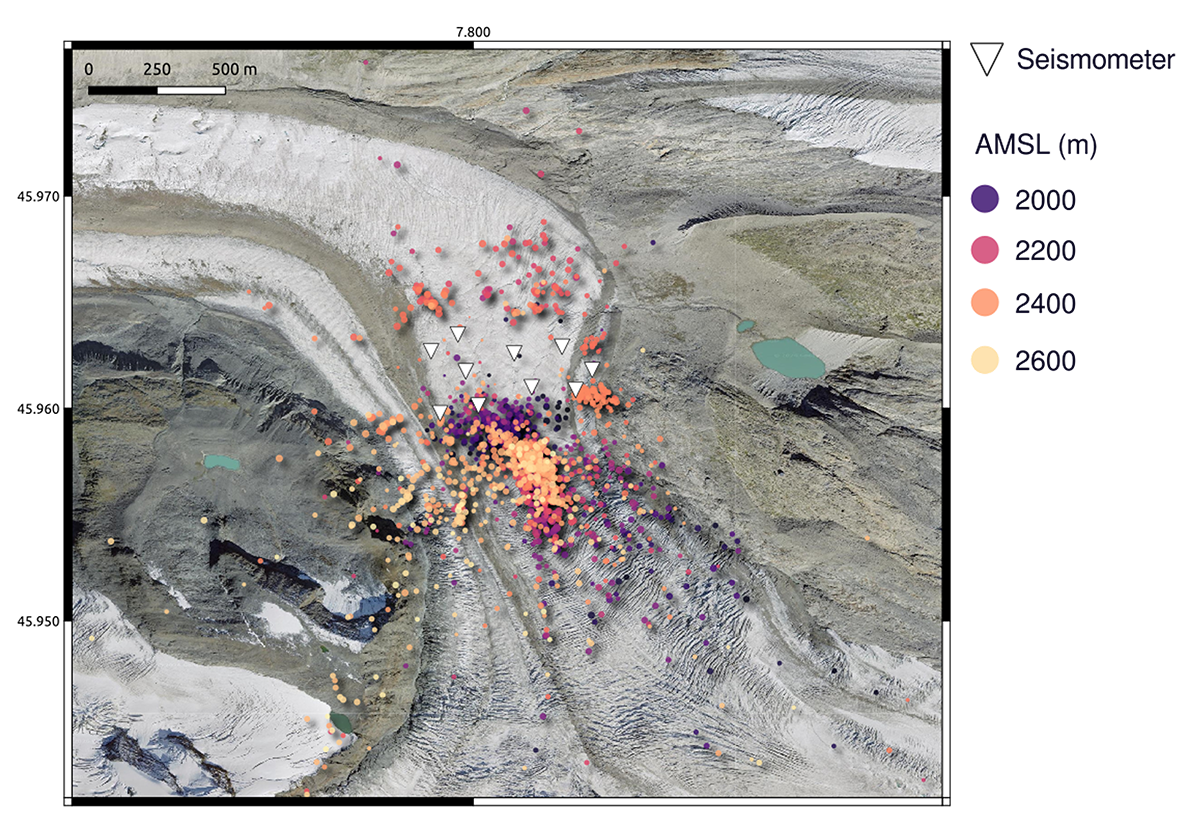
(3) For the localization of detected events, methods based on beamforming, such as matched-field processing [7] and stacking-and-migration techniques [8], are used to determine their spatial distribution. Furthermore, unsupervised clustering algorithms are used to identify patterns and structures within the large event catalog.
Aims
Our investigations aim to improve the understanding of glacial basal motion, a widely debated and difficult-to-observe process in glaciology. A better understanding of basal sliding is crucial for improving ice-stream dynamics and predictions of meltwater production.
Problems
Most seismic methods were originally developed for single-station recordings of earthquake signals. These methods therefore need to be adapted and further developed to account for the characteristics of cryoseismic events and the unique properties of modern recording techniques such as DAS. This data type presents several challenges, including high noise levels due to poor ground coupling, the abundance of recorded data, and the still poorly understood response and recording characteristics of DAS systems. In particular, the signals of interest for us, e.g., basal stick-slip events, are often obscured in the data due to wave attenuation along their long travel paths to the surface sensors and to various sources of environmental noise.
Practical example created during the project
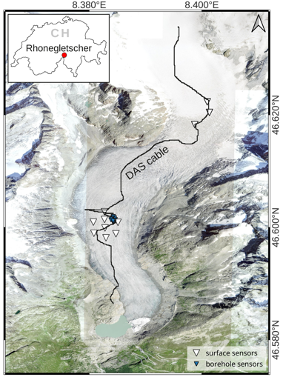
Based on a DAS dataset from Rhonegletscher in Switzerland, acquired in July 2020 and spanning approximately 9 km along the glacier flow line, we develop and evaluate denoising, detection, localization, and analysis techniques for efficiently investigating cryoseismic activity across an entire glacier. Additionally we analyze seismic signals from Glacier d’Argentière, France, and from Gornergletscher and Grenzgletscher, Switzerland.
Team
Team Lead

Dr. Josefine Umlauft
Leipzig University


Prof. Dr. Ostap Okhrin
TUD Dresden University of Technology
Chair of Econometrics and Statistics, esp. in the Transport Sector
Team members

Stephan Meyer
TUD Dresden University of Technology
Chair of Applied Statistics

Johanna Zitt
Leipzig University
Partners
Dr. Marius Isken: GFZ Helmholtz Centre for Geosciences, Potsdam, Germany
Dr. Jannis Münchmeyer: GFZ Helmholtz Centre for Geosciences, Potsdam, Germany
Dr. Patrick Paitz: Swiss Federal Institute for Forest, Snow and Landscape Research WSL, Birmensdorf, Switzerland
Dr. Dominik Gräff: Department of Earth and Space Sciences, University of Washington, Seattle, WA, USA
Dr. Fabian Walter: Swiss Federal Institute for Forest, Snow and Landscape Research WSL, Birmensdorf, Switzerland
Prof. Dr. Andreas Fichtner: Institute of Geophysics, ETH Zürich, Zürich, Switzerland
Publications
- Zitt, J., Isken, M., Münchmeyer, J., Gräff, D., Fichtner, A., Walter, F., & Umlauft, J. (2026). Best Practices for Machine Learning based Icequake Picking with Distributed Acoustic Sensing (No. EGU26-12160). Copernicus Meetings.
- Zitt, J., Paitz, P., Fichtner, A., Walter, F., & Umlauft, J. (2025). Self‐supervised coherence‐based denoising of cryoseismological distributed acoustic sensing data. Journal of Geophysical Research: Machine Learning and Computation, 2(3), e2024JH000414.
- Zitt, J., Paitz, P., Fichtner, A., Walter, F., & Umlauft, J. (2025). Enhancing Event Detection in Distributed Acoustic Sensing Data through Comprehensive Denoising (No. EGU25-11352). Copernicus Meetings.
- Zitt, J., Paitz, P., Walter, F., & Umlauft, J. (2024). Uncovering Stick-Slip Events: Denoising Cryoseismological Distributed Acoustic Sensing Data with an Autoencoder. European Geosciences Union General Assembly 2024 (EGU24), 10147.
- Zitt, J., Paitz, P., Walter, F., & Umlauft, J. (2023, May). Denoising cryoseismological distributed acoustic sensing data using a deep neural network. In EGU General Assembly Conference Abstracts (pp. EGU-13269).
References
[1] Zitt, J., Paitz, P., Fichtner, A., Walter, F., & Umlauft, J. (2025). Self‐supervised coherence‐based denoising of cryoseismological distributed acoustic sensing data. Journal of Geophysical Research: Machine Learning and Computation, 2(3), e2024JH000414.
[2] R. E. Kalman, A New Approach to Linear Filtering and Prediction Problems, Journal of Basic Engineering, 82(1), 35–45, 1960. https://doi.org/10.1115/1.3662552
[3] Rauch, H. E., Tung, F., & Striebel, C. T. (1965). Maximum likelihood estimates of linear dynamic systems. AIAA journal, 3(8), 1445-1450.
[4] Allen, R. (1982). Automatic phase pickers: Their present use and future prospects. Bulletin of the Seismological Society of America, 72(6B), S225–S242. https://doi.org/10.1785/bssa07206b0225
[5] Zhu, W., & Beroza, G. C. (2019). PhaseNet: a deep-neural-network-based seismic arrival-time picking method. Geophysical Journal International, 216(1), 261-273.
[6] Mousavi, S. M., Ellsworth, W. L., Zhu, W., Chuang, L. Y., & Beroza, G. C. (2020). Earthquake transformer—an attentive deep-learning model for simultaneous earthquake detection and phase picking. Nature communications, 11(1), 3952.
[7] Umlauft, J., Lindner, F., Roux, P., Mikesell, T. D., Haney, M. M., Korn, M., & Walter, F. T. (2021). Stick‐slip tremor beneath an alpine glacier. Geophysical Research Letters, 48(2), e2020GL090528. https://doi.org/10.1029/2020gl090528
[8] Isken, M. P., Niemz, P., Münchmeyer, J., Buyukakpinar, P., Heimann, S., Cesca, S., … & Dahm, T. (2025). Qseek: a data-driven framework for automated earthquake detection, localization and characterization. Seismica, 4(1).




Dresden
ScaDS.AI Dresden/Leipzig
Bürogebäude Strehlener Straße
Strehlener Straße 12, 14
01069 Dresden
Zentrum für Informationsdienste und Hochleistungsrechnen
ScaDS.AI Dresden/Leipzig
01062 Dresden
Leipzig
Löhrs Carré
Humboldtstraße 25, Uferstr. 11
04105 Leipzig
Data Science Center ScaDS.AI Leipzig
Internes Postfach: 322001
04081 Leipzig
Quicklinks:
Copyright 2026 © SCADS.AI Dresden/Leipzig – All rights reserved.