

AUTOENCODIX: powering a hub for biological representation learning models
Title: AUTOENCODIX
Project Duration: since 2023
Research Area: Life Science and Medicine
Modern life sciences generate data at an unprecedented scale, from single-cell and spatial omics to biomedical imaging. Turning this complex, high-dimensional data into biological insight requires computational methods that learn compact, meaningful representations. Autoencoders, a family of neural networks, have become one of the most versatile tools for this task. They do far more than compress data: they underpin methods that remove technical noise, integrate different molecular layers, embed prior biological knowledge for interpretable results, generate realistic synthetic data, and simulate how cells respond to genetic or chemical perturbations.
Yet the field remains fragmented. New autoencoder methods are typically released as isolated, one-off code that is hard to compare, reuse, or transfer to new data types, and pretrained models are rarely shared. AUTOENCODIX addresses this gap. It is an open, modular Python framework and model hub for biological representation learning, with a consistent interface from data ingestion to training and analysis, support for sharing and reusing pretrained models, built-in explainable AI, and support for both omics and imaging data.
Aims
Our goal is to make state-of-the-art representation learning reproducible, comparable and accessible, and above all explainable: integrating prior biological knowledge into transparent models whose results researchers can interpret, trust and turn into new hypotheses, biomarkers and disease insights.
Technology
A zoo of purpose-built architectures. AUTOENCODIX offers a growing collection of autoencoder architectures, each designed for a specific analytical need:
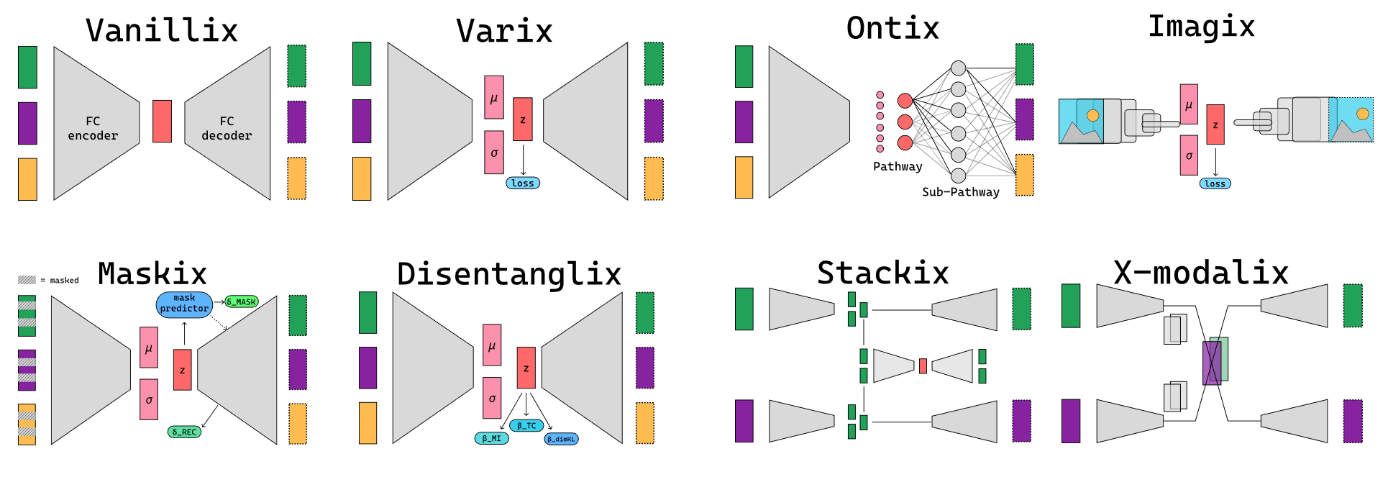
Vanillix and Varix : the classical and variational autoencoders, for compact, general-purpose representations.
Maskix: recovers missing values and reduces technical noise in sparse data.
Disentanglix: separates distinct biological and technical factors of variation into dedicated latent dimensions.
Ontix: builds prior biological knowledge directly into the model, so each latent dimension corresponds to a known pathway or ontology term.
Imagix: learns representations from 2D images and 3D volumes, from CT scans to spatial transcriptomics.
Stackix and X-modalix: integrate multiple omics layers or translate between data types, such as images and gene expression.
One pipeline, built for insight. Every architecture runs through the same consistent pipeline, from preprocessing of single-cell, tabular and image data to training, hyperparameter tuning and evaluation (Figure B). What sets AUTOENCODIX apart is its focus on explainability. Ontology-guided models make embeddings interpretable by design, while built-in feature attribution identifies the genes driving each latent dimension. Large language models then translate these attributions into literature-backed, plain-language descriptions of the underlying biology. Integrated visualizations show how latent spaces capture biological structure. Downstream evaluation works with any scikit-learn-compatible model, including foundation models such as TabPFN. Native compatibility with the scverse, PyTorch and scikit-learn ecosystems means AUTOENCODIX fits into existing workflows rather than replacing them. Its modular design lets new architectures be assembled quickly from existing components.
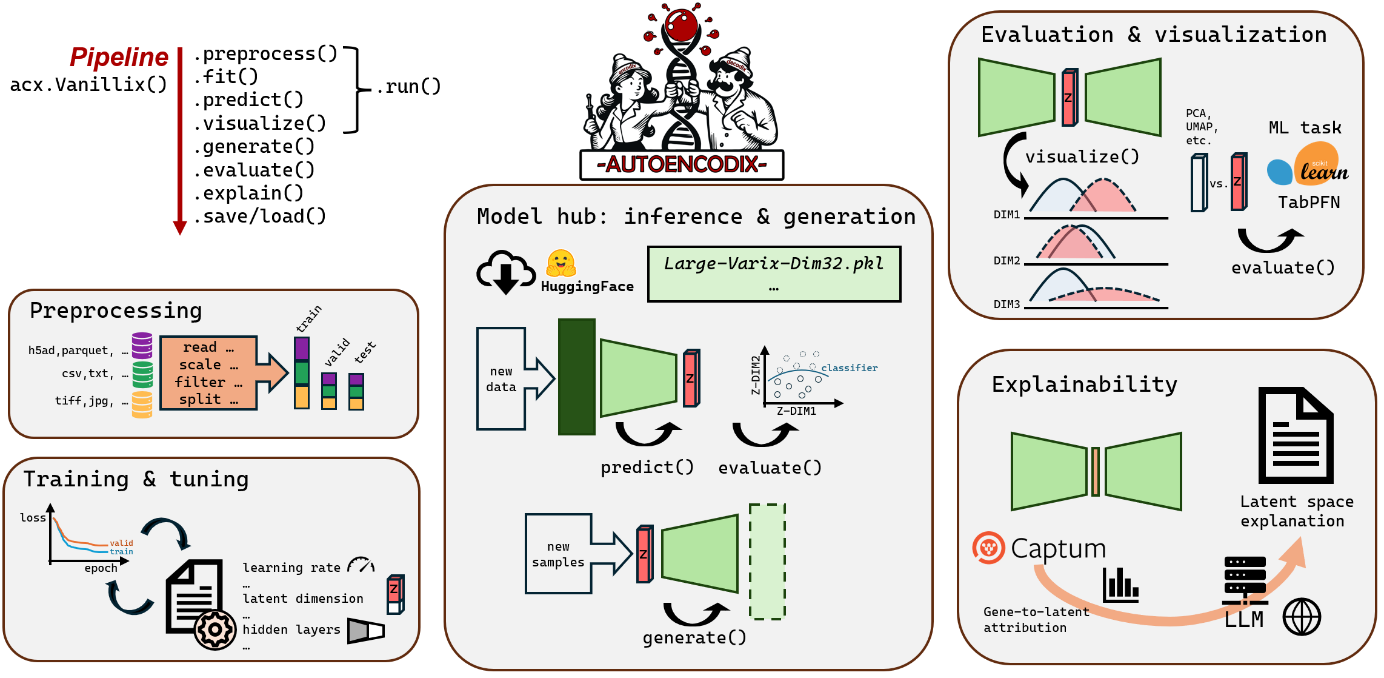
A hub for pre-trained models. AUTOENCODIX treats trained models as self-contained, shareable objects. Through its model hub, connected to Hugging Face, researchers can publish pretrained models for specific biological contexts or data types. Others can then load them to embed new data, make predictions or generate realistic synthetic samples without retraining from scratch, so models can be reused rather than rebuilt for every project.
How to get started?
We have a rich set of tutorials for all architecture, features and deep dives available for experts. If you are new to AUTOENCODIX, start with the Vanillix tutorial.
Team
Core developers
Maximilian Joas (alumni)
Jan Ewald
Contributing developers
Luca Thale-Bombien
Kristina Müller
Alicia Diem
Vincent David Friedrich
Christian Bäuchl
Jonathan Kind
Neringa Jurenaite
Project partners
Aaron Klein (ELLIS Institute Tübingen)
Nico Scherf (Max Planck Institute for Human Cognitive and Brain Sciences)
Markus Scholz (Institute for Medical Informatics, Statistics and Epidemiology, Leipzig University)
Holger Kirsten (Institute for Medical Informatics, Statistics and Epidemiology, Leipzig University)
Kristin Reiche (Fraunhofer Institute for Cell Therapy and Immunology and Interdisciplinary Transformation, University Linz)
Parvaneh Joharinad (ScaDS.AI Dresden/Leipzig and Max Planck Institute for Mathematics in the Sciences)
Links
- Source code: https://github.com/jan-forest/autoencodix_package/
- Python package: https://pypi.org/project/autoencodix/
- Documentation: https://jan-forest.github.io/autoencodix_package/
- Model hub and datasets: https://huggingface.co/autoencodix
- LivingLab demonstrator on dimension reduction and personalized medicine: https://launchpad.scads.ai/audio#Personalized_Medicine
Blog posts and News articles
- Wang, D., Zhang, Q. (2026) Decoding omics via representation learning. Nat Comput Sci 6, 17–18. https://doi.org/10.1038/s43588-025-00909-3
- Gleitsman, K. (December 2026) Interpretable Latent Spaces, Messy Biology: What AUTOENCODIX Teaches Us About Autoencoders in the Wild. https://kristinrulegleitsman.com/interpretable-latent-spaces-messy-biology-what-autoencodix-teaches-us-about-autoencoders-in-the-wild/
Directly related student theses and related PhD projects:
- Isabella Kreller: Implementation and comparison of post-hoc explainability methods for autoencoders and multi-omics data
- Christian Bäuchl: Implementation and benchmarking of three-dimensional variational autoencoders for analysis of stroke imaging
- Jonathan Kind: Explainable biomedical data modality translation with ontology-based cross-modal autoencoders
- Nicko Kornetzky: Estimation and automated adjustment loss term weights in variational autoencoders
- Ralf König: Meta hyperparameter tuning for multi-omics data integration by autoencoders
Publications and License
[New preprint soon] AUTOENCODIX: powering a hub for biological representation learning models
- Joas, M. J., Jurenaite, N., Praščević, D., Scherf, N., & Ewald, J. (2026). AUTOENCODIX: a generalized and versatile framework to train and evaluate autoencoders for biological representation learning and beyond. Nature Computational Science, 6(1), 96-108. https://doi.org/10.1038/s43588-025-00916-4
- Thale-Bombien, L., Ewald, J., König, R., & Klein, A. (2026). BBOmix: A Tabular Benchmark for Hyperparameter Optimization of Unsupervised Biological Representation Learning. AutoML 2026 ABCD Track. https://doi.org/10.48550/arXiv.2606.05139
AUTOENCODIX is open-source and licensed under the Apache License, Version 2.0 (the “License”)





Dresden
ScaDS.AI Dresden/Leipzig
Bürogebäude Strehlener Straße
Strehlener Straße 12, 14
01069 Dresden
Center for Interdisciplinary Digital Sciences (CIDS)
ScaDS.AI Dresden/Leipzig
01062 Dresden
Leipzig
Löhrs Carré
Humboldtstraße 25, Uferstr. 11
04105 Leipzig
Data Science Center ScaDS.AI Leipzig
Internes Postfach: 322001
04081 Leipzig
Quicklinks:
Copyright 2026 © SCADS.AI Dresden/Leipzig – All rights reserved.