


Knowledge-Aware AI (KAAI)
KAAI studies the knowledge inside language models and knowledge bases. We develop empirical methods and open systems that make machine knowledge measurable, structured and auditable.
Our work spans knowledge extraction and consolidation, factuality, provenance, commonsense knowledge and human-facing tools. We connect rigorous measurement with working research systems and openly available resources.
Explore our research | Meet the team | Publications
Research program
Measuring model knowledge
We develop controlled empirical methods for determining what language models know, what they merely appear to know, and how prompts, protocols and model variants affect observable answers.
Extracting and consolidating knowledge
We turn knowledge expressed in text and language models into structured resources, reconcile conflicting or redundant information, and study coverage, uncertainty and provenance.
Building knowledge-aware systems
We create open datasets, knowledge bases and interfaces that make research results inspectable and useful to researchers and practitioners.
Flagship work
Epistemic twins
Epistemic twins are a core KAAI idea: discrete, comprehensive and comprehensible models of the factual knowledge stored inside an LLM. By building epistemic twins, we enable a symbolic science of language model knowledge.
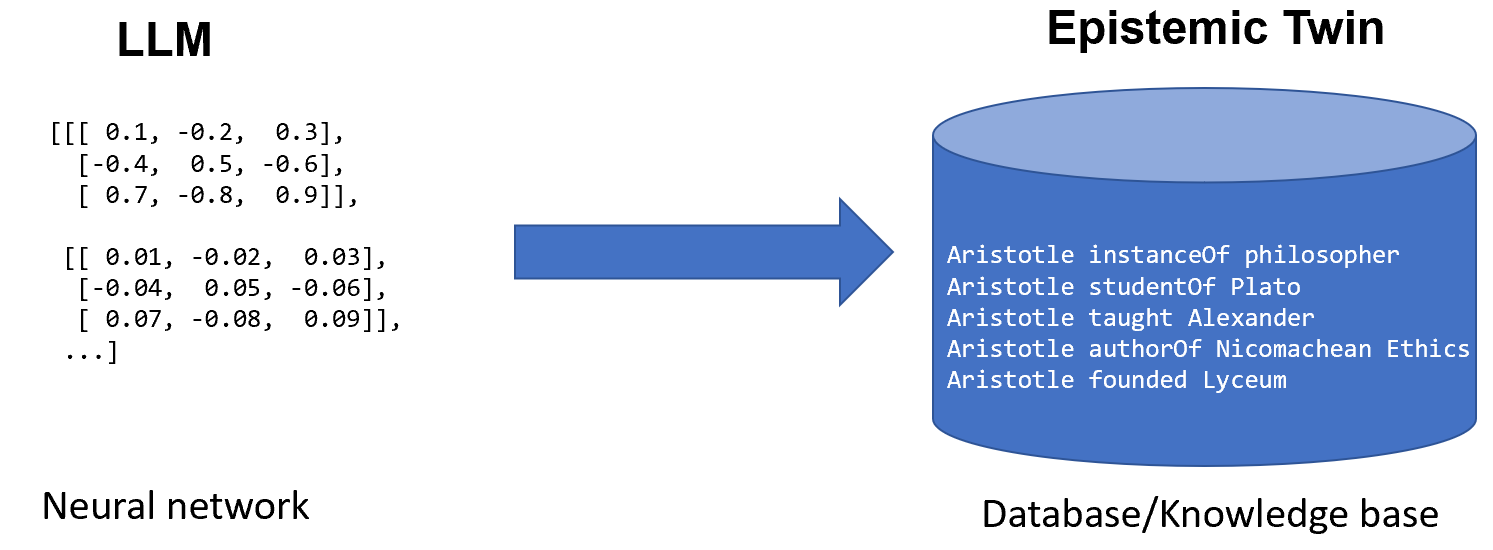
GPTKB and LLMpedia are the two flagship projects that turn this idea into public research artifacts.
GPTKB
GPTKB transforms parametric LLM knowledge into knowledge bases in triple form, providing a basis for systematic statistical analysis, querying, and comparison of LLM knowledge. The current version, GPTKB 2.0, extracts more than 38 M triples from GPT 5.1.
LLMpedia
LLMpedia transforms parametric LLM knowledge into text form, in the style of Wikipedia, providing a richer and more natural format for human readers, albeit less accessible to statistical tools. The current version, LLMpedia, builds more than 1 M articles from GPT-5-mini.
Work with us
We welcome research collaborations and enquiries from prospective doctoral researchers, students and visiting researchers. Meet the KAAI team, review our teaching, or write to kaai@tu-dresden.de.
News
- 9/2026: Our epistemic-twin paper is accepted at AKBC 2026
- 8/2026: LLMpedia is accepted as a full research paper at EMNLP
- 7/2026: New GPTKB version released: Version 2.0 implements full entity disambiguation
- 6/2026: Joint KAAI-DIG workshop with the DIG team at Télécom Paris
- 3/2026: We will co-organize the AKBC workshop at EMNLP this year
- 2/2026: We welcome Muhammed Saeed to our group
- 11/2025: Our GPTKB project won the best demo award at ISWC
- 8/2025: We will co-organize a Dagstuhl seminar on LLMs and knowledge graphs in 2026
About KAAI
KAAI is the Chair of Knowledge-Aware Artificial Intelligence at ScaDS.AI Dresden/Leipzig and TU Dresden. The chair is held by Prof. Dr. Simon Razniewski.
LinkedIn | GitHub | Hugging Face
Contact: Prof. Dr. Simon Razniewski, simon.razniewski@tu-dresden.de
Office: Strehlener Str. 12–14, Room 646B, 01069 Dresden, Germany
Secretariat: Ruth Eckardt and Angèle Héliès, kaai@tu-dresden.de, +49 (0)351 463 40900


Dresden
ScaDS.AI Dresden/Leipzig
Bürogebäude Strehlener Straße
Strehlener Straße 12, 14
01069 Dresden
Zentrum für Informationsdienste und Hochleistungsrechnen
ScaDS.AI Dresden/Leipzig
01062 Dresden
Leipzig
Löhrs Carré
Humboldtstraße 25, Uferstr. 11
04105 Leipzig
Data Science Center ScaDS.AI Leipzig
Internes Postfach: 322001
04081 Leipzig
Quicklinks:
Copyright 2026 © SCADS.AI Dresden/Leipzig – All rights reserved.