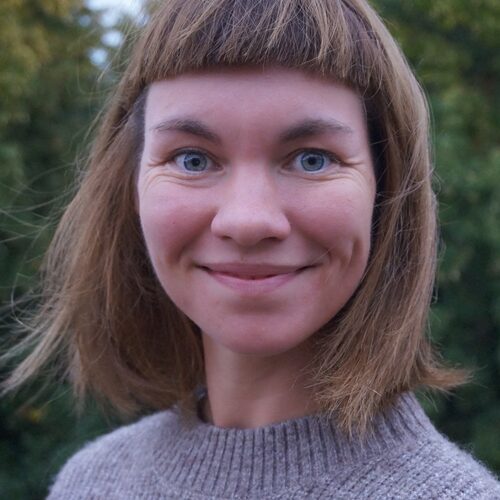


Dr. Josefine Umlauft
Josefine Umlauft holds a PhD in Geophysics and leads the Earth and Environmental Sciences group at ScaDS.AI. Her scientific background is rooted in geophysics and wave physics, with a focus on ambient seismic noise analysis, finite-difference modeling, and time-series methods.
Building on this foundation, she has led and contributed to several large field campaigns in environmental seismology, investigating Earth surface and near-surface processes through seismic observations. Today, she coordinates and advances research at the interface of Earth system science and machine learning, with a focus on integrating heterogeneous environmental data sources and developing scalable, data-driven approaches for environmental monitoring and analysis.
Research Interests
Her research focuses on understanding environmental and ecological processes through physical sensing and data-driven analysis. A central theme is environmental seismology, where acoustic and elastic signals are used to study dynamic Earth surface processes and their relevance for ecosystem and biodiversity dynamics across scales.
Methodologically, her work centers on advanced time-series analysis and machine learning, with an emphasis on denoising, prediction, explainable AI, and image segmentation and tracking. She works with a range of data sources, including seismic measurements, satellite, drone, and time-lapse imagery, and uses Earth system data cubes as a common data format to organize and analyze multimodal environmental data. A key research direction is the development of machine learning tooling that enables scalable, interpretable, and, in the long term, integrated analysis of heterogeneous Earth system datasets.
Curriculum Vitae
- since 01/2022: Team Lead "Earth and Environmental Sciences"
- 01/2020 - 04/2020: Scientific Visitor - Los Alamos National Laboratory (LANL), New Mexico, USA
- 01/2019 - 12/2021: Researcher - Leipzig University, Institute of Geophysics and Geology
- 01/2018 - 04/2018: Scientific Visitor - Institut des Sciences de la Terre (ISTerre), Grenoble, France
- 02/2015-01/2019: PhD in Geophysics - Leipzig University, Institute of Geophysics and Geology



Dresden
ScaDS.AI Dresden/Leipzig
Bürogebäude Strehlener Straße
Strehlener Straße 12, 14
01069 Dresden
Zentrum für Informationsdienste und Hochleistungsrechnen
ScaDS.AI Dresden/Leipzig
01062 Dresden
Leipzig
Löhrs Carré
Humboldtstraße 25, Uferstr. 11
04105 Leipzig
Data Science Center ScaDS.AI Leipzig
Internes Postfach: 322001
04081 Leipzig
Quicklinks:
Copyright 2026 © SCADS.AI Dresden/Leipzig – All rights reserved.