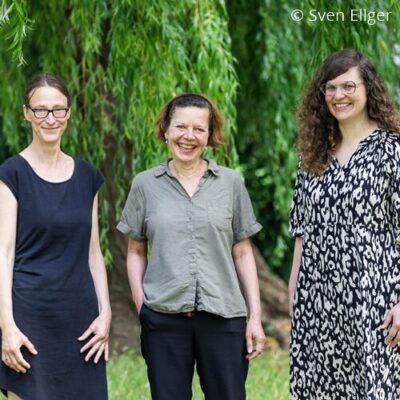

Shift your Perspective – Bias in Design and Creation of Digital Bodies, Worlds and Futures
Following on from previous colloquia, Dr. Stephanie Feilitzsch (ScaDS.AI Dresden/Leipzig) and Dr. Sandra Buchmüller (SustainING) are pleased to continue their successful collaboration with a new, versatile series of events. This time, we are offering a combination of different formats.
In addition to our established discussions of texts and current publications from various fields of social science research on technology, data, and AI, we are offering a one-day workshop that goes beyond theoretical approaches to provide practical experience with digital embodiments. The focus is on a critical examination of the problems and risks, as well as the potential and possibilities, of digital technologies and worlds. In doing so, we draw on queer-feminist, postcolonial, and socially inclusive perspectives.
We cordially invite you to join the conversation and explore new perspectives together.
Wednesday, September 30, 2026, 10:00 AM – 4:30 PM
Workshop: Magic Mirror – On the Ambivalent Aesthetics of Digital Embodiments
In public debates, data- and AI-based systems are often touted as tools for more objective predictions that, unlike humans, provide a basis for more well-founded, bias-free decisions. However, numerous studies show the opposite. They have identified various forms of bias, stereotyping, and discrimination that, when applied, generate “automated inequalities.” Furthermore, the material foundations and prerequisites for the production and use of AI, as well as its environmental impacts, are increasingly being addressed. Exploitative working conditions of so-called “clickworkers,” extensive raw material extraction, and the consumption of electricity, water, and resources.
Data- and AI-based systems do not exist in a vacuum. At various levels – from the training data, through the development teams, the testing environment, data annotation, and content moderation, all the way to the algorithms and the material and technical infrastructure – societal power dynamics, gender relations, and inequalities are embedded within them. These are reflected in the results without being noticed and can thus perpetuate and reinforce these dynamics.
We invite you to experience data- and AI-based systems through your own body image. We allow ourselves to be dazzled by digital perfection and aesthetics so that, from there, we can look behind the seductive facade and grasp the influences that shape and enable them. Starting from an understanding of humans as beings of imperfection and creativity (Arnold Gehlen), we examine their tools, embodiments, and the worlds and worlds they create, and ask:
- Whose ideas, values, and bodies are revealed in the digital space, or cyberspace?
- What kind of futures do we build using tools that rely on distorted, incomplete, and likely fragmented data from the past?
- For whom or what are these worlds made?
- Who and what kinds of bodies can live and exist within them?
- Who or what is excluded, overlooked, or driven out?
Program Overview
From 10:00 AM to 4:30 PM, a varied program awaits you, featuring an inspiring presentation and an interactive workshop. Everyone is cordially invited to register for the entire program or for individual sessions.
- 10:00 AM – 11:30 AM: Seductive Aesthetics of Ambivalent Post-Digital Worlds and Embodiments.
Keynote presentation by Dr. Sandra Buchmüller and Vanessa Kuhfs.
Location: Merkelbau, Room 118/BigBlueButton (hybrid; in-person or online participation available) - 11:30 AM – 12:30 PM: Lunch break
- 12:30 PM – 4:30 PM: Magic Mirror.
Workshop with Vanessa Kuhfs.
On site: Living Lab Dresden; Andreas-Pfitzmann-Bau, Room 1020
Please note: The workshop will take place exclusively in person. Space is limited to 10 regular spots + 5 on the waiting list.
If you are interested in a theoretical introduction and further exploration of the topic, we recommend the two texts that we read and discussed in preparation for the colloquium on August 19, 2026. However, attendance at the colloquium is not a prerequisite for participating in the workshop.
The Magic Mirror project is a collaborative feminist research project by Vanessa Kuhfs and Johannes Häfner, developed at the Burg Giebichenstein University of Art and Design in Halle and ScaDS.AI Dresden/Leipzig. If you’re looking for more information about the Magic Mirror, feel free to visit:
- https://scads.ai/magic-mirror-for-women-in-science/
- https://www.ga.uni-leipzig.de/graduiertenakademie-leipzig/workshops-und-veranstaltungen/veranstaltungsdetail/termin/magic-mirror-generative-bild-ki-koerperbilder-und-macht.
Please register at: pandu@tu-dresden.de.
Wednesday, August 19, 2026, 2:50 – 4:20 PM
- Kreislauf der Diskriminierung; Gesellschaftliche Biases und Diskriminierung in IT-Systemen als wiederkehrender Kreislauf der (Re)Produktion sozialer Ungleichheiten am Beispiel der Kategorie Geschlecht by Nicola Marsden, Kerstin Raudonat, Monika Pröbster; in Frauen machen Informatik. Magazin der GI-Fachgruppe Frauen in der Informatik (2023)
- Designing Postdigital Futures: Which Designs? Whose Futures? by Felicitas Macgilchrist, Heidrun Allert, Teresa Cerratto Pargman, Juliane Jarke; in Postdigital Science and Education (2024).
Both texts explore the question of how social structures and power relations become visible in technological contexts. The first text focuses on the reproduction of inequalities and discrimination, using gender in IT systems as an example, and also presents possibilities for design and intervention. The second text examines whose perspectives are considered in design processes and how alternative, more equitable futures can be shaped. In between, a space for discussion emerges.
Venue: Room 118, Merkelbau, Helmholtzstrasse 14, TU Dresden Campus, or online via BigBlueButton



Dresden
ScaDS.AI Dresden/Leipzig
Bürogebäude Strehlener Straße
Strehlener Straße 12, 14
01069 Dresden
Zentrum für Informationsdienste und Hochleistungsrechnen
ScaDS.AI Dresden/Leipzig
01062 Dresden
Leipzig
Löhrs Carré
Humboldtstraße 25, Uferstr. 11
04105 Leipzig
Data Science Center ScaDS.AI Leipzig
Internes Postfach: 322001
04081 Leipzig
Quicklinks:
Copyright 2026 © SCADS.AI Dresden/Leipzig – All rights reserved.