May 11, 2026
Field Research among the Trees with Dr. Josefine Umlauft
Research
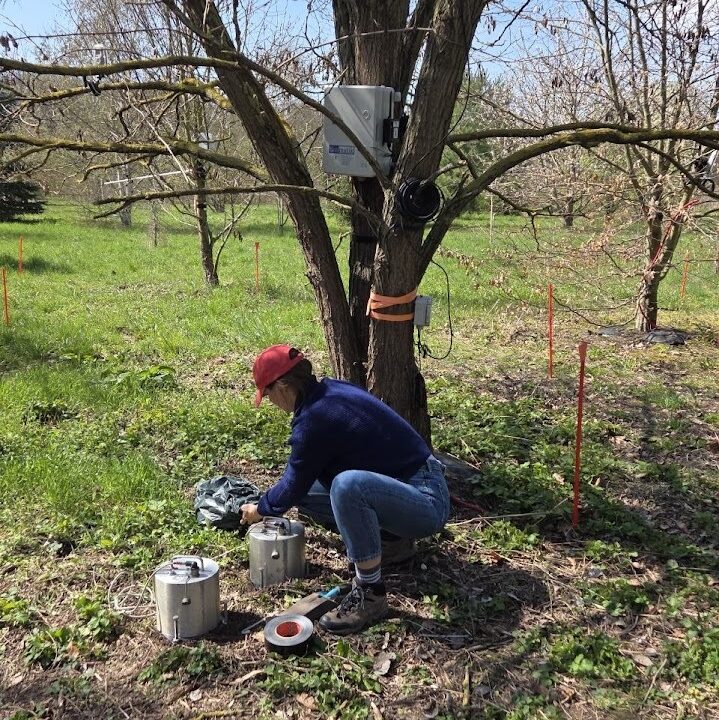
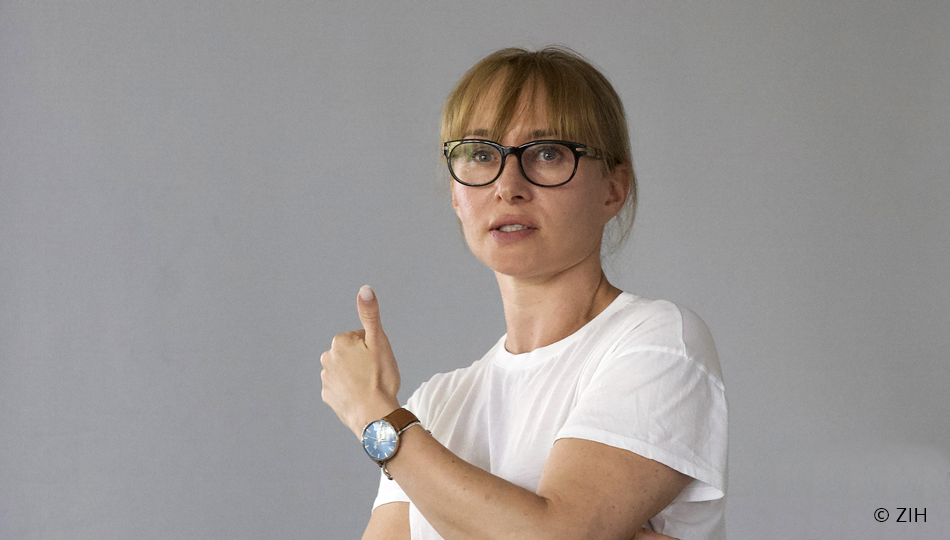
Unlike many researchers, who spend their time in laboratories or at their laptops, Dr. Josefine Umlauft takes her research out into nature. She is the team leader of the Earth and Environmental Sciences group at ScaDS.AI Dresden/Leipzig, as well as being a geophysicist. On glaciers and in forests, Josefine Umlauft conducts environmental seismology field campaigns at the intersection of Earth system sciences and machine learning, using seismic measurements to investigate processes on the Earth’s surface. Her current fieldwork conducted together with the Systematic Botany & Functional Biodiversity Working Group by Prof. Alexandra Weigelt and Prof. Christian Wirth took her to the Research Arboretum ARBOfun in Großpösna. This arboretum is a scientific platform that enables researchers to compare the characteristics of numerous tree species. There, she installed ten new ground-based seismometers on loan from GIPP Potsdam (Geophysikalischer Gerätepool Potsdam).
Research on the Impacts of Climate Change on Forests
Climate change is increasing the frequency and intensity of extreme weather events such as heatwaves, droughts and storms. This is putting forests under growing physiological and mechanical stress. Analyzing this stress using standard indicators is costly and difficult to scale up for continuous long-term monitoring of entire stands. Josefine Umlauft and her colleagues Karin Mora, Fabian Limberger, Kilian Gerberding, Christian Wirth, Christiane Werner and Teja Kattenborn are searching for new, cost-effective indicators to measure the stress on trees caused by climate change, which could potentially fill a mesoscale gap in the wide range of established instruments for forest monitoring.
The seismic fingerprint of wind-induced tree sway
To this end, she has already investigated wind-induced tree sway, serving as a first proof of concept. Using seismometers on the ground and accelerometers attached to tree trunks at the ECOSENSE site in the Black Forest, tree sway signals were recorded simultaneously and subsequently isolated and analyzed based on spectral decomposition and vibration mode tracking. It was demonstrated that seismometers can passively monitor the biomechanical response of trees. Furthermore, compared to other tree-attached devices, seismometers offer the advantages of being non-invasive and low-maintenance. Further, they have the potential to answer species-specific questions and to capture responses across forest plots.
Current Research Project in Großpösna
At the ARBOfun Research Arboretum in Großpösna, Josefine Umlauft and her colleagues aim to investigate the extent to which seismic indicators can serve as an approach for monitoring the trees’ hydrological state. In the long term, this research could contribute to new scalable and non-invasive methods for monitoring forest health and resilience under climate change.
funded by:



ScaDS.AI Dresden/Leipzig (Center for Scalable Data Analytics and Artificial Intelligence) is a center for Data Science, Artificial Intelligence and Big Data with locations in Dresden and Leipzig.


Dresden
Visitor address
Technische Universität Dresden
ScaDS.AI Dresden/Leipzig
Bürogebäude Strehlener Straße
Strehlener Straße 12, 14
01069 Dresden
ScaDS.AI Dresden/Leipzig
Bürogebäude Strehlener Straße
Strehlener Straße 12, 14
01069 Dresden
Postal address
Technische Universität Dresden
Zentrum für Informationsdienste und Hochleistungsrechnen
ScaDS.AI Dresden/Leipzig
01062 Dresden
Zentrum für Informationsdienste und Hochleistungsrechnen
ScaDS.AI Dresden/Leipzig
01062 Dresden
Leipzig
Visitor address
ScaDS.AI Dresden/Leipzig
Löhrs Carré
Humboldtstraße 25, Uferstr. 11
04105 Leipzig
Löhrs Carré
Humboldtstraße 25, Uferstr. 11
04105 Leipzig
Postal address
Universität Leipzig
Data Science Center ScaDS.AI Leipzig
Internes Postfach: 322001
04081 Leipzig
Data Science Center ScaDS.AI Leipzig
Internes Postfach: 322001
04081 Leipzig
Quicklinks:
Copyright 2026 © SCADS.AI Dresden/Leipzig – All rights reserved.