August 26, 2025
Predicting Stroke Treatment Outcomes with Deep Learning
Research
Why Stroke Treatment Needs Better Predictions
Every minute counts during a stroke. Stroke is the second leading cause of death and the third leading cause of disability worldwide. Thrombectomy, the minimally invasive removal of a blood clot from a brain vessel, has greatly improved survival and recovery. However, not every patient benefits equally. Some recover almost fully, while others face lasting disability even after treatment. Doctors under intense time pressure must quickly decide who will gain the most from thrombectomy.
An AI Approach from Leipzig and Dresden
Researchers at Leipzig University Medical Center, ScaDS.AI Dresden/Leipzig, and TUD Dresden University of Technology developed a deep learning model to support these critical decisions. The system combines multimodal CT scans with clinical data to simulate two scenarios: one in which thrombectomy succeeds and one in which it fails.
By comparing the outcomes, the AI predicts how much brain tissue could be preserved and how the patient’s neurological status, measured by the NIH Stroke Scale, is likely to change. In effect, it provides a patient-specific forecast of treatment benefit, something that current imaging methods cannot achieve.
Results from Real-World Data
The team trained the model on 405 patients who underwent thrombectomy and then tested it on independent datasets from Leipzig and Dresden. Compared with conventional methods, the AI system delivered far more accurate predictions. For tissue outcome, its Dice score reached 0.48 internally and 0.52 externally, versus 0.26–0.36 for threshold-based tools and 0.34–0.35 for a generalized linear model commonly used in hospitals.
For clinical outcomes, the AI predicted discharge NIHSS scores with median errors of 1.5 points internally and 3.0 points externally, outperforming existing machine learning approaches. Importantly, the model performed consistently across hospitals, demonstrating its potential for broader clinical use.
Impact on Patient Care
This innovation could help stroke teams move beyond population averages toward truly personalized medicine. For patients, it means more accurate treatment decisions. For healthcare systems, it allows better allocation of specialized resources.
Publication
The study, Prediction of Tissue and Clinical Thrombectomy Outcome in Acute Ischaemic Stroke Using Deep Learning, has been published in Brain (2025). Read the full article here.
Insight Cover: July 2025
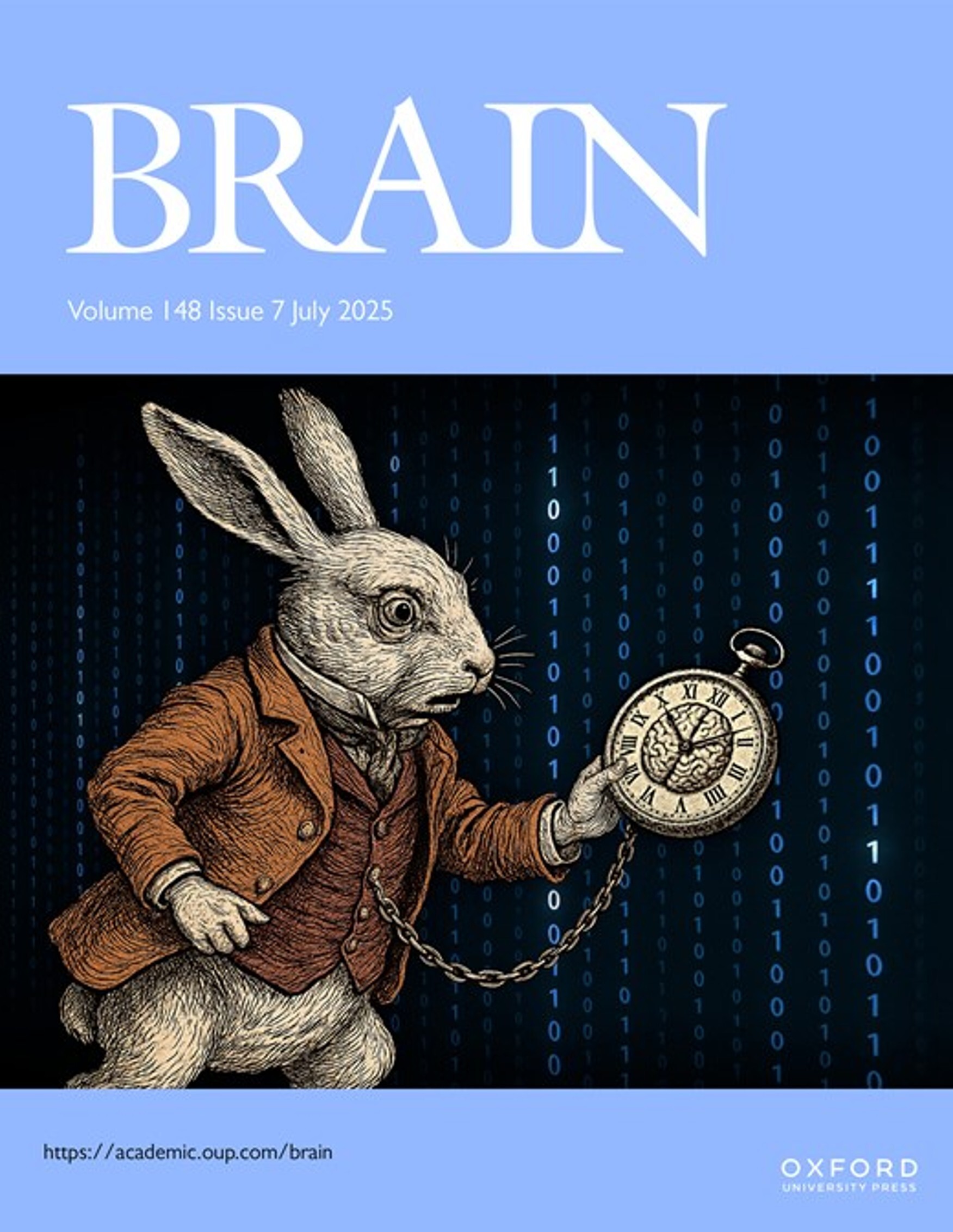
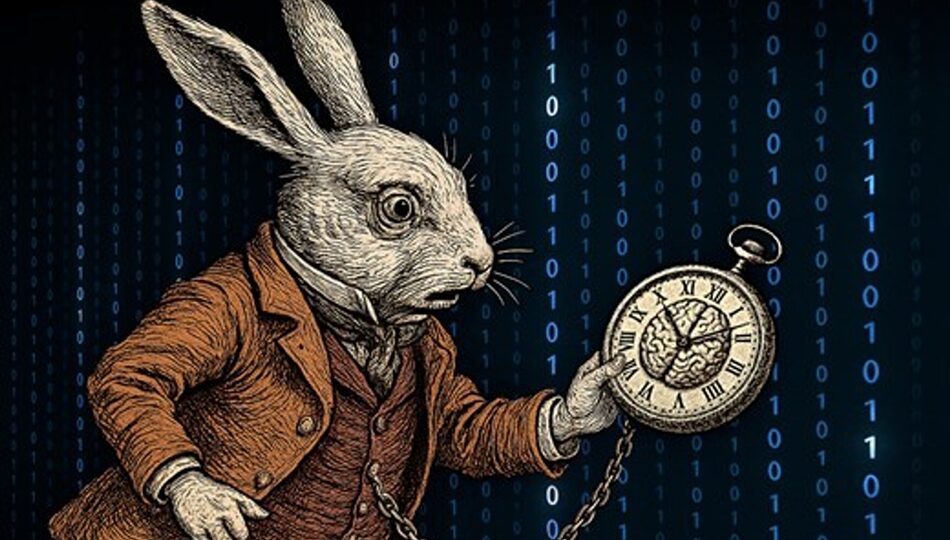
The White Rabbit from Lewis Carroll’s world – forever racing against time – captures the urgency of decision-making in acute stroke care. In this reinterpretation, his watch reflects not just time, but the brain’s fate. Thanks to new AI-based tools, fast and personalized predictions of stroke outcomes are now within reach, with the potential to guide critical treatment decisions when every second counts. Image built from OpenAI’s model DALL·E outputs, manually merged and regined. Von Braun et al., Brain. 2025; 148(7):2348-2360.
funded by:
ScaDS.AI Dresden/Leipzig (Center for Scalable Data Analytics and Artificial Intelligence) is a center for Data Science, Artificial Intelligence and Big Data with locations in Dresden and Leipzig.


Dresden
Visitor address
Technische Universität Dresden
ScaDS.AI Dresden/Leipzig
Bürogebäude Strehlener Straße
Strehlener Straße 12, 14
01069 Dresden
ScaDS.AI Dresden/Leipzig
Bürogebäude Strehlener Straße
Strehlener Straße 12, 14
01069 Dresden
Postal address
Technische Universität Dresden
Zentrum für Informationsdienste und Hochleistungsrechnen
ScaDS.AI Dresden/Leipzig
01062 Dresden
Zentrum für Informationsdienste und Hochleistungsrechnen
ScaDS.AI Dresden/Leipzig
01062 Dresden
Leipzig
Visitor address
ScaDS.AI Dresden/Leipzig
Löhrs Carré
Humboldtstraße 25, Uferstr. 11
04105 Leipzig
Löhrs Carré
Humboldtstraße 25, Uferstr. 11
04105 Leipzig
Postal address
Universität Leipzig
Data Science Center ScaDS.AI Leipzig
Internes Postfach: 322001
04081 Leipzig
Data Science Center ScaDS.AI Leipzig
Internes Postfach: 322001
04081 Leipzig
Quicklinks:
Copyright 2026 © SCADS.AI Dresden/Leipzig – All rights reserved.