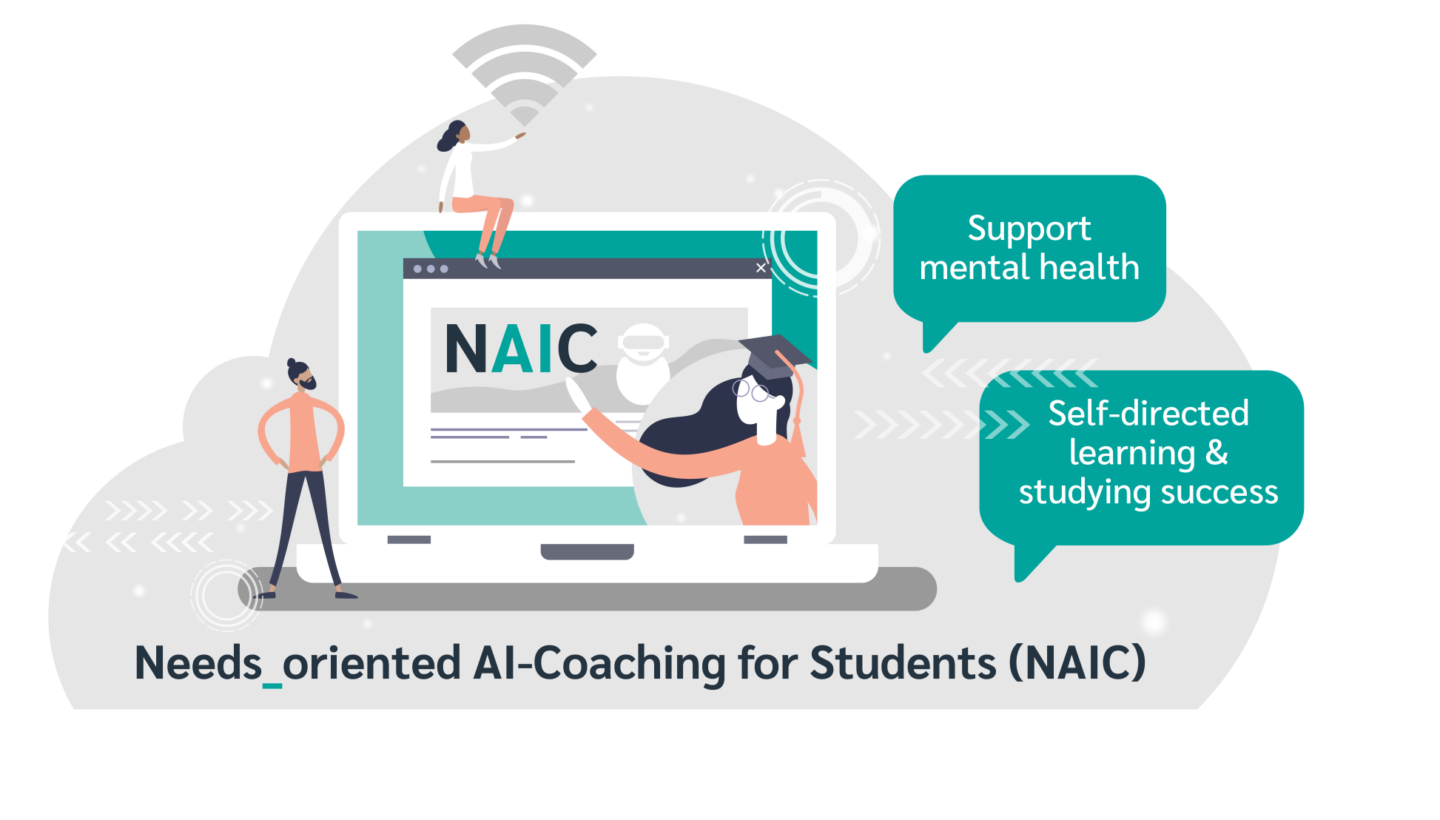
Within the junior research group Needs-oriented AI-Coaching for Students, the team is investigating the use and efficacy of AI-driven coaching methodologies in higher education. The primary focus is on exploring and developing intelligent and adaptive conversational agents to enable tailored learning journeys and personalized coaching support.
Furthermore, the group is investigating the use of AI and specifically NLP technologies for mental health support. In this new and fast-growing research field, the team is focusing on voice assistant-based interventions for mental health support of students as well as on the tracking of emotional and mental health states through conversational agents.
AI research in this research group is application-oriented, adhering to the human-centered design process and placing a strong emphasis on the diverse profiles of our target audience. This includes their sensory and cognitive (learning) abilities, as well as the scope of their individual and mental resources.
There is a widely shared consensus that AI technologies, particularly adaptive learning systems and the personalized delivery of optimized learning content, have the potential to enhance learning success. However, there is currently a lack of sound empirical studies on the use and impact of AI technologies in higher education — a gap that our research seeks to address.
In this ScaDS.AI podcast, we introduce the NICE junior research group, highlighting the research focus and previous successes of the research group in the area of the potential of AI-based communication agents for university coaches.
In this podcast series, we introduce you to each of the junior research groups and their projects. The researchers themselves talk about their work and give an insight into the future of their projects. All articles are available as audio podcasts (in German only) and as text (in English). A full playlist of all podcast episodes is available on our YouTube channel.
The junior research group leader, Dr.-Ing. Claudia Loitsch, started at ScaDS.AI Dresden in January 2023. She studied Media Computer Science at the TUD Dresden University of Technology and obtained a doctorate in engineering at TUD Dresden University of Technology on the topic of Designing Accessible User Interfaces for All by Means of Adaptive Systems. For this work, Loitsch was awarded by the 3m5 Excellence award.
Since 2010, Loitsch delved into digital accessibility, human-computer interaction, adaptive user interfaces, and the fascinating field of artificial intelligence. Her research is on Diversity-aware design – an endeavor where technology adapts itself to human abilities and needs, not the other way around. It’s not just about those with disabilities. It’s about each of us, with our ever-changing needs and skills, whether in a specific moment, environment or across a lifetime. This research lays the foundation for the design and development of adaptive AI-driven UIs that groove with the disparities in human capacities, diverse work methodologies or learning behaviors, or individual preferences and requirements in the context of digital technologies.
Her scientific achievement is centered on enhancing the field of accessible User Interface (UI) engineering by integrating user-adaptive design and knowledge-based modeling to cater to the needs of people with diverse needs, including people with disabilities. Loitsch developed an integrated semantic knowledge base for computation and automation of User Interface (UI) adaptation in the scope of eAccessibility and Usability. The core contribution of this achievement lies in addressing the heterogeneity and complexity of customization options of ICT as well as the fragmented nature of existing know-how across various user domains and target groups, while also formalizing a structured approach to extend this knowledge for effective UI adaptation and scalability to other contexts.
Dr.-Ing. Claudia Loitsch
TUD Dresden University of Technology
Center for Interdisciplinary Digital Sciences (CIDS)
Team Members
Chrakhan Barzanji
TUD Dresden University of Technology
Center for Interdisciplinary Digital Sciences (CIDS)
Sebastian Eberl
TUD Dresden University of Technology
Center for Interdisciplinary Digital Sciences (CIDS)
Niclas Rosteck
TUD Dresden University of Technology
Center for Interdisciplinary Digital Sciences (CIDS)
Sebastian Rottmann
TUD Dresden University of Technology
Center for Interdisciplinary Digital Sciences (CIDS)
Julian Striegl
TUD Dresden University of Technology
Center for Interdisciplinary Digital Sciences (CIDS)
Barzanji, C., Rosteck, N., Eberl, S., Rottmann, S., & Loitsch, C. (2026). From Interview to Persona: A Transparent Workflow for Learner-Centered Educational Technology Design. In Proceedings of Mensch und Computer 2026 (pp. 444-450). https://doi.org/10.1145/3772363.3798558
Striegl, J., Butz, N., & Loitsch, C. (2026, June). Scoping Review: Intervention Methods in Conversational Agent-Based Cognitive Behavioral Therapy. In International Conference on Human-Computer Interaction (pp. 235-260). Cham: Springer Nature Switzerland. https://doi.org/10.1007/978-3-032-29842-3_16
Barzanji, C., Rosteck, N., Eberl, S., Rottmann, S., & Loitsch, C. (2026, April). ST-Buddy: Designing and Evaluating a Course-Grounded LLM Chatbot for Academic and Administrative Support. In Proceedings of the Extended Abstracts of the 2026 CHI Conference on Human Factors in Computing Systems (pp. 1-6). https://doi.org/10.1145/3772363.3798558
Barzanji, C., Lau, A., Kuhfs, V., Rottmann, S., Rosteck, N., & Loitsch, C. (2026). Female Student Personas for Educational Chatbots. Zenodo. https://doi.org/10.5281/zenodo.22144710
Barzanji, C., Rosteck, N., Lau, A., Rottmann, S., & Loitsch, C. (2025). Expectations and Needs of Female STEM Students for Academic Chatbots. In Proceedings of the 2025 Mensch und Computer 2025 (pp. 565-570). https://doi.org/10.1145/3743049.3748564
Barzanji, C., Müller, T. T., & Loitsch, C. (2025). Designing effective feedback in educational programming assistants: Recommendations, analysis, and practical guidelines. In Mensch und Computer 2025-Workshopband. Gesellschaft für Informatik eV. https://doi.org/10.18420/muc2025-mci-wip-338
Striegl, J., Buchholz, M., Auguszt, T., & Loitsch, C. (2025, May). Conversational Agent-Based Mental Health Support for Students: Identifying Psychosocial Resources and Stressors with WUM. In International Conference on Human-Computer Interaction (pp. 268-280). Cham: Springer Nature Switzerland. https://doi.org/10.1007/978-3-031-93505-3_17
Rosteck, N., Striegl, J., & Loitsch, C. (2025, April). Bridging the treatment gap: a novel LLM-driven system for scalable initial patient assessments in mental healthcare. In Proceedings of the Extended Abstracts of the CHI Conference on Human Factors in Computing Systems (pp. 1-8). https://doi.org/10.1145/3706599.3720043
Barzanji, C., & Loitsch, C. (2025). Exploring conversational agents for novice programmers: a scoping review. Discover Artificial Intelligence, 5(1), 271. https://doi.org/10.1007/s44163-025-00521-4
Striegl J, Richter JW, Grossmann L, Bråstad B, Gotthardt M, Rück C, Wallert J, Loitsch C. (2024). Deep learning-based dimensional emotion recognition for conversational agent-based cognitive behavioral therapy. PeerJ Computer Science 10, e2104. https://doi.org/10.7717/peerj-cs.2104
Striegl, J., Rottmann, S., & Loitsch, C. (2024, July). Effectiveness and acceptance of conversational agent-based psychotherapy for depression and anxiety treatment: Methodological literature review. In Intelligent Systems Conference (pp. 188-203). Cham: Springer Nature Switzerland. https://doi.org/10.1007/978-3-031-66329-1_14
Striegl, J., Fekih, F., Weber, G., & Loitsch, C. (2024, June). Chatbot-based mood and activity journaling for resource-oriented CBT support of students. In International Conference on Human-Computer Interaction (pp. 177-188). Cham: Springer Nature Switzerland. https://doi.org/10.1007/978-3-031-61063-9_12
Guhr, O., Loitsch, C., Weber, G., & Böhme, H. J. (2024, May). Enhancing usability of voice interfaces for socially assistive robots through deep learning: A german case study. In International Conference on Human-Computer Interaction (pp. 231-249). Cham: Springer Nature Switzerland. https://doi.org/10.1007/978-3-031-60615-1_15
Loitsch, C., & Striegl, J. (2024). AI for inclusive learning in higher education: Diversity, accessibility, and mental health. Rehabilitation Technology in Transformation: A Human-Technology-Environment Perspective; Heitplatz, V., Wilkens, L., Eds, 595-612. http://dx.doi.org/10.17877/DE290R-24364
Striegl, J., Loitsch, C., & Weber, G. (2023, July). Voice Assistant-Based Cognitive Behavioral Therapy for Test Anxiety in Students. In International Conference on Human-Computer Interaction (pp. 396-406). Cham: Springer Nature Switzerland. https://doi.org/10.1007/978-3-031-35602-5_28
Striegl, J., Gotthardt, M., Loitsch, C., & Weber, G. (2022, July). Investigating the usability of voice assistant-based CBT for age-related depression. In International conference on computers helping people with special needs (pp. 432-441). Cham: Springer International Publishing. https://doi.org/10.1007/978-3-031-08648-9_50
Gotthardt, M., Striegl, J., Loitsch, C., & Weber, G. (2022, July). Voice assistant-based CBT for depression in students: effects of empathy-driven dialog management. In International conference on computers helping people with special needs (pp. 451-461). Cham: Springer International Publishing. https://doi.org/10.1007/978-3-031-08648-9_52
funded by:
ScaDS.AI Dresden/Leipzig (Center for Scalable Data Analytics and Artificial Intelligence) is a center for Data Science, Artificial Intelligence and Big Data with locations in Dresden and Leipzig.
Dresden
Visitor addressTechnische Universität Dresden
ScaDS.AI Dresden/Leipzig
Bürogebäude Strehlener Straße
Strehlener Straße 12, 14
01069 Dresden
Postal addressTechnische Universität Dresden
Zentrum für Informationsdienste und Hochleistungsrechnen
ScaDS.AI Dresden/Leipzig
01062 Dresden