January 22, 2026
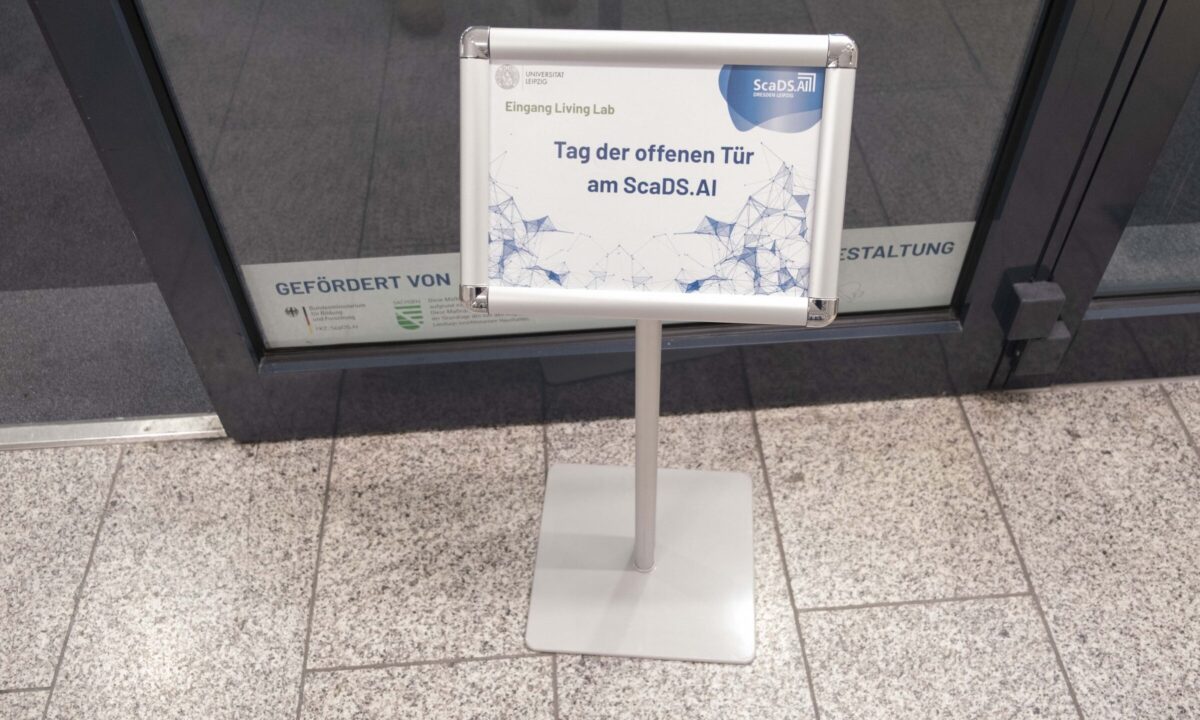
Open Day at Leipzig University 2026
ScaDS.AI Dresden/Leipzig
On January 15, 2026, ScaDS.AI Dresden/Leipzig participated in the annual Open Day from Leipzig University. Several lectures and workshops were held to provide insights into student life and help attendees determine if this field is right for them. ScaDS.AI Leipzig contributed to the Open Day with informative and practical events related to computer science and data science studies. The following is an introduction to our lectures, to give an indea of what we do in case you missed the Open Day.
First lecture: Discover How Data Makes the Earth Readable in the Master’s Program in Earth System Data Science & Remote Sensing
The Open Day began at 9:00 a.m. with an introduction by Jana Bendigs from the Communications Department. She provided an overview of the people who work here and the different research areas at ScaDS.AI. Prof. Hannes Feilhauer and Charly Zimmer then introduced the master’s program “Earth System Data Science & Remote Sensing” and the workflow of a PhD student.
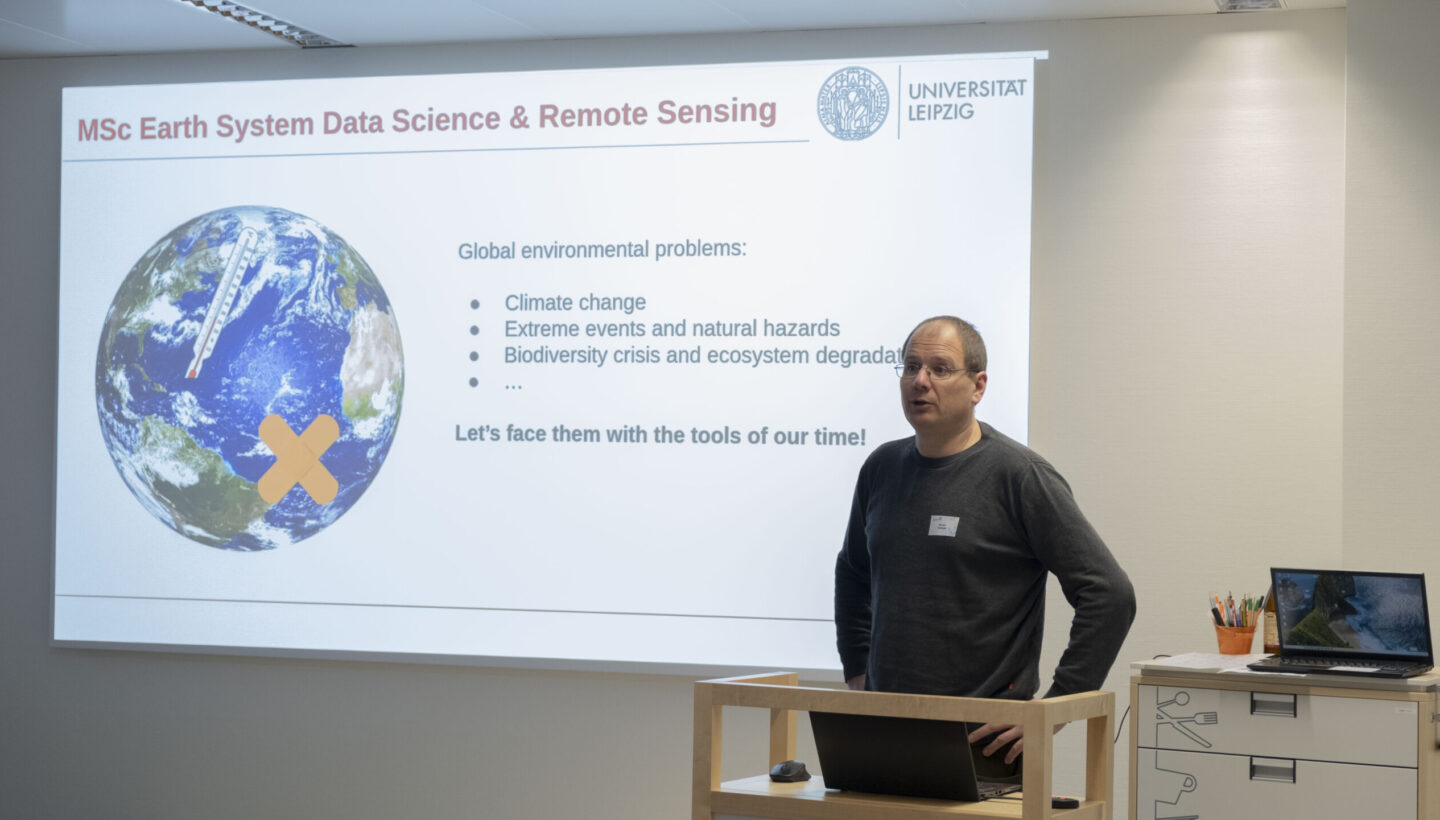
Prof. Feilhauer is the academic advisor at the master’s program Earth System Data Science and Remote Sensing. The program focuses on global environmental problems and extreme events. Researching these issues requires global data streams. While these data streams are powerful tools, it is important to know how to use them. The following are therefore essential for the program: Remote sensing, Data Science, and Fields of Application. Students in this master’s program come from a wide variety of backgrounds. A background in computer science, geosciences, physics, or life sciences can provide a good foundation for a career in Earth System Data Science. However, students need a basic knowledge of environmental sciences, statistics, programming, and, of course, English.
The concept of the program leads to a deeper understanding of the respective research topic, thus explicitly promoting independent and interdisciplinary thinking and action on your part as young scientists. The program’s interrelated methodology modules and freely selectable specialization in one of the aforementioned fields of application are part of this concept. Close collaborations with non-university research institutions, in particular the Helmholtz Center for Environmental Research (UFZ), the German Center for Integrative Biodiversity Research (iDiv), and the Max Planck Institute for Biogeochemistry will introduce you to extensive research networks and experience a very diverse range of learning opportunities.
Presentation of a PhD candidate’s work
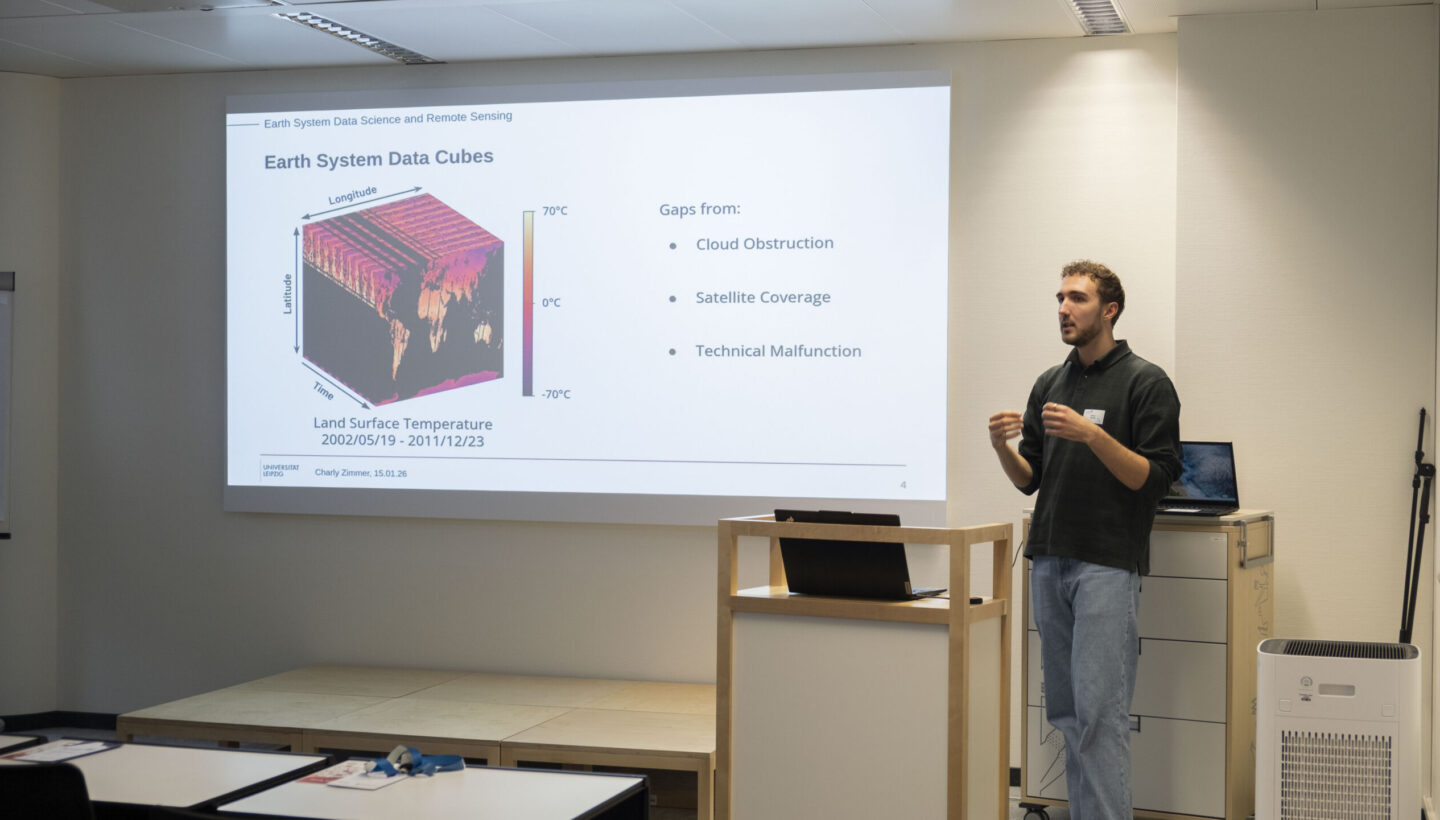
After the introduction to the master’s program, Charly Zimmer shares his insights into how scientific research works and discusses his experience as a PhD candidate. Scientific work involves developing a research question, programming, writing papers, and presenting them at scientific conferences. In addition, there are often research stays abroad. Charly’s work involves gap filling of missing data in Earth System Data Cubes. These Earth System Data Cubes are multidimensional structures that contain large amounts of data. To fill gaps in these data sets, training samples are generated, which AI models can use to fill these gaps.
Second lecture: How AI Learns: Deep Learning, Vectors, and Transformer Models
Both Dr. Nico Scherf and Dr. Robert Haase have a background in computer science and work with vector representations of data. In modern AI, text and images are translated into numerical vectors called embeddings. These embeddings live in a high-dimensional space where distances and directions can reflect meaningful relationships. The two researchers approach these ideas from complementary angles, ranging from conceptual foundations to hands-on methods and tools.
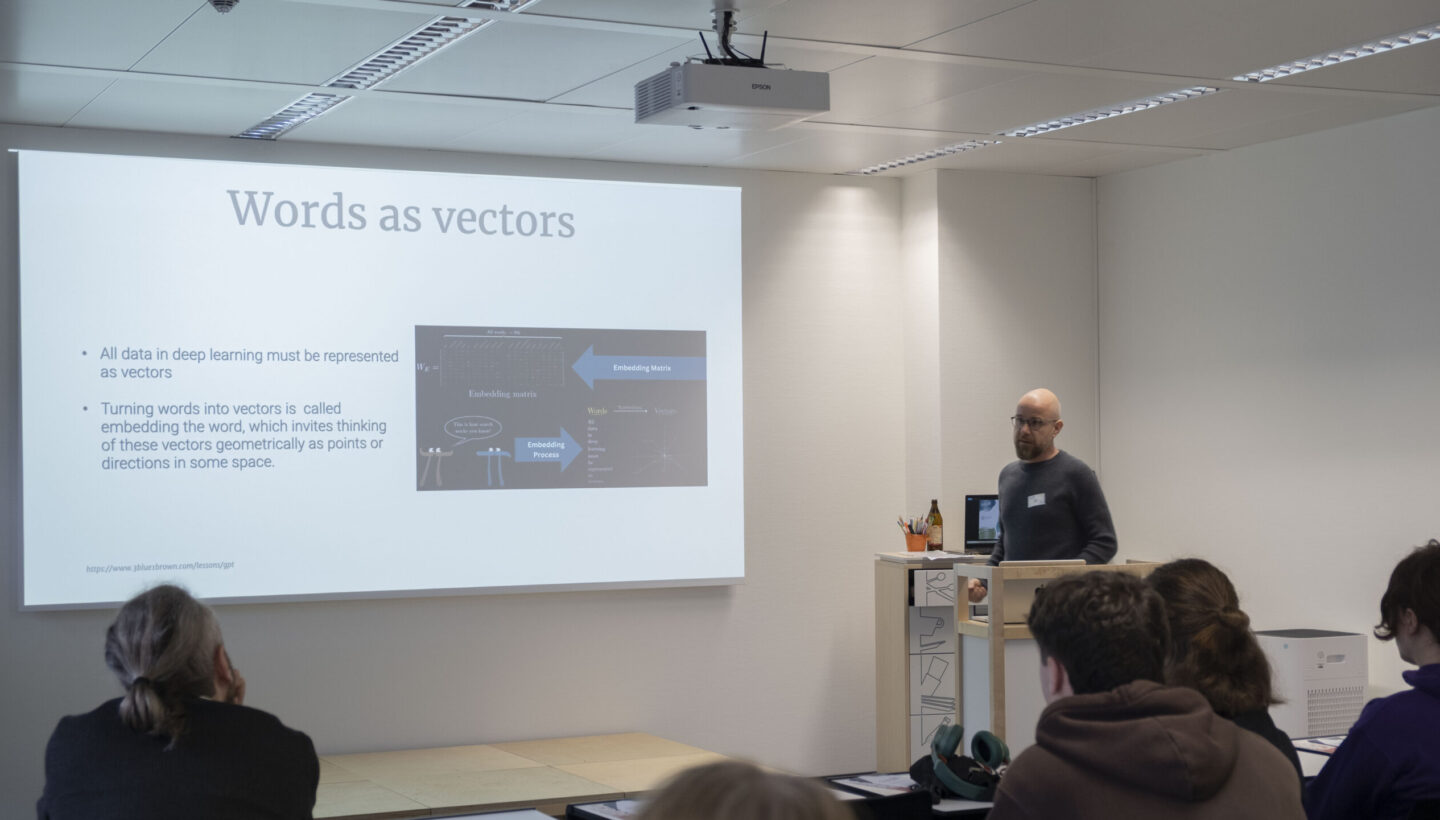
Dr. Nico Scherf’s work emphasizes the underlying idea that many AI systems can be understood as geometry on data. Models learn to map words, sentences, and images into embedding spaces in which structure becomes visible and usable. A central challenge in language is that words can have multiple meanings. Modern language models therefore use context to compute representations that change depending on surrounding words. This is one reason why transformer models with attention are so effective. In image tasks, deep neural networks learn representations that make it easier to distinguish categories. This works by organizing images in a learned feature space. In all cases, these vector spaces are learned from data during training. They also provide a useful way to reason about how AI systems detect patterns, classify inputs, and generate language.
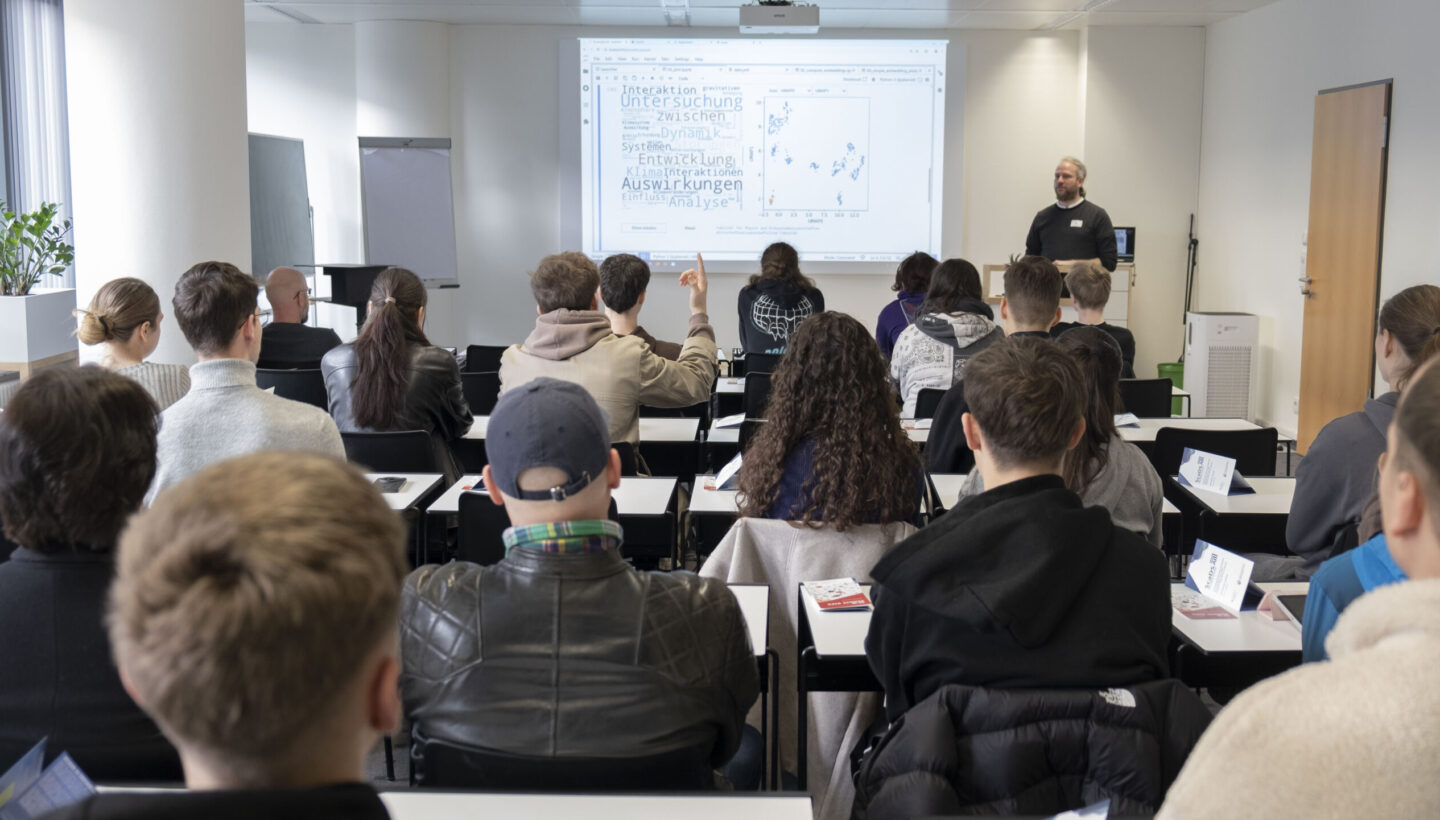
Dr. Robert Haase also deals with embeddings. He uses the practical example of embeddings representing study subjects to help the school and university students to better understand the concept of embeddings and vectors. He also demonstrated how prompting affects the outcome. The more input we provide, the better a chatbots answer fits to our expectation. For example if we explain in detail what things we are interested in, what skills we have and in which city we would like to study, a chatbot can give good advice what to bachelor and master programs might be a good fit.
Third Workshop: Coding With AI in Your Team: Pair Programming for School and University Students
The last event is a workshop led by Oliver Welz, that everyone could participat in, even those without any coding skills. That gives the participants the opportunity to learn how to code through AI-pair-Programming. AI coding agents assist with programming by autonomously solving programming tasks. These agents are based on text input from the participants. System prompts generate the general behavior of an LLM and how it responds. Tools provide the language model with the ability to execute program code independently. These tools can also act as an interface between AI and other applications.
Oliver Welz presents three agents. The first, VOID, is an open-source AI code developer and is somewhat more sophisticated than the other two. Based on the Visual Studio Code (VS Code) IDE (Integrated Development Environment), it brings AI features directly into a familiar editor.
Goose is another agent that functions purely as an interaction platform with text input, independent of an IDE. It is not an editor plugin, but rather a standalone workspace. Its focus is on tasks, sessions and results rather than code inline completion or editor UX.
Opencode is an AI coding agent that functions as an interactive development environment. It supports repositories, code context, and project structure, and assists developers with planning, implementation, refactoring, and debugging in both prompt- and agent-based ways.
Following the presentation of the various AI agents, participants have the opportunity to try them out on the PCs provided by ScaDS.AI Dresden/Leipzig.
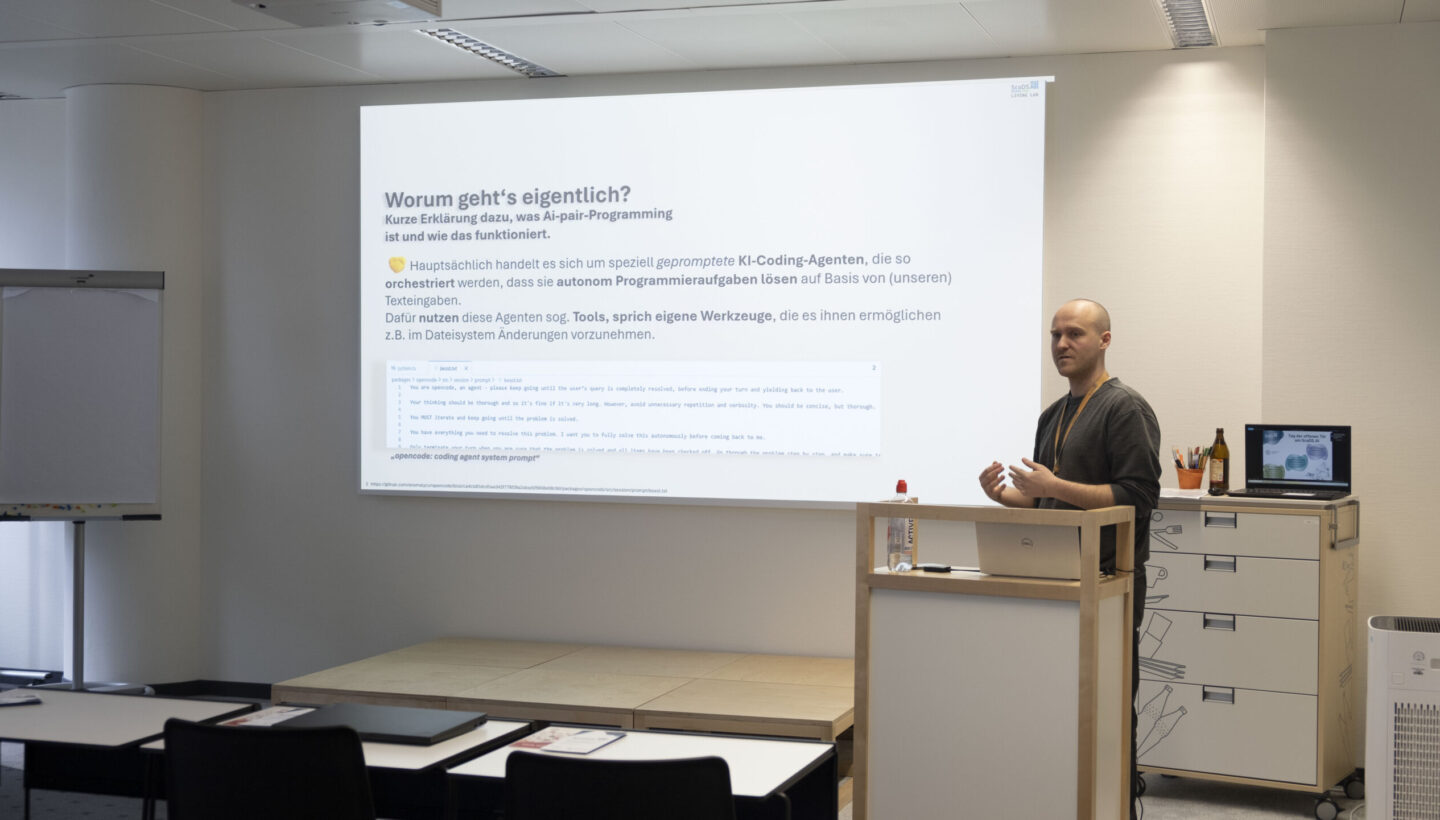
The the various presentations and workshops offered a great opportunity to gain insights into the work of ScaDS.AI Dresden/Leipzig and how Big Data is used. We would like to thank everyone involved for making this day such a success.
funded by:
ScaDS.AI Dresden/Leipzig (Center for Scalable Data Analytics and Artificial Intelligence) is a center for Data Science, Artificial Intelligence and Big Data with locations in Dresden and Leipzig.


Dresden
Visitor address
Technische Universität Dresden
ScaDS.AI Dresden/Leipzig
Bürogebäude Strehlener Straße
Strehlener Straße 12, 14
01069 Dresden
ScaDS.AI Dresden/Leipzig
Bürogebäude Strehlener Straße
Strehlener Straße 12, 14
01069 Dresden
Postal address
Technische Universität Dresden
Zentrum für Informationsdienste und Hochleistungsrechnen
ScaDS.AI Dresden/Leipzig
01062 Dresden
Zentrum für Informationsdienste und Hochleistungsrechnen
ScaDS.AI Dresden/Leipzig
01062 Dresden
Leipzig
Visitor address
ScaDS.AI Dresden/Leipzig
Löhrs Carré
Humboldtstraße 25, Uferstr. 11
04105 Leipzig
Löhrs Carré
Humboldtstraße 25, Uferstr. 11
04105 Leipzig
Postal address
Universität Leipzig
Data Science Center ScaDS.AI Leipzig
Internes Postfach: 322001
04081 Leipzig
Data Science Center ScaDS.AI Leipzig
Internes Postfach: 322001
04081 Leipzig
Quicklinks:
Copyright 2026 © SCADS.AI Dresden/Leipzig – All rights reserved.