July 14, 2026
SemRepo: Knowledge Graph for Research Software
ScaDS.AI Dresden/Leipzig
Modern scientific research increasingly depends on software. In fields such as artificial intelligence, computational biology, and physics, scientific discoveries no longer appear in publications alone. They also live in GitHub repositories, model implementations, datasets, and computational workflows. Publications explain what researchers discovered, while software shows how they put these ideas into practice. Yet connecting these two worlds remains surprisingly difficult.
The modern research ecosystem spans several specialized infrastructures. Bibliographic databases describe publications, authors, and citations, while software platforms capture repositories, contributors, development history, and dependencies. Other systems maintain datasets, benchmarks, and experiments. Each resource is valuable on its own, but they largely exist in isolation. As a result, studying research software within its broader scientific context remains difficult.
This raises a simple but important question:
How can we systematically connect scientific ideas with their software implementations?
Answering this question also helps us ask other important questions. Which publications result in software that is still actively maintained? Which research communities build sustainable software ecosystems? Which institutions contribute most to open research software? And how do scientific methods spread through software?
SemRepo provides this missing semantic layer.
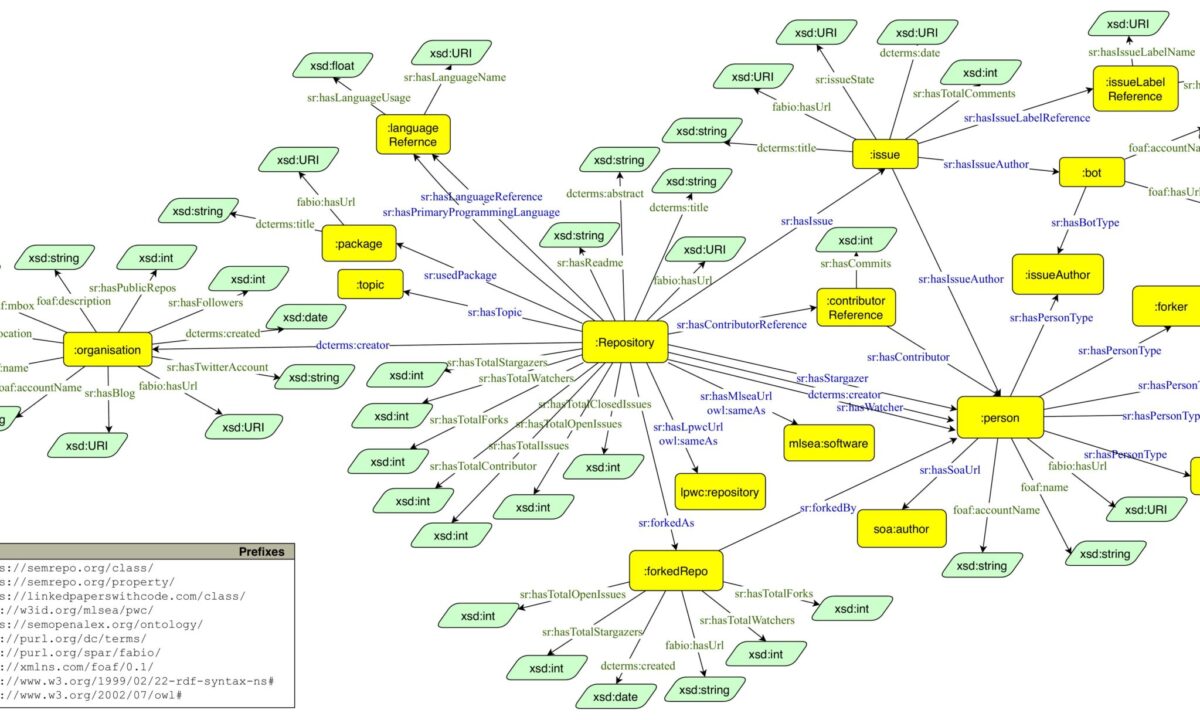
SemRepo is a large-scale RDF knowledge graph with more than 81 million RDF triples. It describes nearly 200,000 research-related GitHub repositories and captures metadata such as programming languages, contributors, issues, dependencies, and development activity. It also links repositories to publications, researchers, institutions, datasets, and experiments. The result is a unified knowledge graph for exploring research software in its full scholarly context.
From Publications to Software
Scientific knowledge does not end with a publication. Papers often evolve into software that researchers maintain, extend, and reuse around the world. Understanding this lifecycle is essential for understanding modern computational science.
Through semantic links, SemRepo reconstructs provenance chains that connect publications, repositories, researchers, and institutions. These links make it possible to trace influential publications to their software implementations and identify the people and organizations behind them.
This broadens our understanding of scientific impact. Today, a researcher’s contribution appears not only in publications and citations, but also in maintained software, reusable tools, and shared research infrastructure.
Different Research Fields, Different Software Cultures
Research software reflects the culture of scientific communities. Machine learning, for example, relies heavily on Python ecosystems that support rapid experimentation, notebooks, and deep learning frameworks. Performance-critical domains depend much more on technologies such as C++ and CUDA, where efficiency matters most. Other research areas show similarly characteristic technology stacks.
SemRepo makes these implementation cultures visible and enables systematic analysis across scientific disciplines.
Measuring Software Sustainability
Publishing source code does not automatically make research reproducible. Repositories become difficult to reuse when development stops, dependencies become outdated, or maintenance declines. SemRepo enables large-scale analyses of software sustainability by combining indicators such as commits, contributors, issue resolution, stars, and forks.
An analysis of 20,000 publication-linked repositories reveals substantial differences in software sustainability. Many repositories receive little long-term maintenance, and a surprisingly large fraction shows a high reproducibility risk. Popularity and maintenance quality correlate only weakly, which means that highly starred repositories are not necessarily well maintained.
This highlights an important insight:
Scientific software can be influential without being sustainable.
Understanding this distinction is essential for improving reproducibility, research infrastructure, and long-term software preservation.
A Joint Research Effort
SemRepo was developed at TU Dresden and ScaDS.AI Dresden/Leipzig. Abdul Rafay led the project under the supervision of Michael Färber. Yuni Susanti from FIZ Karlsruhe and David Lamprecht from metaphacts GmbH contributed to the work.
The project forms part of our broader research on scholarly knowledge graphs, research software analytics, and AI for Science. Our goal is to make publications, software, datasets, researchers, and other research artifacts more transparent, connected, and reusable.
Learn more
The full publication and dataset are available via Zenodo and the project website or GitHub.


funded by:


ScaDS.AI Dresden/Leipzig (Center for Scalable Data Analytics and Artificial Intelligence) is a center for Data Science, Artificial Intelligence and Big Data with locations in Dresden and Leipzig.


Dresden
Visitor address
Technische Universität Dresden
ScaDS.AI Dresden/Leipzig
Bürogebäude Strehlener Straße
Strehlener Straße 12, 14
01069 Dresden
ScaDS.AI Dresden/Leipzig
Bürogebäude Strehlener Straße
Strehlener Straße 12, 14
01069 Dresden
Postal address
Technische Universität Dresden
Zentrum für Informationsdienste und Hochleistungsrechnen
ScaDS.AI Dresden/Leipzig
01062 Dresden
Zentrum für Informationsdienste und Hochleistungsrechnen
ScaDS.AI Dresden/Leipzig
01062 Dresden
Leipzig
Visitor address
ScaDS.AI Dresden/Leipzig
Löhrs Carré
Humboldtstraße 25, Uferstr. 11
04105 Leipzig
Löhrs Carré
Humboldtstraße 25, Uferstr. 11
04105 Leipzig
Postal address
Universität Leipzig
Data Science Center ScaDS.AI Leipzig
Internes Postfach: 322001
04081 Leipzig
Data Science Center ScaDS.AI Leipzig
Internes Postfach: 322001
04081 Leipzig
Quicklinks:
Copyright 2026 © SCADS.AI Dresden/Leipzig – All rights reserved.