July 16, 2026
ACL 2026: Outstanding Paper Award for Zhan Qu and Michael Färber
Research
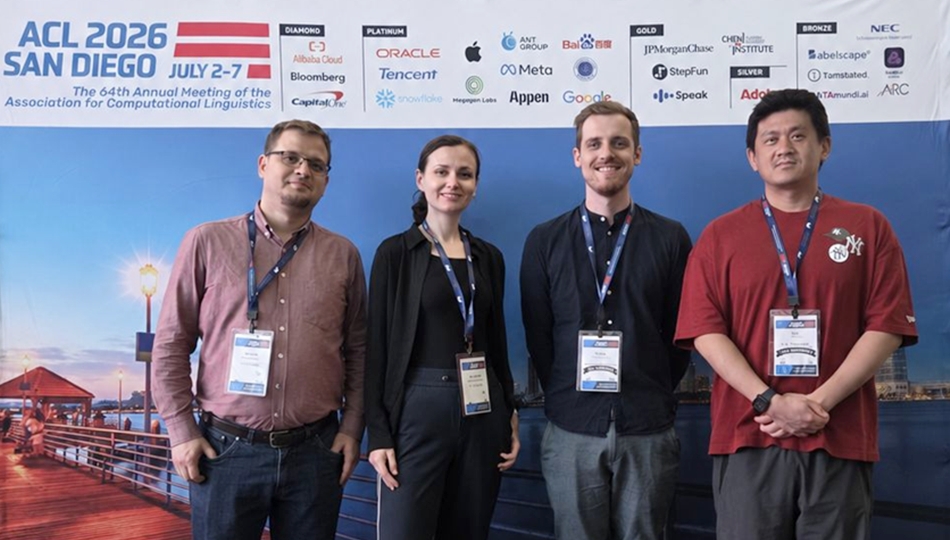
From July 2–7, 2026, the 64th Annual Meeting of the Association for Computational Linguistics (ACL 2026) took place in San Diego, California. ScaDS.AI Dresden/Leipzig contributed four papers to the conference. Zhan Qu and Prof. Michael Färber received an Outstanding Paper Award at the conference. We congratulate all contributing authors!
Contributions
MediEval: A Unified Medical Benchmark for Patient-Contextual and Knowledge-Grounded Reasoning in LLMs
Knowing a medical fact is not the same as applying it correctly in a real-world medical scenario. As large language models are increasingly being explored for clinical decision support, this distinction becomes increasingly important. In clinical care, a decision must be medically correct and appropriate for the individual patient. A treatment may be valid in general but unsafe or unsuitable for someone with a particular medical condition. At the same time, diseases, medications, and procedures may all appear in the same long, noisy patient record without forming a genuine clinical relationship. This makes reliable clinical reasoning a fundamental challenge for language models.
To examine whether language models can reason reliably from such noisy clinical data while maintaining medical correctness, Zhan Qu and Michael Färber developed MediEval. The benchmark evaluates medical knowledge and patient specific evidence within a unified framework.
The results reveal safety critical reasoning errors that conventional benchmarks can easily overlook.
- Models may claim that a patient’s record supports a medical statement when it does not (Hallucinated Support Error)
- Models may treat a false clinical relationship as correct simply because the relevant concepts appear together in the patient’s record (Truth Inversion Error)
MediEval highlights why trustworthy medical AI must reason correctly about both medical knowledge and patient specific medical records.
Large Language Models (LLMs) are increasingly applied to medicine, yet their adoption is limited by concerns over reliability and safety. Existing evaluations either test factual medical knowledge in isolation or assess patient-level reasoning without verifying correctness, leaving a critical gap. We introduce MediEval, a benchmark that links MIMIC-IV electronic health records (EHRs) to a unified knowledge base built from UMLS and other biomedical vocabularies. MediEval generates diverse factual and counterfactual medical statements within real patient contexts, enabling systematic evaluation across a 4-quadrant framework that jointly considers knowledge grounding and contextual consistency. Using this framework, we identify critical failure modes, including hallucinated support and truth inversion, that current proprietary, open-source, and domain-specific LLMs frequently exhibit. To address these risks, we propose Counterfactual Risk-Aware Fine-tuning (CoRFu), a DPO-based method with an asymmetric penalty targeting unsafe confusions. CoRFu improves by +16.4 macro-F1 points over the base model and eliminates truth inversion errors, demonstrating both higher accuracy and substantially greater safety.
Zhan Qu and Michael Färber. 2026. MediEval: A Unified Medical Benchmark for Patient-Contextual and Knowledge-Grounded Reasoning in LLMs. In Proceedings of the 64th Annual Meeting of the Association for Computational Linguistics (Volume 1: Long Papers), pages 16150–16164, San Diego, California, United States. Association for Computational Linguistics.
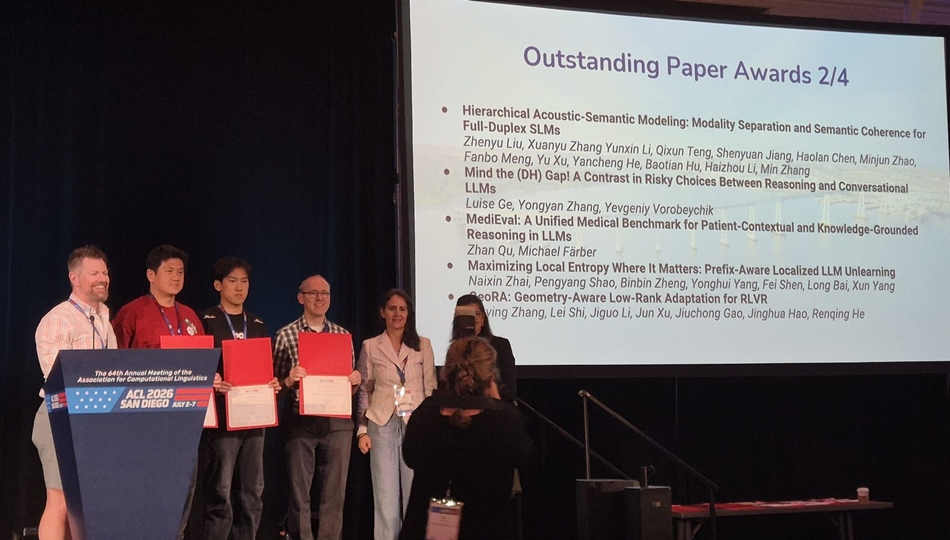
The paper MediEval: A Unified Medical Benchmark for Patient-Contextual and Knowledge-Grounded Reasoning in LLM has been awarded with the Outstanding Paper Award. Zhan Qu accepted the award at the conference. An overview of all awarded papers of ACL 2026 is available here.
Attribution, Citation, and Quotation: A Survey of Evidence-based Text Generation with Large Language Models
How can we tell whether information generated by large language models is actually supported by evidence? Tobias Schreieder, Tim Schopf and Michael Färber analyse 134 research papers to examine how large language models use attribution, citations and quotations to make their responses more traceable and verifiable. The survey organizes existing approaches, compares evaluation methods, and highlights directions for future research.
The increasing adoption of large language models (LLMs) has raised serious concerns about their reliability and trustworthiness. As a result, a growing body of research focuses on evidence-based text generation with LLMs, aiming to link model outputs to supporting evidence to ensure traceability and verifiability. However, the field is fragmented due to inconsistent terminology, isolated evaluation practices, and a lack of unified benchmarks. To bridge this gap, we systematically analyze 134 papers, introduce a unified taxonomy of evidence-based text generation with LLMs, and investigate 300 evaluation metrics across seven key dimensions. Thereby, we focus on approaches that use citations, attribution, or quotations for evidence-based text generation. Building on this, we examine the distinctive characteristics and representative methods in the field. Finally, we highlight open challenges and outline promising directions for future work.
Tobias Schreieder, Tim Schopf, and Michael Färber. 2026. Attribution, Citation, and Quotation: A Survey of Evidence-based Text Generation with Large Language Models. In Proceedings of the 64th Annual Meeting of the Association for Computational Linguistics (Volume 1: Long Papers), pages 30956–31000, San Diego, California, United States. Association for Computational Linguistics.
Quantifying the Impact of Translation Errors on Multilingual LLM Evaluation
European initiatives are working on open, trustworthy and multilingual language models to strengthen Europe’s digital sovereignty. To ensure that such models can be reliably developed and compared, meaningful evaluations across many languages are required. However, many of the benchmarks used for this purpose are machine-translated. Even a single translation error can alter what a question actually measures. Klaudia-Doris Thellmann, Bernhard Stadler, Michael Färber and Jens Lehmann investigate the extent to which such errors distort the evaluation of multilingual language models.
Machine-translated benchmarks are widely used to assess the multilingual capabilities of large language models (LLMs), yet translation errors in these benchmarks remain underexplored, raising concerns about the reliability and comparability of multilingual evaluation. We address two practical gaps: (i) how well automatic MQM-style error spans from LLM judges and a span-aware QE baseline (xCOMET-XXL) match expert human span annotations on benchmark translations, and (ii) how strongly translation errors (as opposed to source-side issues in the English original) explain accuracy drops on translated benchmarks. We find that span agreement is non-trivial on naturally occurring benchmark translations, and that target-side translation errors are consistently associated with measurable, percentage-point drops in translated accuracy even after controlling for English correctness and source-side anomalies.
Klaudia Thellmann, Bernhard Stadler, Michael Färber, and Jens Lehmann. 2026. Quantifying the Impact of Translation Errors on Multilingual LLM Evaluation. In Proceedings of the 64th Annual Meeting of the Association for Computational Linguistics (Volume 1: Long Papers), pages 41311–41334, San Diego, California, United States. Association for Computational Linguistics.
Tracing Relational Knowledge Recall in Large Language Models
Large language models can represent relationships between people, places or other entities. However, it is not yet fully understood how this knowledge is accessed internally during text generation. Nicholas Popovič and Michael Färber investigate which internal representations capture such relationships particularly well and which characteristics influence how reliably they can be recognised.
We study how large language models recall relational knowledge during text generation, with a focus on identifying latent representations suitable for relation classification via linear probes.Prior work shows how attention heads and MLPs interact to resolve subject, predicate, and object, but it remains unclear which representations support faithful linear relation classification and why some relation types are easier to capture linearly than others.We systematically evaluate different latent representations derived from attention head and MLP contributions, showing that per-head attention contributions to the residual stream are comparatively strong features for linear relation classification. Feature attribution analyses of the trained probes, as well as characteristics of the different relation types, reveal clear correlations between probe accuracy and relation specificity, entity connectedness, and how distributed the signal on which the probe relies is across attention heads.Finally, we show how token-level feature attribution of probe predictions can be used to reveal probe behavior in further detail.
Nicholas Popovič and Michael Färber. 2026. Tracing Relational Knowledge Recall in Large Language Models. In Findings of the Association for Computational Linguistics: ACL 2026, pages 43490–43509, San Diego, California, United States. Association for Computational Linguistics.
ACL 2026
The 64th Annual Meeting of the Association for Computational Linguistics is an A*-ranked flagship conference. Its thematic focus is research on AI and natural language processing (NLP). ACL 2026 reported 12,148 unique submissions with an acceptance rate of 18,9% at the main conference. Learn more about the conference on its official website.
funded by:

ScaDS.AI Dresden/Leipzig (Center for Scalable Data Analytics and Artificial Intelligence) is a center for Data Science, Artificial Intelligence and Big Data with locations in Dresden and Leipzig.


Dresden
Visitor address
Technische Universität Dresden
ScaDS.AI Dresden/Leipzig
Bürogebäude Strehlener Straße
Strehlener Straße 12, 14
01069 Dresden
ScaDS.AI Dresden/Leipzig
Bürogebäude Strehlener Straße
Strehlener Straße 12, 14
01069 Dresden
Postal address
Technische Universität Dresden
Zentrum für Informationsdienste und Hochleistungsrechnen
ScaDS.AI Dresden/Leipzig
01062 Dresden
Zentrum für Informationsdienste und Hochleistungsrechnen
ScaDS.AI Dresden/Leipzig
01062 Dresden
Leipzig
Visitor address
ScaDS.AI Dresden/Leipzig
Löhrs Carré
Humboldtstraße 25, Uferstr. 11
04105 Leipzig
Löhrs Carré
Humboldtstraße 25, Uferstr. 11
04105 Leipzig
Postal address
Universität Leipzig
Data Science Center ScaDS.AI Leipzig
Internes Postfach: 322001
04081 Leipzig
Data Science Center ScaDS.AI Leipzig
Internes Postfach: 322001
04081 Leipzig
Quicklinks:
Copyright 2026 © SCADS.AI Dresden/Leipzig – All rights reserved.