August 3, 2026
ScaDS.AI Dresden/Leipzig at KR 2026 in Lisbon, Portugal
Research
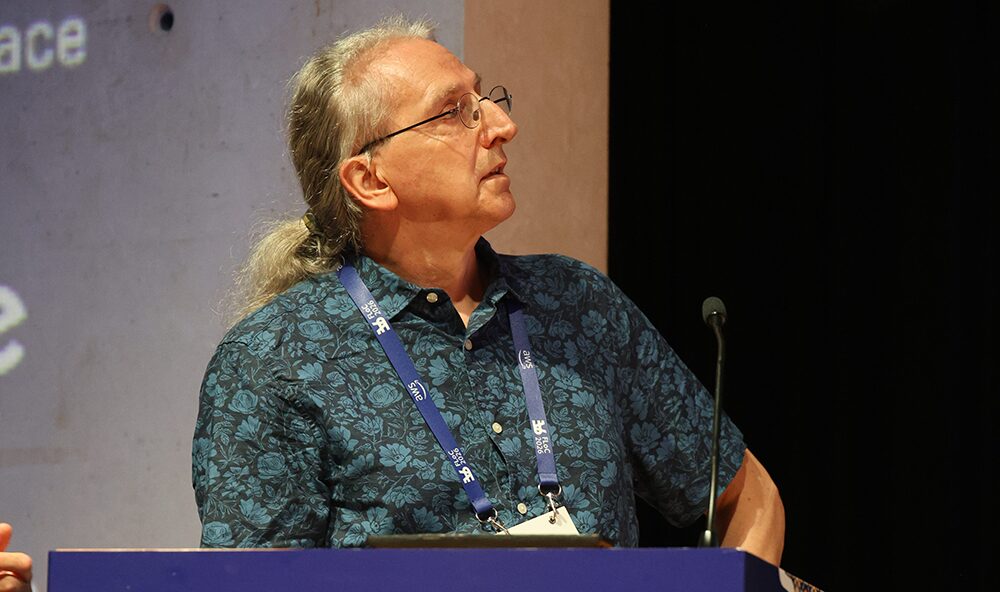
From July 20-23, 2026, researchers from our Knowledge Representation and Methods Group attended the 23rd International Conference on Principles of Knowledge Representation and Reasoning (KR) in Lisbon, Portugal. They submitted several papers and were actively involved in program planning as program chairs or members of the program committee.
Program Committee and Chairs
- Prof. Franz Baader, Principal Investigator at ScaDS.AI Dresden/Leipzig, was one of the two program chairs for the conference.
- In addition, Prof. Markus Krötzsch was heading the “KR in the Wild” section.
- Dr. Dörthe Arndt and Dr. Sergei Obiedkov helped him shape the track’s content.
- Numerous ScaDS.AI Dresden/Leipzig researchers were also contributing to the program as area chairs. These include Prof. Sebastian Rudolph, Prof. Gerhard Brewka, Prof. Carsten Lutz, and Prof. Ringo Baumann.
Best paper award
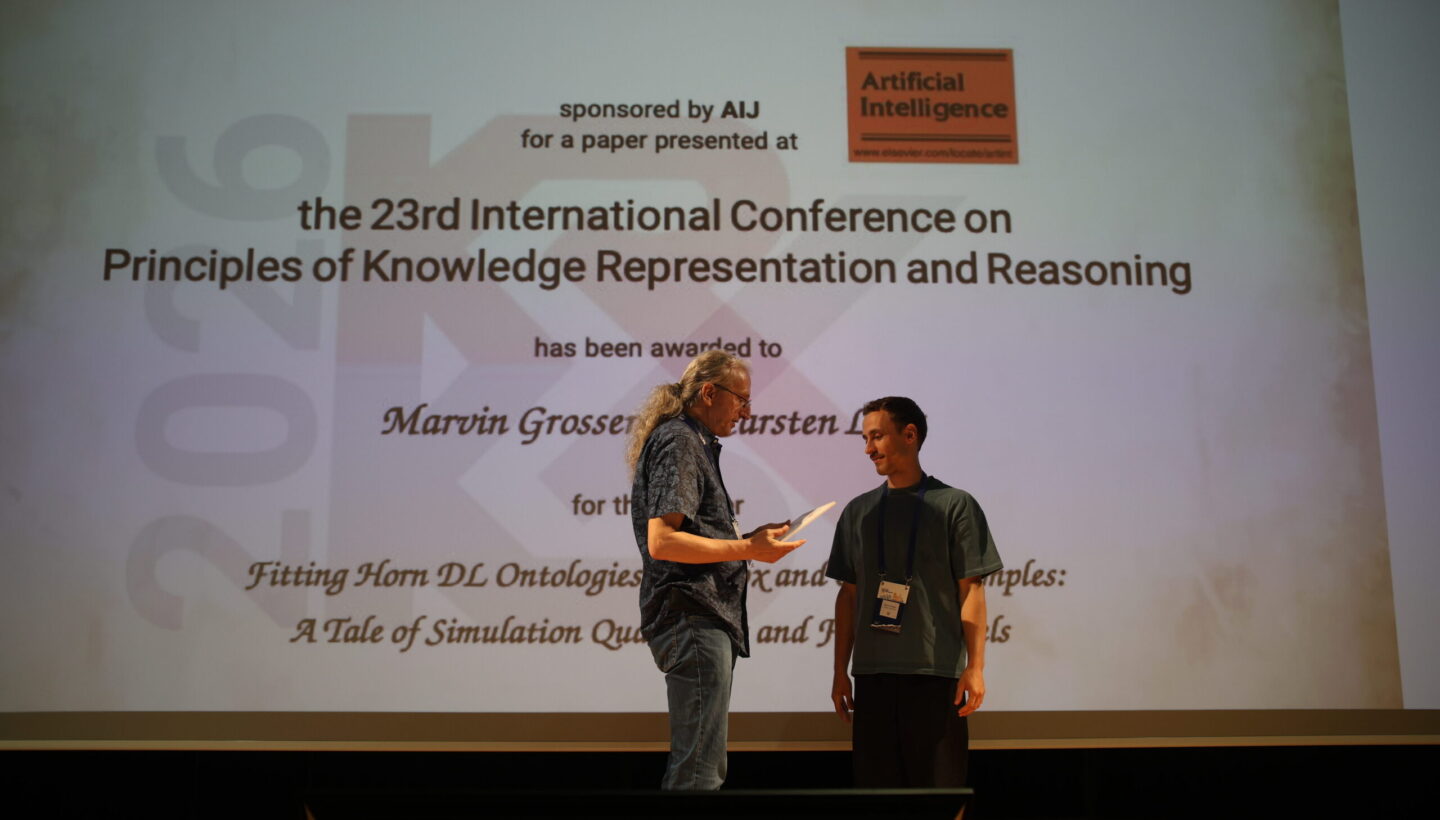
Marvin Grosser received the Ray Reiter Best Paper Prize for the paper Fitting Horn DL Ontologies to ABox and Query Examples: A Tale of Simulation Quantifiers and Finite Models. The award was introduced in 2004 in honour of the contributions made by Ray Reiter and sponsored by the Artificial Intelligence Journal.
We study the problem of fitting a description logic (DL) ontology to a given set of positive and negative examples that take the form of an ABox and a Boolean query. While previous work has investigated this problem for the expressive DLs ALC and ALCI, we here focus on the Horn DLs EL and ELI, as well as their extensions with the bottom concept. As the query language, we consider atomic queries (AQs), conjunctive queries (CQs), and unions thereof (UCQs). We provide characterization of the existence of a fitting ontology based on simulations, use them to develop decision procedures, and clarify the exact computational complexity. For AQs, the problem is in PTime for both EL and ELI. For CQs and UCQ, it is Sigma_P^2-complete for EL and ExpTime-complete for ELI. Adding the bottom concept does not change any of these complexities. Interestingly, moving from ALC and ALCI to EL and ELI introduces additional technical challenges rather than simplifying the matter.
Carsten Lutz: The Logical Expressive Power of Graph Neural Networks
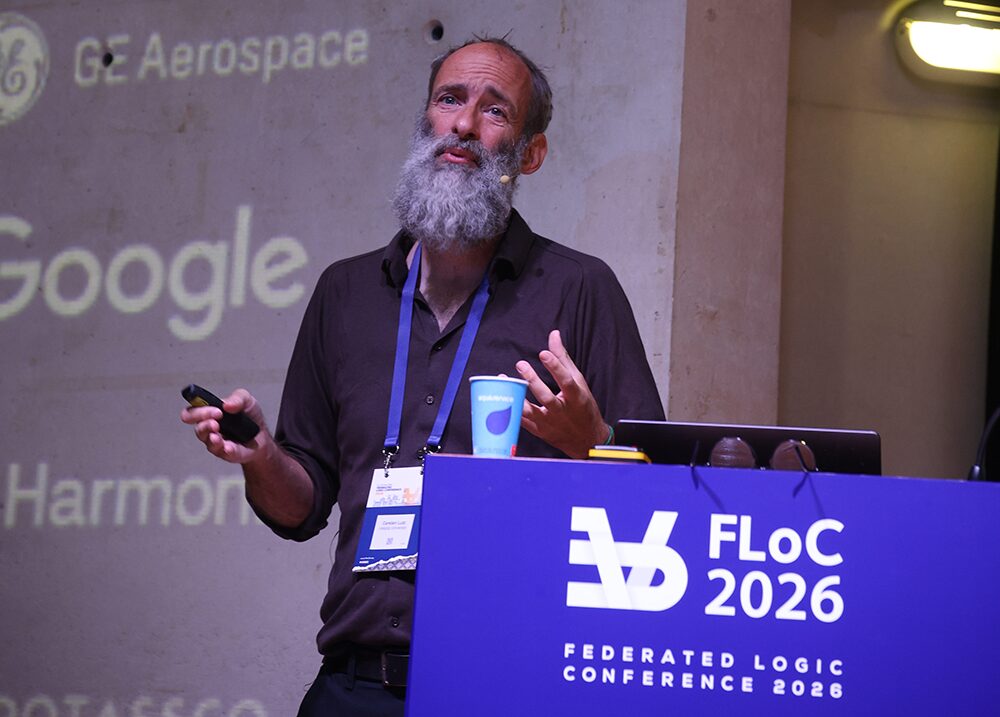
The invited talk The Logical Expressive Power of Graph Neural Networks by Prof. Carsten Lutz reviewed approaches for leveraging logics developed in symbolic AI. This should assess the expressive power of subsymbolic (neural) learning methods like graph neural networks. He provided an overview of graph neural networks (GNNs) and the latest advancements in characterizing their precise expressive capabilities.
Graph Neural Networks (GNNs) have emerged as one of the most prominent models for machine learning on graph-structured data. Over the past few years, significant effort has gone into characterizing their exact expressive power. This is achieved in terms of well-established formalisms such as various logical languages and the Weisfeiler-Leman graph isomorphism test. In this talk, I will present an overview of these developments, with particular emphasis on logics that are relevant for knowledge representation, including modal and description logics.
Find the corresponding slides here.
Two submissions of Sergei Obiedkov
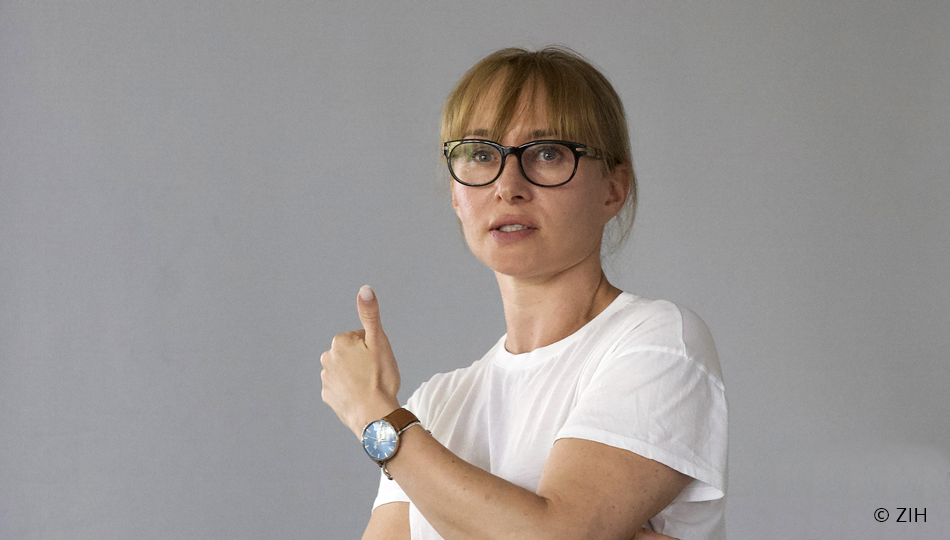
Dr. Sergei Obiedkov had two submissions accepted at the KR Conference. One was a regular paper in the main track titled “Computing Extensions of Abstract Argumentation Frameworks by Enumerating Closed Sets.” In the paper, he presents a new approach for computing complete, stable, and preferred extensions of abstract argumentation frameworks. His approach solves the problem directly by leveraging the fact that these extensions are contained within certain closure systems. The second paper, PAC Learning of Concept Inclusions for Ontology-Mediated Query Answering is an extended abstract. It presents a probably approximately correct algorithm for learning the terminological part of a description logic knowledge base via subsumption queries.
Workshop contribution by Christian Alrabbaa
At the Joint Workshop on “Explainable Logic-Based Knowledge Representation (XLoKR) and Explanations with Constraints and Satisfiability (ExCoS)” Christian Alrabbaa presents a tool develop jointly with members of PI Dachselt’s group. It provides visual decision support for the interactive repair of ontologies. This work is an important contribution towards making symbolic AI techniques more trust-worthy and explainable.
Workshop contribution by Oscar Barreca
At the workshop on “Logical Approaches to Handling Inconsistent Data”, PhD student Oscar Barreca presents a poster. It points out that errors in knowledge-bases need not manifest themselves as inconsistency. Thus, not only approaches for inconsistency-tolerant reasoning, but also ones for error-tolerant reasoning must be considered. This again is a step towards making symbolic AI techniques more trust-worthy by developing ways for dealing with modeling errors.
KR 2026
The International Conference on Principles of Knowledge Representation and Reasoning (KR) is the leading forum for the in-depth and timely presentation of advances in the theory and practice of representing and computationally managing knowledge. The conference is dedicated to formal modeling and the application of knowledge in intelligent systems capable of logical reasoning and rational decision-making. Research in this field focuses on the expressiveness, computational efficiency, and explainability of various representation forms. Learn more on the official website.
funded by:

ScaDS.AI Dresden/Leipzig (Center for Scalable Data Analytics and Artificial Intelligence) is a center for Data Science, Artificial Intelligence and Big Data with locations in Dresden and Leipzig.


Dresden
Visitor address
Technische Universität Dresden
ScaDS.AI Dresden/Leipzig
Bürogebäude Strehlener Straße
Strehlener Straße 12, 14
01069 Dresden
ScaDS.AI Dresden/Leipzig
Bürogebäude Strehlener Straße
Strehlener Straße 12, 14
01069 Dresden
Postal address
Technische Universität Dresden
Zentrum für Informationsdienste und Hochleistungsrechnen
ScaDS.AI Dresden/Leipzig
01062 Dresden
Zentrum für Informationsdienste und Hochleistungsrechnen
ScaDS.AI Dresden/Leipzig
01062 Dresden
Leipzig
Visitor address
ScaDS.AI Dresden/Leipzig
Löhrs Carré
Humboldtstraße 25, Uferstr. 11
04105 Leipzig
Löhrs Carré
Humboldtstraße 25, Uferstr. 11
04105 Leipzig
Postal address
Universität Leipzig
Data Science Center ScaDS.AI Leipzig
Internes Postfach: 322001
04081 Leipzig
Data Science Center ScaDS.AI Leipzig
Internes Postfach: 322001
04081 Leipzig
Quicklinks:
Copyright 2026 © SCADS.AI Dresden/Leipzig – All rights reserved.