March 19, 2026
MINT-EC Zukunftsforum 2026 – Career Orientation for STEM Talents
Living Lab
On March 16–17, 2026, the MINT-EC Zukunftsforum brought together students, educators, researchers, and industry partners in Dresden. For two days, the event focused on career orientation and exchange in STEM fields. ScaDS.AI Dresden/Leipzig happily contributed a lecture and a guided tour through the Living Lab to the program.
Our Contributions
Lecture
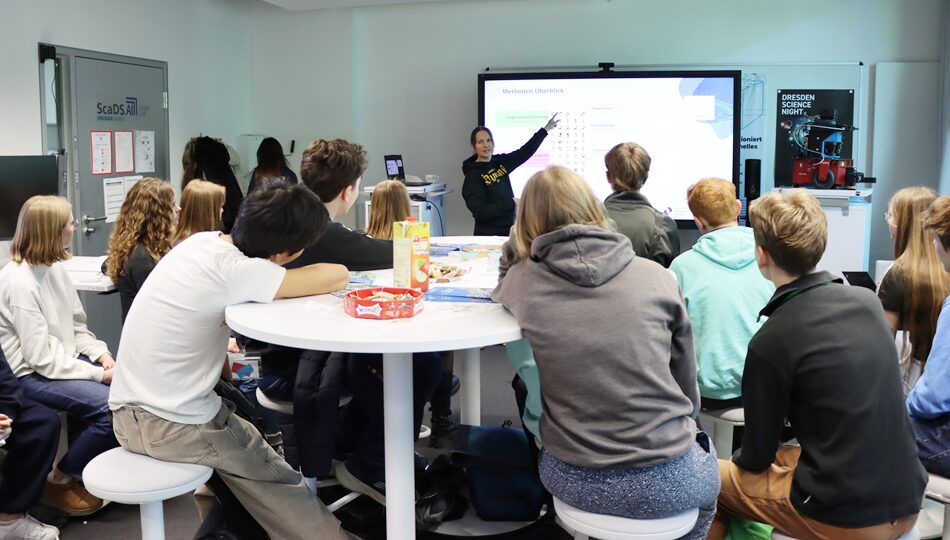
On the first day of the event, our principal investigator Prof. Pascal Kerschke (Chair of Big Data Analytics in Transportation, TU Dresden) gave a lecture on how artificial intelligence (AI) supports us in shaping the sustainable, automated, and connected transportation system of the future.
Guided Tour through the Living Lab
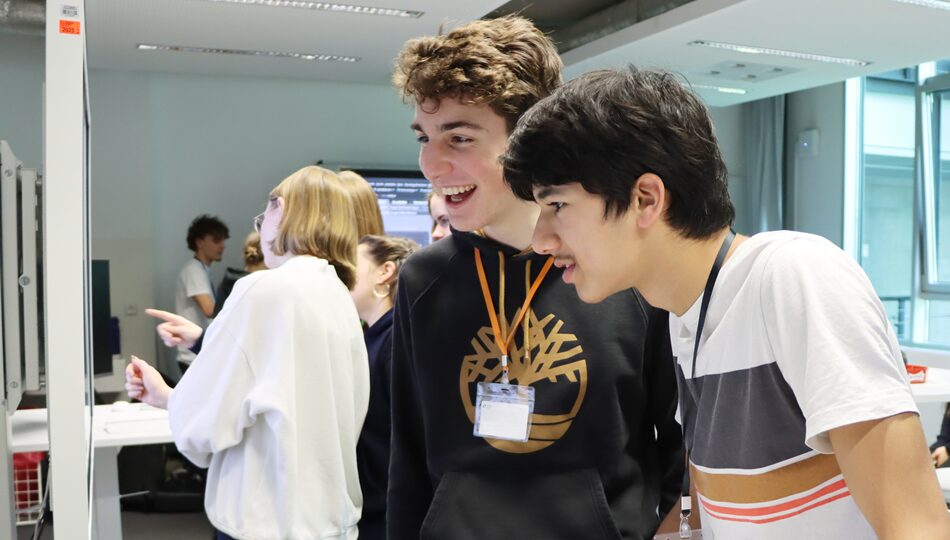
On the second day, a group of pupils visited our Living Lab in Dresden. During the visit, the pupils experienced several demos that showcased how AI analyzes images, recognizes emotions, and visualizes complex data. Instead of only hearing about AI, participants could interact with the demos directly.
Emotion Symphony
This demo explored how AI systems detect human emotions from facial expressions. It analyzes visual cues and classifies emotional states. As a result, the pupils discussed affective computing and how machines interpret human signals.
Multicut
The Multicut demo introduced the pupils to image segmentation – an important task in the field of computer vision. An image can be interpreted as a set of pixels that are arranged in a grid. The task of segmenting the image can be solved by cutting that grid into multiple parts. However, finding an optimal multicut is hard.
asanAI
asanAI allows users to experiment with Machine Learning without any prior knowledge, using their own images, CSV files, or any arbitrary tensor data as training material. The open source software provided by ScaDS.AI Dresden/Leipzig allows for an easy entry into machine learning. Learn more about it here.
Magic Mirror
The Magic Mirror allowed the pupils to interact with computer vision and voice recognition technology. The system analyzes camera and voice input in real time to generate new requested outfits for the people standing in front of the mirror. The demo offers great insights into generative AI and bias. Learn more about the demo here.
FloodVis
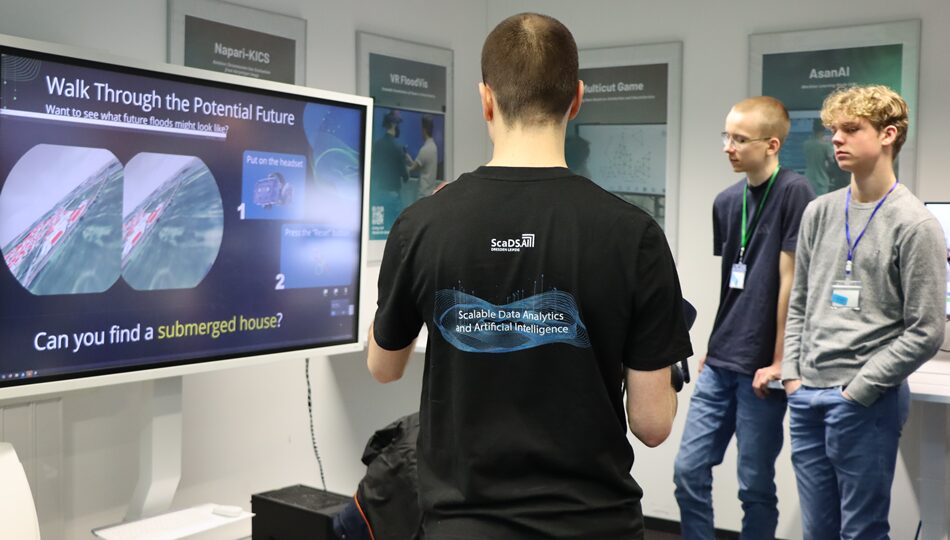
FloodVis visualizes potential future flood risks in Virtual Reality (VR). Displaying the results in a VR supports the user in understanding the complexity of the dynamics of the flood risk system and exploring the temporal evolution of different flood events under the influence of climate change.
Encouraging the Next Generation of AI Researchers
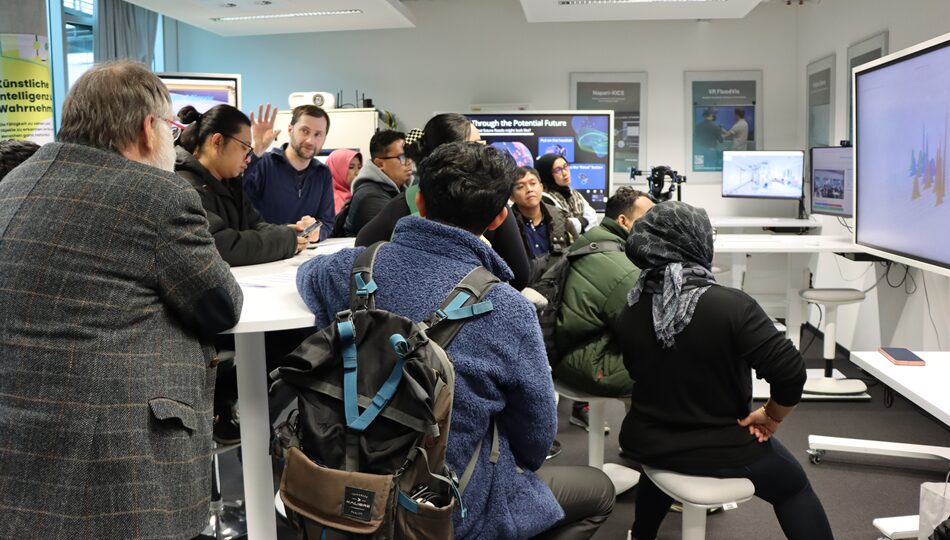
Events like the MINT-EC Zukunftsforum help pupils experience research environments firsthand. By meeting researchers and exploring working AI systems, participants gain a clearer idea of what studying STEM can look like. For ScaDS.AI Dresden/Leipzig, it was a pleasure to welcome such curious and motivated visitors to the Living Lab. The discussions showed strong enthusiasm among the next generation to understand and shape the future of technology. We look forward to future opportunities to engage with young STEM talents!
MINT-EC Zukunftsforum 2026
The MINT-EC Zukunftsforum 2026 was hosted as a 2-day-event at TU Dresden and organized within the MINT-EC network. It was supported by the MINT-EC school, the Marie-Curie-Gymnasium Dresden, whose dedicated students helped with the on-site organization. The event allowed participants to explore study options, discover current research topics, and connect with experts from academia and industry. Students from MINT-EC schools across Germany joined the forum to learn more about academic pathways and future careers in mathematics, computer science, natural sciences, and engineering. Learn more about the MINT-EC network on its website.

funded by:

ScaDS.AI Dresden/Leipzig (Center for Scalable Data Analytics and Artificial Intelligence) is a center for Data Science, Artificial Intelligence and Big Data with locations in Dresden and Leipzig.


Dresden
Visitor address
Technische Universität Dresden
ScaDS.AI Dresden/Leipzig
Bürogebäude Strehlener Straße
Strehlener Straße 12, 14
01069 Dresden
ScaDS.AI Dresden/Leipzig
Bürogebäude Strehlener Straße
Strehlener Straße 12, 14
01069 Dresden
Postal address
Technische Universität Dresden
Zentrum für Informationsdienste und Hochleistungsrechnen
ScaDS.AI Dresden/Leipzig
01062 Dresden
Zentrum für Informationsdienste und Hochleistungsrechnen
ScaDS.AI Dresden/Leipzig
01062 Dresden
Leipzig
Visitor address
ScaDS.AI Dresden/Leipzig
Löhrs Carré
Humboldtstraße 25, Uferstr. 11
04105 Leipzig
Löhrs Carré
Humboldtstraße 25, Uferstr. 11
04105 Leipzig
Postal address
Universität Leipzig
Data Science Center ScaDS.AI Leipzig
Internes Postfach: 322001
04081 Leipzig
Data Science Center ScaDS.AI Leipzig
Internes Postfach: 322001
04081 Leipzig
Quicklinks:
Copyright 2026 © SCADS.AI Dresden/Leipzig – All rights reserved.