July 13, 2026
ScaDS.AI Dresden/Leipzig at ICML in Seoul, South Korea
Research
From July 6–11, 2026, researchers from ScaDS.AI Dresden/Leipzig joined the 43th International Conference on Machine Learning (ICML) in Seoul, South Korea.
Contributions
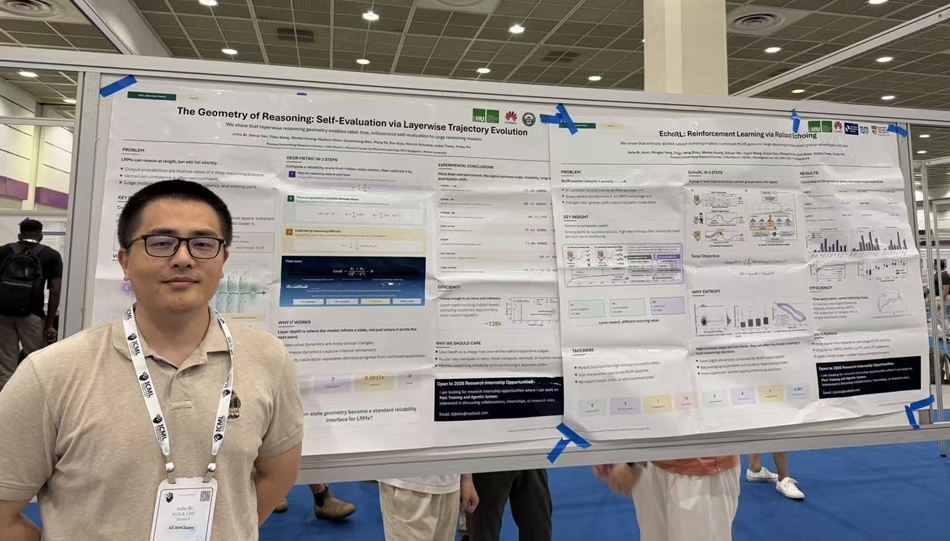
EchoRL: Reinforcement Learning via Rollout Echoing
Jinhe Bi (MCML) presented the paper „EchoRL: Reinforcement Learning via Rollout Echoing“, co-authored by Michael Färber (Professor for Scalable Software Architectures for Data Analytics at ScaDS.AI Dresden/Leipzig), as well as Aniri, Minglai Yang, Xingcheng Zhou, Wenke Huang, Sikuan Yan, Yujun Wang, Zixuan Cao, Xun Xiao, Volker Tresp and Yunpu Ma.
Abstract
Reinforcement Learning with Verifiable Rewards is an effective route for post-training to strengthen the reasoning capability of large language models. However, as training proceeds, the learning signal can collapse thus makes the training gain become marginal and ineffective. Specifically, a growing fraction of prompts’ rollouts become advantage-degenerated. All the self-generated rollouts show verified-success, making the standard deviation over their rewards be zero; accordingly each rollout’s advantage becomes degenerated (zero) as well. Given such rollouts’ advantages, the policy-gradient for model optimization eventually vanishes, capping the training performance. We argue that some of these rollouts still contain valuable learning signals but unfortunately omitted with the existing RLVR methods. In this paper, we propose EchoRL for better exploiting the advantage-degenerated rollouts to further improve the training performance. EchoRL is a lightweight module that first identifies an EchoClip from verified-success rollouts based on their step-level entropy values. Then, it feeds this clip back as an auxiliary supervision signal in the RL objective. Extensive experiments across 10 benchmarks, 5 LLM backbones, and 7 popular RLVR post-training methods demonstrate that EchoRL consistently improves RLVR post-training with minimal overhead.
View the submission here.
Sheaf Neural Networks on SPD Manifolds: Second-Order Geometric Representation Learning
Prof. Anna Wienhard and her colleagues Yuhan Peng, Junwen Dong, Yuzhi Zeng, Hao Li, Ce Ju, Huitao Feng, Diaaeldin Taha, and Kelin Xia presented the poster “Sheaf Neural Networks on SPD Manifolds: Second-Order Geometric Representation Learning”.
Abstract
Graph neural networks face two fundamental challenges rooted in the linear structure of Euclidean vector spaces.
- Current architectures represent geometry through vectors (directions, gradients). Yet many tasks require matrix-valued representations that capture relationships between directions—such as how atomic orientations covary in a molecule. These second-order representations are naturally captured by points on the symmetric positive definite matrices (SPD) manifold;
- Standard message passing applies shared transformations across edges. Sheaf neural networks address this via edge-specific transformations, but existing formulations remain confined to vector spaces and therefore cannot propagate matrix-valued features. We address both challenges by developing the first sheaf neural network operates natively on the SPD manifold.
Our key insight is that the SPD manifold admits a Lie group structure. This enables well-posed analogs of sheaf operators without projecting to Euclidean space. Theoretically, we prove that SPD-valued sheaves are strictly more expressive than Euclidean sheaves. They admit consistent configurations (global sections) that vector-valued sheaves cannot represent, directly translating to richer learned representations. Empirically, our sheaf convolution transforms effectively rank-1 directional inputs into full-rank matrices encoding local geometric structure. Our dual-stream architecture achieves SOTA on 6/7 MoleculeNet benchmarks, with the sheaf framework providing consistent depth robustness.
Beyond Scalar Electrostatics: Multipole Features for Long-Range Molecular Machine Learning
Furthermore, Rhyan Barrett, PhD student in the research group of Jun.-Prof. Dr. Julia Westermayr, presented the poster “Beyond Scalar Electrostatics: Multipole Features for Long-Range Molecular Machine Learning”.
Abstract
Graph neural network potentials build energies from each atom’s local neighborhood, but electrostatic interactions decay slowly and reach far beyond any local cutoff, and these long-range forces dominate systems such as solvents, proteins, and interfaces. The standard QM/MM scheme treats a small reactive region quantum-mechanically (QM) while representing the surroundings as classical point charges (MM); the challenge is communicating that MM environment’s long-range electrostatics to the ML potential. Local only descriptors miss it, while brute-force fixes like full pairwise attention scale as O(N²) and become prohibitive. Our approach, Field-MACE, captures these long-range QM/MM interactions accurately, without that cost.
ICML 2026
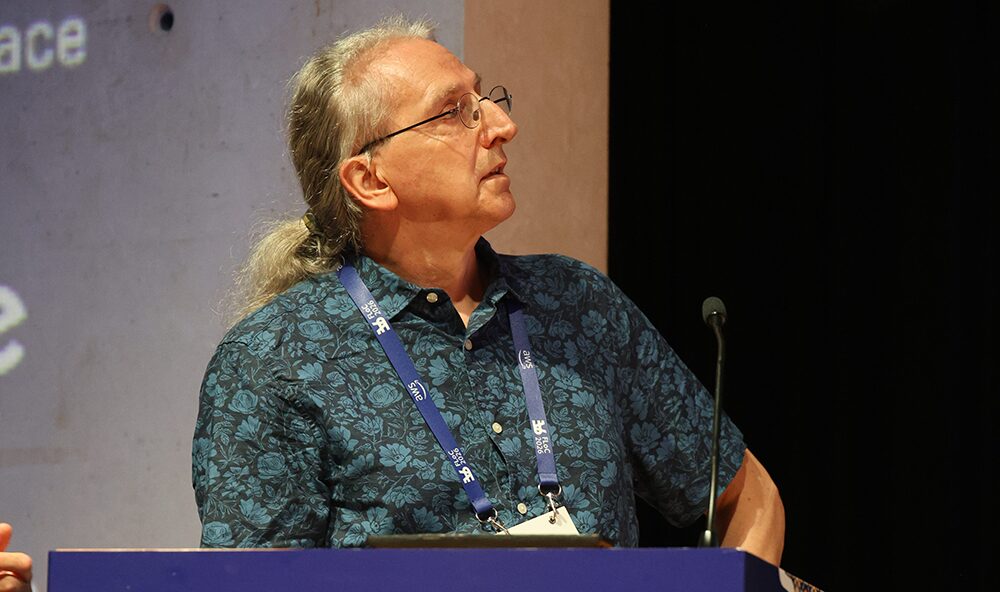
ICML is a major conference addressing all aspects of machine learning. This field is closely related to artificial intelligence, statistics and data science. It has its key applications in areas such as computer vision, computational biology, speech recognition and robotics. Participants at ICML come from a variety of backgrounds, including researchers from academia and industry, entrepreneurs, engineers, doctoral students, and postdoctoral researchers.

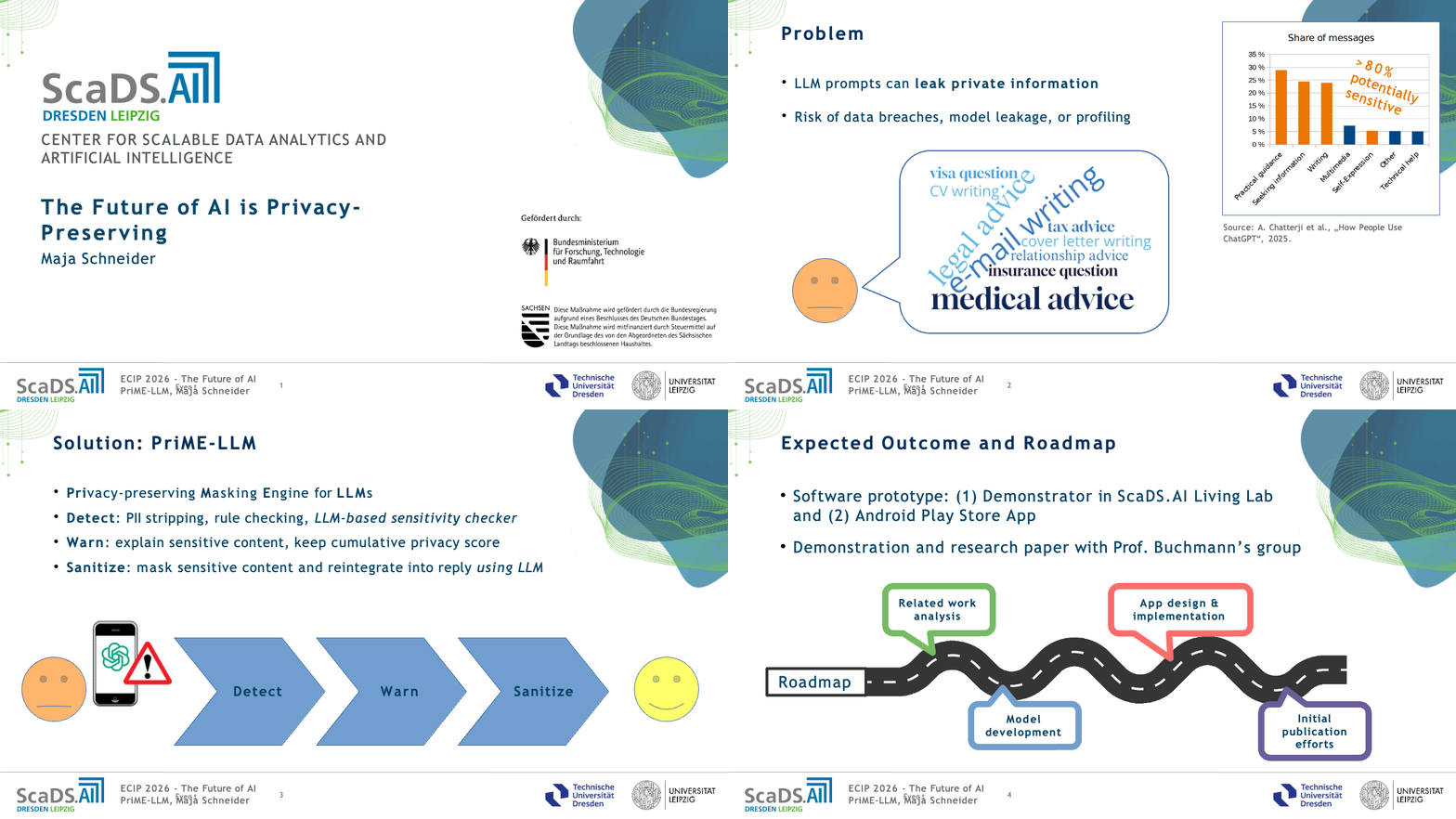

funded by:

ScaDS.AI Dresden/Leipzig (Center for Scalable Data Analytics and Artificial Intelligence) is a center for Data Science, Artificial Intelligence and Big Data with locations in Dresden and Leipzig.


Dresden
Visitor address
Technische Universität Dresden
ScaDS.AI Dresden/Leipzig
Bürogebäude Strehlener Straße
Strehlener Straße 12, 14
01069 Dresden
ScaDS.AI Dresden/Leipzig
Bürogebäude Strehlener Straße
Strehlener Straße 12, 14
01069 Dresden
Postal address
Technische Universität Dresden
Zentrum für Informationsdienste und Hochleistungsrechnen
ScaDS.AI Dresden/Leipzig
01062 Dresden
Zentrum für Informationsdienste und Hochleistungsrechnen
ScaDS.AI Dresden/Leipzig
01062 Dresden
Leipzig
Visitor address
ScaDS.AI Dresden/Leipzig
Löhrs Carré
Humboldtstraße 25, Uferstr. 11
04105 Leipzig
Löhrs Carré
Humboldtstraße 25, Uferstr. 11
04105 Leipzig
Postal address
Universität Leipzig
Data Science Center ScaDS.AI Leipzig
Internes Postfach: 322001
04081 Leipzig
Data Science Center ScaDS.AI Leipzig
Internes Postfach: 322001
04081 Leipzig
Quicklinks:
Copyright 2026 © SCADS.AI Dresden/Leipzig – All rights reserved.