

Dresden Science Night 2026
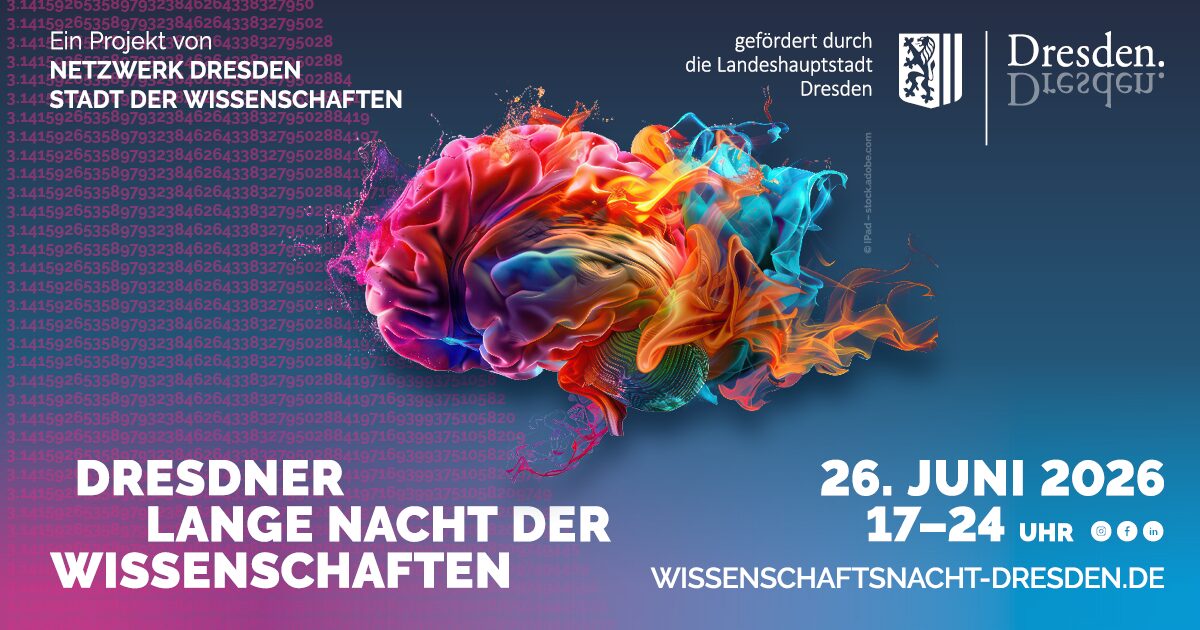
On June 26, 2026, ScaDS.AI Dresden/Leipzig invites you to join Dresden Science Night 2026. Once again, we will open the doors to our Living Lab and give you an insight into the cutting-edge AI research conducted at our center. Our researchers look forward to answering your questions about Artificial Intelligence!
Date: June 26, 2026, 5 PM – midnight
Venue: Living Lab Dresden, Andreas Pfitzmann Bau, Room: 1020, Nöthnitzer Str. 46, 01187 Dresden
Target group: interested people of all ages, no experience needed
Program
A Glimpse into the Magic Mirror
The Magic Mirror is an interactive system that allows you to try on clothes virtually. By combining image and voice processing, you can select items of clothing and see them directly in your own reflection. You stand in front of a life-size screen with an integrated camera that shows a real-time image of your appearance. You use voice commands to specify the desired garments, which are then digitally projected onto your reflection. This intuitive experience makes trying on clothes more comfortable and offers an innovative way to try out different styles and outfits without having to actually change clothes. Try it out yourself!
asanAI: Machine learning made easy
How do machines learn? We present asanAI – a software with which you can experiment with machine learning without any prior knowledge. We will give you a comprehensive introduction to our open source software asanAI and answer all of your questions so that you can continue working on your own from home afterwards. All you need is an internet-enabled laptop or cell phone to train an AI model on your own images, webcam data, CSV files or any tensor data for your use case – without ever leaving your browser.
Chatopia: A Living Lab of Artificial Researchers
Introducing Chatopia: a digital platform that creates a virtual world where hundreds of AI agents interact, socialize, and learn from one another simultaneously – much like watching an entire simulated society unfold, rather than chatting with a single chatbot. Chatopia works like a flight simulator for artificial intelligence: Scientists can safely train AI systems and test complex social scenarios at computer speed (in minutes or hours) instead of waiting years for real-world results. This makes experiments faster, cheaper, and risk-free.
Experience Artificial Intelligence
Chatbots, video games with computer opponents and smart voice assistants: Artificial intelligence has long since ceased to be a foreign concept – and yet numerous myths and fears surround this pioneering technology. Why? The AI Competence Center ScaDS.AI Dresden/Leipzig invites you to this year’s Long Night of Science to learn more about artificial intelligence, machine learning, language models, and their applications. Try out various demos in our Living Lab and become an expert in working with AI and language models!
GPTKB – Massive knowledge extraction from the GPT language model
What facts do large language models believe in? chatGPT and co. are impressive in many applications, but what facts are their answers based on? In the GPTKB project, researchers extract and visualize massive amounts of facts from large language models. With this new method, we can systematically and comprehensively capture the knowledge of an LLM. To do this, we ask it many questions and intelligently summarize the answers. As a test run, we used GPT-4o-mini to create GPTKB – a huge collection of knowledge with 101 million facts about 2.9 million subjects. Best of all, we did the whole thing for just 1% of the cost of previous projects! GPTKB is a significant step forward in two areas: First, it helps to better understand how LLMs “think” and what facts they know. Secondly, it shows new, efficient ways to create large knowledge collections. GPTKB is available online.
How safe is AI? Toward Trustworthy AI
As AI systems grow more pervasive, questions of safety and trust demand urgent, practical answers. This session presents five research efforts spanning the AI safety landscape: a classifier that identifies AI-generated content across model families (IITGnGPT); toxicity detectors for low-resource Indian languages covering 17 fine-grained harm categories across 12 languages (UnityAI-Guard 1.0 & 2.0); a demonstration of backdoor attacks in YOLO, text classifiers, generative models, and translation systems — revealing a systemic adversarial threat surface; and SangrahaTox, a benchmark dataset for auditing multimodal models for stereotypes, bias, and toxicity. Together, these projects chart a path from detecting what AI produces, to exposing how it can be manipulated, to measuring the biases it silently encodes — offering both diagnostic tools and a broader framework for building trustworthy AI.
How Words Become Numbers – Understanding Language Through Mathematics
How can language be made understandable to computers? We will show how words are translated into numbers and how this can be used to calculate differences, similarities, and meanings. This forms the basis for how today’s language models – such as ChatGPT or automatic translators – can analyze, complete, or respond to texts.
LLMpedia – Materializing an LLM’s Encyclopedic Knowledge at Scale
What does a large language model actually know, and how reliable is that knowledge in long-form text? Benchmarks such as MMLU suggest that modern language models are highly factual, but they only test questions that researchers thought to ask. In the LLMpedia project, researchers generate and evaluate encyclopedia-style articles directly from a model’s parametric memory, making it possible to study what the model knows beyond fixed benchmarks. LLMpedia is available online.
SQuAI: Answering Scientific Questions Reliably
SQuAI uses AI to answer scientific questions by searching relevant research articles and summarizing the most important information in a clear and accessible way. It places a strong emphasis on the verifiability of AI-generated content by providing citations within its answers and direct access to the referenced text passages from the original articles. This makes it transparent how an answer is constructed and on which scientific evidence it is based. As a result, SQuAI is not only informative but also promotes transparency and facilitates access to up-to-date research. Try it out here.



Dresden
ScaDS.AI Dresden/Leipzig
Bürogebäude Strehlener Straße
Strehlener Straße 12, 14
01069 Dresden
Zentrum für Informationsdienste und Hochleistungsrechnen
ScaDS.AI Dresden/Leipzig
01062 Dresden
Leipzig
Löhrs Carré
Humboldtstraße 25, Uferstr. 11
04105 Leipzig
Data Science Center ScaDS.AI Leipzig
Internes Postfach: 322001
04081 Leipzig
Quicklinks:
Copyright 2026 © SCADS.AI Dresden/Leipzig – All rights reserved.